
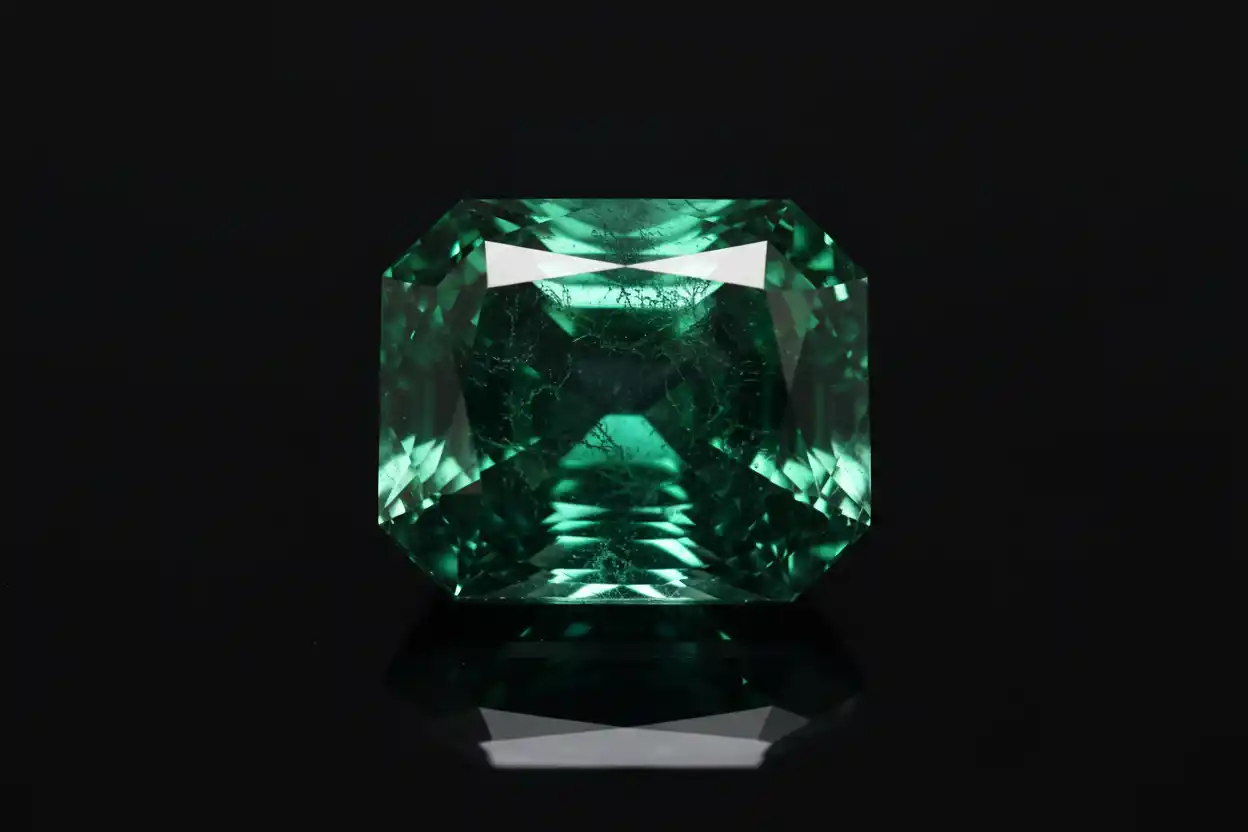

A lab emerald is a genuine emerald crystal grown under controlled laboratory conditions rather than mined from a natural deposit. It has the same beryl structure and essential chemical composition as natural emerald, while its growth history, inclusions, price and rarity differ.
Lab Emerald at a Glance
| Property | Lab Emerald Characteristics |
|---|---|
| Material type | Laboratory-grown green beryl |
| Composition | Be₃Al₂Si₆O₁₈, colored principally by chromium, vanadium or both |
| Growth methods | Hydrothermal and flux growth |
| Colors | Bluish green, pure green, yellowish green and deep green |
| Crystal system | Hexagonal |
| Crystal habit | Seeded hydrothermal plates or prisms; flux-grown crystals and faceting rough |
| Luster | Vitreous |
| Transparency | Transparent to translucent |
| Mohs hardness | Approximately 7.5–8 |
| Cleavage | Indistinct basal cleavage |
| Tenacity | Brittle, with durability affected by fractures and inclusions |
| Tenacity | Brittle, with durability |
| Main care concern | Fractures, post-growth filling, heat and inaccurate origin disclosure |
What Is a Lab Emerald?
A lab emerald is laboratory-grown emerald.
Emerald is the green to bluish-green variety of beryl. Its ideal chemical formula is Be₃Al₂Si₆O₁₈, while chromium, vanadium or a combination of both produces the accepted emerald color.
Laboratory growth recreates the conditions needed for beryl to crystallize. The resulting gem is not glass, cubic zirconia, synthetic spinel or a green coating applied to another stone.
Its crystal lattice, refractive properties, hardness and optical behavior are essentially those of emerald. Consequently, it can pass many ordinary gemstone tests that confirm beryl.
The essential distinction is origin. Natural emerald crystallizes through geological processes in Earth’s crust, whereas lab emerald grows from a seed inside manufactured equipment.
The comparison in lab-grown versus natural gemstones explains why laboratory origin does not make a gem an imitation.
Lab-Created, Synthetic and Cultured Emerald
Lab-created, laboratory-grown and synthetic emerald can all describe the same category of manufactured crystalline beryl.
In gemology, synthetic means that the product has essentially the same composition and structure as a natural mineral but was produced by people.
Some sellers use cultured emerald because it sounds less artificial. However, the word is not more scientifically precise and should never replace clear disclosure.
A product page should identify the gem as laboratory-grown emerald near its name and price. The disclosure should not be hidden in technical specifications or packaging.
Descriptions such as created emerald, hydro emerald and Chatham emerald may refer to genuine lab-grown material, but the buyer should still confirm the growth method and manufacturer.
“Colombian-color lab emerald” describes a target hue rather than geographic origin. A stone grown in a laboratory cannot be a mined Colombian emerald.
Hydrothermal Lab Emerald
Hydrothermal growth uses heated water-based solutions inside a sealed pressure vessel.
Nutrients containing beryllium, aluminum and silica dissolve in a hotter part of the vessel. Temperature differences move the dissolved material toward a cooler seed plate, where emerald crystallizes gradually.
The process operates under elevated temperature and pressure and may continue for weeks or months.
Hydrothermal crystals commonly grow as layers over a seed. Internal features may include straight or angular growth zoning, chevron-like structures, seed remnants, nailhead-shaped spicules and tube-like inclusions.
Some manufacturers intentionally create visible inclusions to produce a more natural-looking appearance. Others prioritize cleaner material suitable for precision cutting.
Hydrothermal emerald currently dominates much of the commercial loose-stone market because the method can produce consistent color, useful sizes and repeatable shapes.
Flux-Grown Lab Emerald
Flux growth uses a molten chemical solvent rather than water.
Emerald-forming ingredients dissolve in the heated flux and crystallize slowly onto a seed or another suitable surface as conditions change.
Growth can take many months and may require substantial temperature control.
Flux-grown material can contain wispy flux veils, fingerprints, partially healed cavities, platinum platelets and crystals formed from the growth medium.
These inclusions may resemble natural fissures under casual inspection, although their shapes, arrangement and associated chemistry can reveal laboratory origin.
Flux-grown stones are often connected with specialist or branded producers. Their production can be slower and more expensive than mass-market hydrothermal growth.
Neither method is automatically superior. Color, transparency, cutting, inclusions and price should determine which stone provides the better result.
Lab Emerald vs Natural Emerald
Natural and lab emerald share the same mineral family and basic physical properties.
Their differences arise principally from formation history.
Natural emerald develops where beryllium-bearing fluids or rocks interact with chromium- or vanadium-bearing geological environments. The process can involve hydrothermal veins, metamorphism, pegmatites and complex fluid-rock reactions.
Lab emerald crystallizes from controlled nutrient material and a prepared seed.
Natural stones commonly contain mineral crystals, multiphase inclusions, healed fissures, growth tubes and fluid inclusions tied to a geological deposit. Lab-grown material may contain seed plates, flux residue, nailhead spicules, curved or angular growth features and inclusions associated with manufacturing equipment.
Natural emerald can have substantial geographic-origin value. Colombian, Zambian, Brazilian and Afghan stones may attract different market premiums.
Lab emerald has no mine rarity. Its value comes from color, cut, brand, manufacturing quality and the cost of producing and finishing the gem.
The emerald price guide should therefore not be used to assign natural-emerald premiums to a manufactured stone.
What Causes Lab Emerald’s Green Color?
Chromium, vanadium or both create the green color.
Chromium-related absorption can produce a vivid green with strong red fluorescence. Vanadium can create similar green absorption without identical fluorescence behavior.
Manufacturers adjust trace-element concentrations and growth conditions to produce different color styles.
Some lab emeralds imitate lighter Colombian-type colors with a visible blue component. Others target darker Zambian-style green.
These descriptions are visual comparisons rather than geographic designations.
A successful stone should remain recognizably green in normal indoor lighting. Excessive darkness can hide brilliance, while a pale yellowish color may fall closer to green beryl than premium emerald appearance.
Color zoning may follow growth layers or the shape of the seed crystal. A precision cutter can reduce unevenness, but zoning remains visible in some large stones.
The green gemstones guide provides comparisons with tourmaline, tsavorite, peridot and sapphire.
Inclusions in Lab Emerald
A flawless-looking lab emerald is possible, but many stones contain deliberate or unavoidable growth features.
Hydrothermal material may show seed plates, chevron zoning, nailhead spicules and elongated voids. Flux-grown gems can contain flux fingerprints, wispy veils, platinum particles and partially healed cavities.
Some manufacturers create inclusion-rich products because consumers associate emerald with a visible internal garden.
However, an inclusion does not prove natural origin. Laboratory processes can create highly convincing scenes.
Conversely, a clean emerald is not automatically lab grown. Fine natural material can have high transparency.
The correct conclusion comes from the complete evidence, including growth structure, spectroscopy, trace chemistry and manufacturer-related features.
The real versus fake emerald guide helps screen glass and obvious simulants, but an advanced laboratory is needed to separate convincing synthetic emerald from natural material.
How Gemologists Identify Lab Emerald
Standard tests first confirm beryl.
Emerald typically has refractive indices around 1.57–1.60 and specific gravity near 2.67–2.78, although trace chemistry and growth method create variation.
A dichroscope may reveal green and bluish-green or yellowish-green pleochroic colors.
Microscopy can expose seed remnants, distinctive zoning, flux residue and hydrothermal inclusions.
Infrared, Raman and visible-range spectroscopy reveal water types, chromium or vanadium absorption and growth-related defects.
Chemical analysis may identify trace elements associated with a particular manufacturing process.
No single visual sign identifies every modern lab emerald. Manufacturers continue improving growth and inclusion appearance, so professional laboratories combine several tests.
A vague store certificate is not equivalent to an independent gemological report.
The identification framework in treated emerald covers synthetic origin alongside fracture filling and other alterations.
Lab Emerald vs Green Glass
Green glass is an imitation rather than emerald.
It commonly has lower hardness, lower density and a single refractive index. Under magnification, it may contain round bubbles, curved flow lines and mold-related surface features.
Glass usually lacks emerald’s crystalline pleochroism.
Nevertheless, modern glass can be clean, evenly colored and convincingly cut. Visual appearance alone remains insufficient.
Extremely inexpensive large “lab emeralds” may actually be glass or synthetic green spinel.
The checks in how to spot fake crystals provide a useful initial screen before laboratory testing.
Lab Emerald vs Other Green Gems
Green tourmaline can overlap in color, but it has different refractive properties, density and stronger directional absorption in many stones.
Peridot is usually more yellow green and shows strong birefringence. The peridot versus emerald comparison explains the practical differences.
Tsavorite garnet has greater brilliance and no pleochroism. The tsavorite versus emerald guide also covers durability and price distinctions.
Green sapphire is harder and generally has stronger brilliance, while laboratory-grown lab sapphire belongs to corundum rather than beryl.
Lab ruby is also corundum. Comparing lab ruby with lab emerald shows why two laboratory-grown gems can share manufactured origin but have different structures and durability.
Hardness and Durability
Lab emerald ranks 7.5–8 on the gemstone hardness chart.
That hardness provides good resistance to everyday scratching. Diamond, sapphire and topaz can still abrade the surface.
Emerald’s main limitation is brittleness rather than softness.
Natural emerald is often heavily fractured, while laboratory-grown material can be cleaner and therefore more durable. However, lab emerald can still contain seed-related fractures, growth cavities and surface-reaching fissures.
Beryl also has indistinct basal cleavage. The risk is lower than in topaz, yet structural weakness remains possible.
The distinction in gemstone toughness versus hardness explains why an emerald can resist scratches but chip after a sharp blow.
Jewelry Suitability
Lab emerald can perform well in rings, pendants, earrings and bracelets.
Its lower price allows buyers to choose a larger stone without accepting the fracture levels common in similarly priced natural emeralds.
A ring should still protect pointed corners and thin girdles. Emerald cuts need support at all four corners, while pear and marquise shapes benefit from protective tips.
A bezel or halo can reduce impact risk without concealing too much color.
The emerald engagement-ring guide applies to both natural and lab-grown material when discussing setting structure.
However, the buyer should disclose laboratory origin during insurance, resale and future repair. A jeweler must know whether the stone has filled fractures or a sensitive coating before applying heat.
Are Lab Emeralds Treated?
Laboratory growth and treatment are separate issues.
The gem is synthetic because of how it crystallized. After growth, it may also receive fracture filling, oil, resin, coating or another enhancement.
Clear oil can reduce the visibility of surface-reaching fractures. Resin provides a more durable fill but may discolor or deteriorate under heat and chemicals.
Some products are cut from relatively clean material and need no filling. Others are intentionally inclusion rich and may contain filled fissures.
A seller should not describe a lab emerald as untreated merely because its green color developed during growth. The claim must also account for any post-growth clarity enhancement.
The broad categories in gemstone treatments explained help separate synthetic origin, color treatment and fracture filling.
Lab Emerald Price and Value
Lab emerald pricing is highly inconsistent because inexpensive mass-produced stones and branded precision-cut gems occupy different markets.
| Lab Emerald Product | Broad Current Asking Range |
|---|---|
| Small calibrated commercial stone | Approximately $20–$100 per stone |
| Commercial 1–3 ct hydrothermal emerald | Approximately $50–$300 per stone |
| Better precision-cut or inclusion-controlled gem | Approximately $200–$800 per stone |
| Large branded or custom-cut emerald | Approximately $500–$2,000+ per stone |
| Gold ring with lab emerald and accent stones | Commonly $1,000–$6,000+ |
| Small hydrothermal rough piece | Commonly $20–$150 |
| Large faceting crystal or boule section | Approximately $150–$500+ |
These are broad retail asking levels rather than a stable appraisal scale.
Color, cut and manufacturer account for much of the spread. A well-cut stone with controlled inclusions can cost far more than a generic commercial gem of similar dimensions.
Brand premiums may also exceed the raw material’s production cost.
The lab emerald price guide should own current retailer comparisons rather than forcing natural-emerald price-per-carat logic onto the category.
Resale value is generally limited because manufacturers can produce additional stones and wholesale prices can decline.
Buying a Lab Emerald
The lab emerald buying guide provides the full purchase process.
The seller should disclose laboratory-grown origin prominently and identify hydrothermal or flux growth when known.
Examine the stone under neutral light. Overexposed videos can make dark emerald look brighter, while black backgrounds strengthen apparent saturation.
Ask whether the gem has been fracture filled, oiled or coated.
Large precision-cut stones should have dimensions, weight and clear return terms. A laboratory report is useful when the stone is expensive, represented as untreated or sold as a premium branded product.
Do not pay a natural-origin premium for phrases such as lab Colombian emerald or created Zambian emerald. Those labels describe color style rather than mine provenance.
Cleaning Lab Emerald Jewelry
Warm water, mild soap and a soft brush provide the safest cleaning method.
The dedicated lab emerald cleaning guide should be followed for mounted pieces.
Avoid ultrasonic cleaning unless a qualified gemologist has confirmed that the stone is unfilled, lightly included and structurally sound. In practice, hand cleaning is the safer default.
The cautions in gemstones and ultrasonic cleaners matter because vibration can extend fractures and damage filler.
Steam and high heat should also be avoided. A jeweler should remove the emerald before soldering near the setting.
Store it separately from harder gemstones, and do not expose filled material to solvents or harsh chemicals.
Lab Emerald Meaning and Symbolism
Lab emerald can carry the broader symbolism associated with green beryl while also reflecting modern technology.
Green emerald traditionally inspires ideas involving growth, renewal, prosperity, loyalty and long-term commitment.
A laboratory-grown stone may add associations with innovation, planned creation and choosing appearance over geological rarity.
Some people value it because it provides the color and crystal structure they want without paying for a scarce natural origin.
Others prefer natural emerald because its geological history forms part of the meaning.
Neither preference is universally correct. Symbolism belongs to the wearer, the occasion and the values attached to the purchase.
Scientific evidence does not show that lab emerald heals illness, attracts wealth or changes relationships through measurable energy.
The green crystals page provides broader modern symbolism, while the May birthstone guide explains emerald’s traditional calendar association.
Frequently Asked Questions About Lab Emerald
Is a lab emerald a real emerald?
Yes. It is crystalline green beryl with essentially the same composition and structure as natural emerald, but it was grown in a laboratory.
What is the difference between flux and hydrothermal emerald?
Flux growth uses a molten chemical solvent, while hydrothermal growth uses heated water-based solutions under pressure.
Is lab emerald as hard as natural emerald?
Yes. Both generally rank 7.5–8 on the Mohs scale.
How can I distinguish lab emerald from green glass?
Emerald is doubly refractive, pleochroic and harder. Glass is usually singly refractive and may contain round bubbles or curved flow lines.
Do lab emeralds have inclusions?
Yes. They can contain seed remnants, growth zoning, nailhead spicules, flux residue, platinum particles and intentionally created natural-looking features.
Are lab emeralds treated after growth?
Some are fracture filled, oiled, resin impregnated or coated. Post-growth treatment should be disclosed separately from synthetic origin.
Is lab emerald suitable for an engagement ring?
Yes, especially when the stone is lightly included and protected by a secure setting.
How much does a lab emerald cost?
Commercial stones may cost tens to a few hundred dollars, while branded, large or precision-cut gems can reach several hundred or several thousand dollars.
Does lab emerald retain resale value?
Usually not strongly. New production remains available, and secondary-market demand is limited.
Can lab emerald go in an ultrasonic cleaner?
Hand cleaning is safer because fractures or filler may be damaged by vibration.
Does lab emerald color fade?
Properly grown emerald color is generally stable under normal wear, although coatings and fillers may deteriorate.
Should a lab emerald have a laboratory report?
A report is advisable when the price depends on growth method, treatment status or a premium manufacturer claim.
Lab emerald belongs within the Crystals That Start With L and Gemstones That Start With L directories.