

Benitoite does not form a large family of formally named mineral varieties. Instead, gem dealers and collectors distinguish types of benitoite by body color, color zoning, transparency, crystal habit, treatment status, and whether the material is suitable for faceting or retained as a mineral specimen.
Every example shares the same rare barium titanium silicate composition described in the main benitoite meaning and properties guide. What changes is the way trace chemistry, orientation, inclusions, crystal growth, and human treatment affect its appearance.
Benitoite at a Glance
| Property | Benitoite |
|---|---|
| Composition | Barium titanium cyclosilicate, BaTiSi₃O₉ |
| Mineral group | Benitoite group; cyclosilicate |
| Main colors | Vivid blue, medium blue, pale blue, violet-blue, greenish blue, colorless, and rare treated peach-orange |
| Crystal system | Hexagonal |
| Typical habit | Tabular or dipyramidal crystals with triangular outlines; granular masses; rare twins |
| Luster | Vitreous |
| Transparency | Transparent to translucent |
| Mohs hardness | 6–6.5 |
| Cleavage | Poor or indistinct |
| Tenacity | Brittle |
| Common uses | Faceted collector gems, mineral specimens, pendants, earrings, and protected rings |
| Main care concern | Chipping, scratching, heat exposure, and damage during setting or ultrasonic cleaning |
What Counts as a Benitoite Variety?
Mineralogically, blue, pale blue, and colorless benitoite are not separate species. They are color expressions of the same mineral. Likewise, a crystal on white natrolite and a faceted blue stone may look completely different while remaining chemically identical.
For that reason, “types of benitoite” is most useful as a practical classification rather than a strict list of mineral varieties. It helps buyers distinguish natural colors from treated colors, gem-grade material from specimen-grade crystals, and ordinary small stones from unusually large or saturated examples.
Benitoite also illustrates why color alone cannot define a gemstone. The broader types of gemstones guide separates mineral species, mineral varieties, rocks, organics, and manufactured materials instead of treating every trade name as a different gem.
Vivid Blue Benitoite
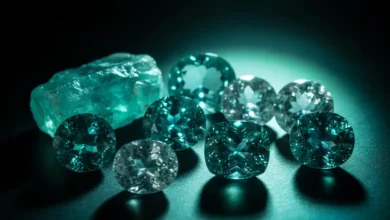
Vivid medium-to-deep blue is the best-known and most valuable benitoite color. Fine stones can resemble high-quality sapphire at first glance, yet their optical behavior is different. Benitoite has unusually strong dispersion, so a well-cut gem may show flashes of spectral color beneath its blue body color.
The most desirable blue is lively rather than excessively dark. A stone that looks intense blue in daylight but nearly black in ordinary indoor lighting may have been cut too deep or oriented poorly. Conversely, shallow material may appear pale even when the rough had stronger color.
Color distribution also affects value. Even blue throughout the face normally commands a premium over visibly patchy stones, although attractive zoning may appeal to collectors. Benitoite belongs among the better-known blue gemstones, but its extreme scarcity and modest durability make it less available than sapphire, spinel, zircon, or topaz.
Medium and Pale Blue Benitoite
Medium and pale blue stones are more common than saturated, evenly colored gems, although “common” remains relative for such a scarce mineral. These lighter stones often display dispersion more clearly because the body color does not mask the spectral flashes.
Pale blue benitoite may also show stronger changes with orientation. One direction can look blue or violet-blue, while another appears nearly colorless. A cutter must therefore balance face-up color against weight retention and brilliance.
Small pale stones are sometimes used as accent gems. They may cost substantially less than vivid blue material of the same weight, but clarity, cut quality, and fluorescence can still make them desirable collector pieces.
Violet-Blue and Indigo Benitoite
Some benitoite leans toward violet, indigo, or purplish blue. These colors reflect its strong pleochroism and the orientation chosen during cutting rather than a different mineral composition.
A violet component can create an appealing cool tone, especially under daylight-balanced illumination. However, strong grayness or excessive darkness generally reduces commercial value. Photographs should therefore be evaluated cautiously because camera sensors, editing, and screen settings can exaggerate either the blue or violet component.
Buyers comparing this material with sapphire should remember that benitoite is much softer and typically far smaller. The variety of colors described in the types of sapphire guide also belongs to corundum, not the benitoite mineral group.
Greenish-Blue and Teal Benitoite
Greenish-blue benitoite appears less often in finished jewelry than classic blue material. In some stones, the green component becomes more obvious when the gem is viewed from a particular crystallographic direction.
A balanced teal can be attractive, although gray-green material generally sells below vivid blue stones. Because benitoite is strongly pleochroic, a greenish appearance in one photograph does not necessarily mean the entire stone has a uniform teal body color.
When buying remotely, request images or video under neutral daylight-equivalent lighting. A single highly saturated photograph does not reveal how the stone performs as it moves.
Colorless and Near-Colorless Benitoite
Colorless benitoite is rare and scientifically interesting. Without a strong blue body color, its high dispersion becomes easier to see, allowing tiny stones to produce bright rainbow flashes.
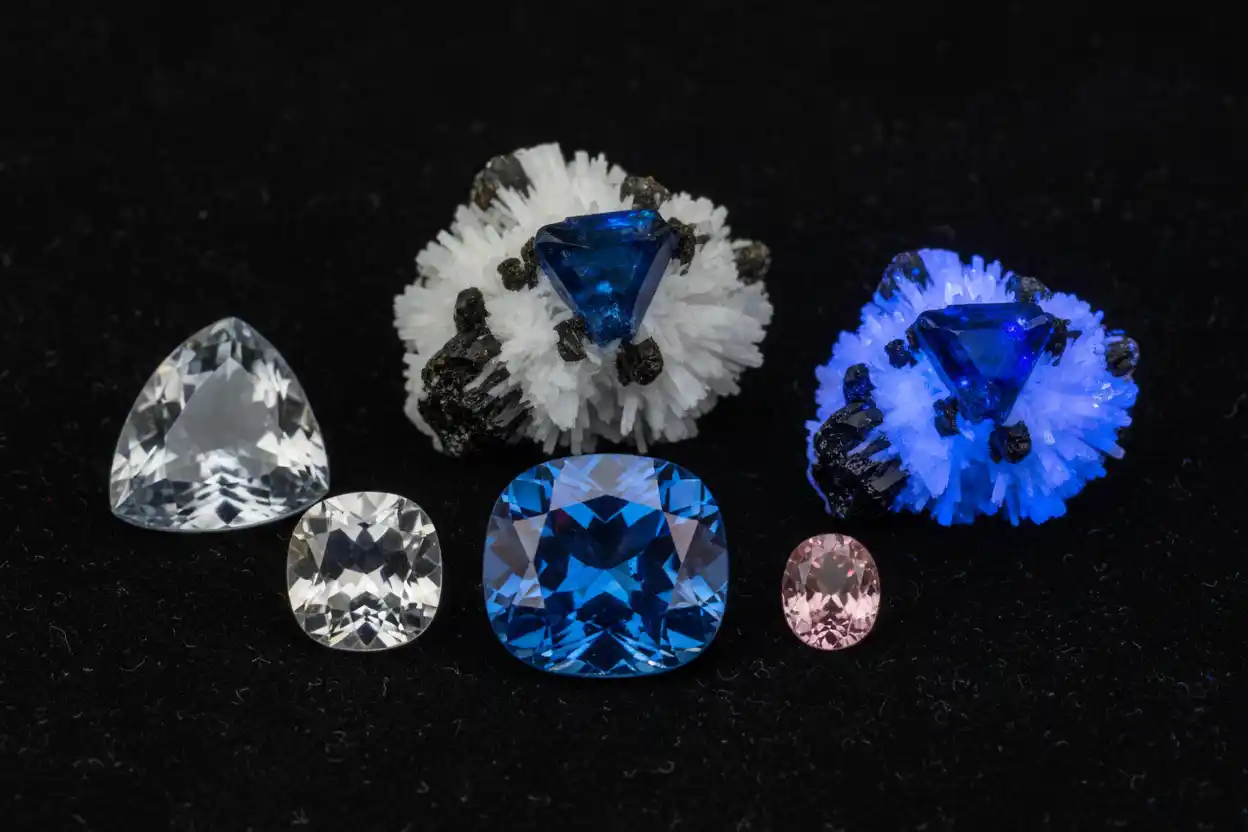
Near-colorless material may carry a faint blue, gray, or yellowish tint. It can also respond differently to ultraviolet light from strongly colored benitoite. Pale and colorless crystals may show dull pinkish or reddish fluorescence under long-wave ultraviolet, while blue benitoite is famous for bright blue to bluish-white fluorescence under short-wave ultraviolet.
Colorless benitoite can be confused with zircon, colorless sapphire, synthetic spinel, or glass. A gemological identification based on refractive index, birefringence, optic character, specific gravity, and spectroscopy is more reliable than appearance alone. The general crystal identification guide explains why no single visual test proves a gem’s identity.
Peach, Pink, and Orange Benitoite
Peach-orange benitoite requires careful disclosure. Controlled heating can turn a limited amount of pale or colorless material peach, pinkish orange, or orange. This treatment does not create a separate mineral species, and the resulting color is uncommon in the market.
Naturally pinkish stones have occasionally been reported, but orange is strongly associated with heat treatment. Consequently, a seller offering peach or orange benitoite should state whether the color is natural, treated, or undetermined.
Heating is not known as a routine way to improve ordinary blue benitoite. The process has only worked on a portion of suitable light-colored material, which helps explain why treated orange stones remain scarce.
Broader enhancement terminology is covered in the gemstone treatments guide. For benitoite, the critical point is simple: color treatment should be disclosed in writing.
Color-Zoned Benitoite
Many benitoite crystals contain uneven color, including blue sectors separated by pale or colorless areas. This zoning reflects changes during crystal growth and may follow the geometry of the crystal.
Cutters can sometimes position a concentrated blue zone beneath the table so the finished stone appears more evenly saturated. That strategy improves face-up color but may require sacrificing weight or accepting an asymmetrical outline.
Visible zoning is not automatically a defect. In a mineral specimen, sharp blue and colorless growth sectors can add scientific and visual interest. In a faceted gem, however, uneven zoning generally lowers value unless the pattern creates an unusual and attractive effect.
Transparent Facet-Grade Benitoite
Facet-grade benitoite must combine transparency, manageable inclusions, adequate size, and enough depth for a workable pavilion. Much of the mined material fails one or more of these tests.
Fine rough commonly contains fractures, included areas, attached matrix, or thin crystal sections. As a result, finished gems are usually small. Stones above one carat are scarce, while clean, richly colored examples above two carats are exceptional.
Clarity grading also matters because inclusions can increase the risk of damage during cutting and setting. The mine’s commercial quality categories emphasize this practical issue: a heavily included stone may survive normal wear but fracture when a prong is tightened.
Benitoite Mineral Specimens
Many of the finest benitoites are kept as specimens rather than cut. Sharp blue crystals on white natrolite create one of the mineral world’s most recognizable color contrasts.
The associated mineral natrolite often fills the veins in which benitoite occurs. Neptunite, joaquinite-group minerals, albite, serpentine, and blueschist minerals may also occur in the same geological environment.
Specimen value depends on crystal size, termination, color, damage, aesthetics, matrix coverage, associated species, and provenance. A small but perfectly positioned crystal can be more desirable than a larger damaged one.
Twinned and Unusual Crystal Forms
Ordinary benitoite commonly shows triangular or flattened dipyramidal forms. Rare twinning can create six-pointed outlines that resemble a star or snowflake.
These unusual crystals are primarily specimen material. Cutting one would destroy the feature that gives it collector importance. Consequently, a well-formed twin can be worth more intact than the small faceted gem it might yield.
Granular or poorly formed benitoite also exists, although it lacks the visual impact of sharp transparent crystals.
California Benitoite
Gem-quality benitoite is tied overwhelmingly to the New Idria district of San Benito County, California. It formed in natrolite-bearing veins associated with hydrothermally altered serpentinite and blueschist-facies rocks created in a subduction-related geological setting.
The combination of barium, titanium, silica, pressure-temperature conditions, fluid chemistry, and suitable host rock was extraordinarily unusual. That geological restriction is one reason benitoite appears in discussions of the rarest gemstones in the world.
California designated benitoite as its official state gemstone in 1985. Although the species has been recorded elsewhere, the California deposit produced the transparent, richly colored crystals that established its gemological reputation.
Benitoite from Other Localities
Benitoite has been reported from a small number of non-California localities, including occurrences in Japan and parts of the United States. These deposits are mineralogically important but have not supplied the market with a comparable volume of facetable blue material.
Non-California benitoite is generally microscopic, included, pale, or embedded in rock. Therefore, origin claims for a large transparent gem deserve documentation. “Benitoite” identifies the mineral species, while “California benitoite” adds a provenance claim that may influence collector value.
Inclusions and Internal Features
Typical benitoite may contain growth zoning, fractures, mineral inclusions, veils, or remnants of its host matrix. Small transparent crystals can be cleaner than larger pieces, although eye-clean examples remain scarce.
Inclusions should be evaluated for both appearance and structural risk. A reflective fracture near a girdle or corner can make setting hazardous. By contrast, a small internal crystal away from stress points may have little effect on durability and can support natural origin.
Benitoite has a Mohs hardness of approximately 6–6.5. The gemstone hardness chart places that below quartz and far below sapphire, meaning dust and harder jewelry materials can scratch it over time.
Hardness does not describe resistance to breaking. The distinction explained in gemstone toughness versus hardness is especially relevant because benitoite is brittle despite its moderate scratch resistance.
How Benitoite Is Identified
A trained gemologist can separate benitoite from most blue lookalikes using a combination of features:
Benitoite has high refractive indices, strong birefringence, marked pleochroism, a specific gravity near 3.65, and strong short-wave ultraviolet fluorescence. Its dispersion is unusually high, producing flashes that can exceed what the blue body color initially suggests.
Sapphire is harder, usually has lower birefringence, and responds differently in standard optical tests. Blue zircon may show strong doubling but has different refractive indices and density. Tanzanite and kyanite also differ in cleavage, refractive properties, and crystal structure.
Poor or indistinct cleavage does not make benitoite immune to chipping. The gemstone cleavage guide explains how cleavage, fractures, and brittle tenacity create different damage patterns.
Treatments, Synthetics, and Imitations
Most blue benitoite is sold without routine enhancement. Heat treatment is primarily relevant to rare pale or colorless material converted to peach-orange tones.
Laboratory-grown benitoite has been produced for scientific purposes, but commercial synthetic benitoite is not a normal part of the jewelry supply. The broader distinction between manufactured and mined gems is covered in lab-grown versus natural gemstones.
More likely imitations include blue sapphire, synthetic sapphire, blue zircon, spinel, glass, and assembled stones. A vague description such as “California blue gem” is not enough for an expensive purchase.
For a significant stone, an independent report can confirm species and sometimes identify treatment. The gemstone certification guide explains what laboratory documents can and cannot establish.
Cutting Behavior
Benitoite rough creates difficult yield decisions. Crystals are often thin, fractured, attached to matrix, or strongly zoned. In addition, the cutter must orient the rough to display blue color rather than the nearly colorless pleochroic direction.
Ovals, cushions, rounds, pears, and modified brilliant cuts are common because they balance light return with limited rough. Freeform shapes may preserve more weight from irregular crystals.
An overly deep pavilion can darken the stone, while an excessively shallow cut may leak light and weaken color. Fine cutting therefore adds real value, especially when the finished gem is both bright and symmetrical.
Durability and Jewelry Suitability
Benitoite can be worn in jewelry, but it is not an ideal stone for unrestricted daily wear. Pendants, earrings, brooches, and occasional-wear rings are safer than exposed everyday rings.
A protective bezel or halo can shield the girdle, although the setter must avoid applying excessive pressure to an included stone. Prongs should not sit directly over surface-reaching fractures.
Benitoite may appeal to someone considering unusual blue engagement-ring stones, but its rarity, brittle nature, and replacement difficulty make it a specialist choice rather than a low-maintenance alternative to sapphire.
Benitoite Prices in 2026
Benitoite prices rise sharply with size, color, clarity, cut quality, and documented California provenance. Retail asking prices vary widely because every stone is unusual and the market is thin.
Small pale or included faceted stones may sell for roughly $200–$800 per stone, depending on weight and appearance. Attractive blue gems below half a carat may fall near $800–$2,500 per carat, while fine stones between about half and one carat can reach approximately $2,000–$4,500 per carat.
Clean, vivid stones above one carat often enter the $3,000–$7,000-plus per carat range. Exceptional color, clarity, cutting, or size can push asking prices beyond these figures. Current mine listings also show that individual stones around one to two carats can cost several thousand dollars.
Mineral specimens range from modest fragments costing tens of dollars to aesthetic crystal groups priced in the hundreds or thousands. The dedicated benitoite price guide should own detailed value tables and future price updates, while the general gemstone pricing guide explains why price per carat rises nonlinearly as rare gems become larger.
How to Buy the Right Type
Begin by deciding whether you want a faceted gem, a fluorescent mineral specimen, a natural blue stone, or a rare treated orange example. Those categories should not be compared by price alone.
For faceted benitoite, request the exact weight, dimensions, treatment disclosure, clarity description, return terms, and video in neutral lighting. A stone that carries most of its weight below the girdle may look small for its carat weight.
For specimens, inspect every crystal termination and contact point. Sellers should disclose repairs, glue, reconstructed matrix, acid cleaning, or artificial mounting.
The dedicated benitoite buying guide covers material-specific quality factors. General transaction safeguards appear in the guide to buying gemstones online.
Cleaning and Storage
Clean benitoite with lukewarm water, a small amount of mild soap, and a very soft brush. Rinse briefly and dry with a lint-free cloth.
Avoid steam cleaning, sudden temperature changes, harsh chemicals, and prolonged ultrasonic treatment. Even when the mineral itself appears clean, vibrations may enlarge an existing fracture or loosen a vulnerable setting. The guide to gemstones in ultrasonic cleaners provides broader equipment-specific guidance.
Store benitoite separately from sapphire, diamond, quartz, and other harder stones. A padded box or individual fabric pouch prevents scratches and accidental contact.
Meaning and Symbolism
Modern crystal traditions commonly associate blue benitoite with clarity, honest communication, insight, and the confidence to express uncommon ideas. Its rarity and California origin also make it a personal symbol of individuality, discovery, and appreciation for the natural world.
Colorless material is sometimes linked with openness and mental focus, while violet-blue stones may be associated with intuition or contemplation. Peach-orange treated benitoite may inspire different personal interpretations, but treatment does not give the material scientifically demonstrated spiritual effects.
These meanings belong to cultural, spiritual, and personal practice rather than mineralogical science.
Frequently Asked Questions
1. Are there official mineral varieties of benitoite?
No widely accepted named mineral varieties divide benitoite by color. Blue, pale blue, colorless, zoned, and treated orange stones are practical gem-market categories of the same mineral species.
2. What is the most valuable type of benitoite?
A transparent, vivid blue, evenly colored, well-cut stone with high clarity and a weight above one carat usually occupies the highest commercial tier.
3. What is the rarest benitoite color?
Colorless natural crystals are uncommon, while peach-orange faceted material is rare because only a limited amount of suitable pale rough responds successfully to heat treatment.
4. Is orange benitoite natural?
Orange and peach-orange benitoite should generally be treated as heat-treated unless a reputable laboratory report states otherwise. The orange color is not typical of untreated material.
5. Does all gem-quality benitoite come from California?
Commercially significant transparent blue gem material is overwhelmingly associated with San Benito County, California. Other occurrences have not supplied comparable faceting rough.
6. Why does benitoite sometimes look violet or greenish?
Strong pleochroism causes different colors to appear along different crystallographic directions. Cutting orientation and viewing angle can emphasize blue, violet, greenish blue, or near-colorless components.
7. How can benitoite be distinguished from sapphire?
Benitoite is softer, has stronger birefringence and dispersion, and commonly fluoresces bright blue under short-wave ultraviolet. A gemologist should confirm identity with standard instruments.
8. Does every benitoite fluoresce blue?
Strong short-wave blue fluorescence is characteristic, but intensity varies. Colorless and pale specimens may also show dull red or pinkish fluorescence under long-wave ultraviolet.
9. Is benitoite suitable for an engagement ring?
It can be used in a protected occasional-wear ring, but its brittleness, moderate hardness, rarity, and replacement cost make it less practical than sapphire for daily wear.
10. Why are large benitoites so rare?
Most crystals are small, thin, fractured, included, or attached to matrix. Cutting also removes considerable weight, so clean finished stones above one carat are scarce.
11. Are synthetic benitoites commonly sold?
No. Laboratory synthesis has scientific applications, but synthetic benitoite is not a routine commercial jewelry product. Blue glass, sapphire, zircon, and spinel are more likely substitutes.
12. Should a benitoite have a laboratory report?
A report is sensible for an expensive, unusually large, colorless, peach-orange, or provenance-sensitive stone. It can confirm mineral identity and may document detectable treatment.
Benitoite’s meaningful “types” are not a long list of formal varieties but a spectrum created by color, orientation, transparency, treatment, crystal form, and geological context. Comparing those features separately makes it easier to choose between a brilliant blue faceted gem, a rare colorless stone, an unusual treated orange example, or an intact crystal on natrolite. Related alphabetical article are organized in the crystals that start with B directory and the gemstones that start with B guide.