Types of Opal: Colors and Varieties Explained
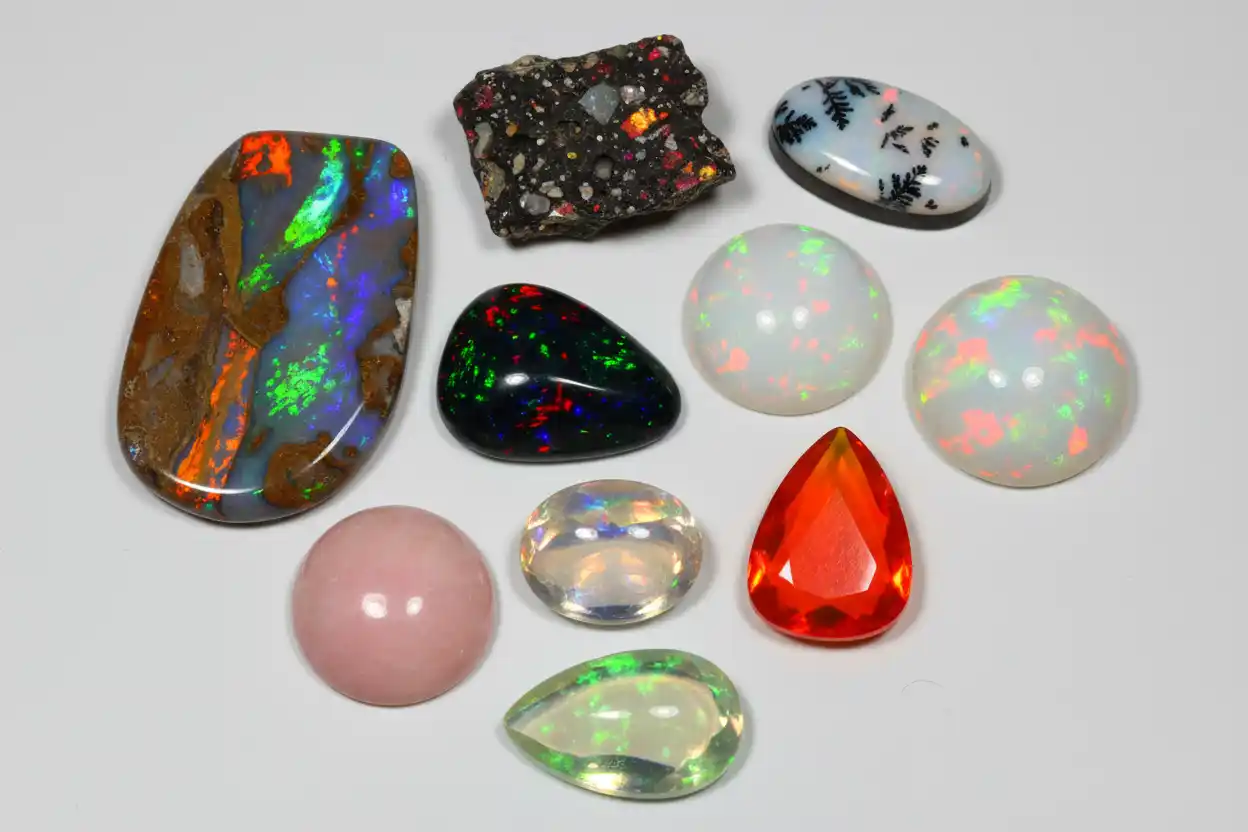
Opal is hydrated amorphous silica whose appearance ranges from chalky white common material to transparent orange fire opal and dark gems filled with shifting spectral color. Unlike crystalline quartz, opal consists of noncrystalline silica with variable water and a microscopic internal structure.
The main types of opal are classified by play-of-color, body tone, transparency, host rock, hydrophane behavior, locality, inclusions, treatment, and assembled construction. The parent opal meaning and properties guide covers the material broadly, while this article separates its principal gemological and commercial categories.
Opal at a Glance
| Property | Opal |
|---|---|
| Composition | Hydrated amorphous silica, commonly written SiO₂·nH₂O |
| Material group | Mineraloid |
| Main colors | Colorless, white, cream, gray, black, brown, blue, green, yellow, orange, red, pink, purple, and multicolored |
| Structure | Amorphous silica with variable water; precious opal contains ordered silica spheres capable of diffraction |
| Typical habit | Veins, seams, nodules, cavity fillings, replacements, concretions, fossils, crusts, and massive material |
| Luster | Vitreous, resinous, waxy, or pearly |
| Transparency | Transparent to opaque |
| Mohs hardness | Approximately 5–6.5 |
| Cleavage | None |
| Tenacity | Brittle; may craze or fracture from stress and dehydration |
| Common uses | Cabochons, carvings, beads, faceted fire opal, inlay, specimens, rings, earrings, pendants, and necklaces |
| Main care concern | Crazing, impact, dehydration, rapid moisture change, heat, hydrophane absorption, treatments, and composite construction |
Precious Opal and Common Opal
The first major division separates precious opal from common opal.
Precious opal displays play-of-color: spectral flashes that move or change as the stone, viewer, or light source shifts. Its internal silica spheres have sufficiently regular sizes and spacing to diffract visible light.
Common opal lacks play-of-color. It may still be attractive through body color, translucency, inclusions, pattern, fluorescence, or unusual formation.
The boundary does not depend on market value alone. A beautiful pink common opal remains common opal, while a small pale stone with genuine moving color qualifies as precious opal.
How Play-of-Color Forms
Precious opal contains microscopic silica spheres arranged in a relatively ordered three-dimensional structure.
The spaces and sphere sizes interact with visible light. Different wavelengths diffract at different angles, producing blue, green, yellow, orange, and red flashes.
Smaller sphere spacing tends to produce shorter wavelengths such as blue and violet. Larger spacing allows orange and red, which commonly increases value when brightness remains strong.
Disorder weakens or eliminates the effect. Therefore, common opal may share the same basic chemistry without displaying spectral color.
Black Opal
Black opal has a dark body tone beneath or around its play-of-color.
The body may appear black, dark gray, blue-gray, brown-black, or deep blue rather than uniformly jet black. Dark potch or included material provides strong contrast, making spectral colors appear brighter.
Lightning Ridge in New South Wales is the defining source of Australian black opal. Fine material may show red, orange, green, blue, violet, or full-spectrum patterns against a naturally dark background.
Black body tone alone does not establish high quality. Brightness, pattern, color range, orientation, stability, thickness, and flaws determine value.
The detailed market intent belongs in the black opal price guide and black opal buying guide.
Dark Opal
Dark opal has a medium-to-dark gray body tone that falls outside the strictest black-opal category.
It can still show vivid play-of-color and may provide excellent value when brightness and pattern are strong.
The boundary between black and dark depends on standardized body-tone comparison rather than the stone’s name or country alone.
Some Ethiopian opal receives smoke treatment to create a dark body. Such material should be described as treated dark or smoked opal rather than natural black opal.
White and Light Opal
White or light opal has a white, cream, pale gray, or light body tone.
Australia’s Coober Pedy, Mintabie, Andamooka, and other fields are historically important sources. White opal also occurs in Ethiopia and several additional countries.
A pale background produces softer contrast than black opal, but fine stones can display strong red, green, blue, and multicolored flashes.
Milky opacity, weak brightness, sand inclusions, crazing, and thin color layers reduce value. Transparent or semitransparent light material may overlap with crystal opal.
Crystal Opal
Crystal opal is transparent to semitransparent precious opal with visible play-of-color.
The term refers to transparency rather than crystal structure; opal remains amorphous. Body color may be colorless, white, yellow, orange, brown, gray, or dark.
Light can enter deeply, creating floating colors beneath the surface. Fine crystal opal may show exceptional depth and brightness.
Dark crystal opal combines transparency with a darker body tone, while black crystal opal combines transparency and black-opal-level darkness.
Boulder Opal
Boulder opal forms as thin seams, patches, or veins attached naturally to ironstone or another host rock.
Cutters retain the host because removing it would destroy the color layer. The resulting stone is a natural opal-and-matrix piece rather than an assembled doublet.
Queensland is the principal source. Important fields include Quilpie, Winton, Yowah, Koroit, and surrounding districts.
Fine boulder opal displays bright color, attractive ironstone pattern, adequate opal thickness, and a face that does not contain distracting fractures or deep pits.
The boulder opal price guide and boulder opal buying guide own the detailed value and purchasing intent.
Yowah Nut Opal
Yowah opal forms inside rounded ironstone concretions known as Yowah nuts.
When opened, a nodule may reveal precious opal, common opal, patterned ironstone, or an empty center. Fine pieces show bright color arranged through veins, central pools, or patterned matrix.
Cutters may polish one half as a specimen, create freeform cabochons, or slice the nodule to reveal internal structure.
Not every Yowah nut contains valuable opal, which makes rough buying highly uncertain.
Koroit Matrix and Pattern Opal
Koroit material comes from Queensland and commonly consists of dark ironstone crossed by thin opal veins.
The value often lies in the pattern rather than a thick continuous sheet of color. Networks can resemble maps, lightning, rivers, roots, or abstract paintings.
Matrix-rich material should not be compared directly with solid black or crystal opal by carat. Ironstone contributes most of the weight.
Matrix Opal
Matrix opal has precious opal distributed through pores, veins, grains, or cavities within a host rock.
Natural Australian matrix opal may occur in ironstone or sandstone. Andamooka matrix often receives sugar-acid treatment to darken the host and improve contrast.
Honduran matrix opal commonly occurs in dark volcanic rock, while other deposits produce sandstone, rhyolite, or sedimentary matrix.
Treatment and host composition should be disclosed because they strongly affect care and value.
Ethiopian Welo Opal
Ethiopian opal from the Wollo region transformed the commercial opal market through its strong brightness, varied patterns, and broad availability.
Much Welo material is hydrophane. Its porous structure absorbs water, oils, smoke, dye, and other liquids.
When wet, a hydrophane opal may become transparent, lose visible play-of-color temporarily, gain weight, or change body tone. As it dries slowly, its original appearance may return.
Oil and dye can cause persistent changes. Consequently, Ethiopian jewelry requires special protection from lotion, perfume, colored liquids, and prolonged soaking.
The Ethiopian opal buying guide and Ethiopian opal price guide retain the deeper purchase and value content.
Shewa and Mezezo Opal
Earlier Ethiopian opal from Shewa or Mezezo differs from much modern Welo material.
It may occur as nodules with brown, orange, or dark body color and can show instability or crazing. Some specimens produce vivid play-of-color, while others remain suitable mainly for collections.
A generic “Ethiopian opal” label does not identify deposit, stability, or hydrophane behavior.
Mexican Fire Opal
Fire opal is transparent to translucent opal with a yellow, orange, or red body color.
Mexico is its best-known source, particularly volcanic regions in Querétaro, Jalisco, Hidalgo, Guerrero, and surrounding states.
Fire opal may have no play-of-color, weak flashes, or intense precious color. Strong red-orange body color can create high value even without diffraction.
Transparent clean material is often faceted, unlike most opal. However, internal fractures and water loss can cause crazing if cutting generates excessive heat.
The fire opal buying guide and fire opal price guide own the dedicated purchasing and valuation intent.
Water Opal
Water opal is transparent or nearly colorless opal, commonly with play-of-color suspended in a watery-looking body.
Mexico is strongly associated with the name, although similar transparent material occurs elsewhere.
Fine water opal should remain clear enough to reveal depth while displaying visible moving color. Cloudiness, yellow tint, instability, and fractures reduce value.
The term may overlap with colorless crystal opal, depending on local and commercial usage.
Pink Opal
Pink opal is generally common opal with pale blush, rose, peach-pink, or stronger pink body color.
Peru is an important source, while material also comes from Mexico, Australia, the United States, and other regions.
Most pink opal lacks play-of-color and appears translucent to opaque. Fine material has even natural color, smooth polish, and minimal brown matrix.
Dyed magnesite, calcite, chalcedony, glass, and reconstructed material can imitate pink opal. The dedicated pink opal buying guide owns those authenticity questions.
Yellow Opal
Yellow opal ranges from cream-yellow and lemon to honey, mustard, and golden brown.
It may be transparent, translucent, or opaque, with or without play-of-color. Iron-bearing inclusions and trace compounds commonly contribute to the body color.
Yellow common opal is widely used for beads, cabochons, carvings, and palm stones. Transparent material can overlap with pale fire opal.
Blue Opal
Blue common opal appears pale sky blue, blue-green, teal, or gray-blue.
Peruvian and Andean trade material is particularly familiar, although blue opal occurs in several countries.
Its color may arise from microscopic inclusions and light scattering rather than an ordered play-of-color structure.
Natural blue opal usually has a softer, less uniform appearance than dyed material. Vivid cobalt products deserve treatment testing.
Green Opal
Green common opal ranges from pale mint and yellow-green to moss, olive, and dark green.
Nickel-bearing minerals, clay, inclusions, or mixed host rock may contribute to the color. Some green opal resembles chrysoprase, serpentine, jade, or prehnite.
Much material is opaque or translucent and used for carvings rather than fine faceting.
Dendritic Opal
Dendritic opal contains branching manganese- or iron-oxide inclusions resembling trees, ferns, frost, or landscape scenes.
The dendrites are inorganic mineral growths rather than fossilized plants.
Fine cabochons position the pattern against a pale or translucent background. Value depends on composition, contrast, polish, and the structural stability of the host opal.
Hyalite Opal
Hyalite opal is colorless to pale transparent opal with a glassy appearance.
It commonly forms botryoidal crusts, droplets, or rounded surfaces in volcanic and hydrothermal environments.
Uranium-bearing trace impurities can produce bright green fluorescence under ultraviolet light. The uranium concentration is generally low, but specimens should still be handled according to professional mineral-collection practices if radioactivity has been measured.
Faceted hyalite is uncommon because much material occurs as thin crusts or rounded coatings.
Owyhee Opal
Owyhee opal is a blue to blue-gray common opal associated with Oregon.
It often appears opaque to translucent with a soft denim, lavender-blue, or gray-blue body. Most examples lack play-of-color.
Cutting quality and stable natural color matter more than complete transparency.
Opalized Wood and Xylopal
Xylopal is wood whose original organic structure has been replaced or filled by opal.
Growth rings, cells, bark texture, or grain patterns may remain visible. The replacing material can be common opal, precious opal, chalcedony, or mixtures.
Opalized wood should not be valued only by play-of-color. Fossil preservation, completeness, locality, polish, and scientific importance also matter.
Opalized Fossils
Silica-rich groundwater can replace shells, bones, wood, plant material, and other remains with opal.
Australia is famous for opalized marine fossils, including shells and occasionally vertebrate material. Some specimens preserve precious play-of-color.
Scientifically important fossils should remain intact and may be subject to heritage, export, ownership, or museum-reporting rules. Cutting them into jewelry can destroy irreplaceable information.
Precious Opal Patterns
Opal pattern describes the arrangement of play-of-color.
Pinfire consists of small close flashes. Harlequin has distinct angular patches and remains rare. Broad flash produces larger sheets, while rolling flash appears to move across the stone.
Ribbon, flagstone, floral, honeycomb, chaff, Chinese writing, and digit patterns describe other arrangements.
Pattern names can be subjective. Brightness, coverage, directionality, body tone, and color range should still be evaluated independently.
Synthetic Opal
Synthetic opal has essentially the same ordered-sphere optical principle as natural precious opal but grows under controlled laboratory conditions.
Manufacturers can create white, black, transparent, and colored material with strong play-of-color. Some products contain polymer or resin, while others consist primarily of silica.
Repeated regular patterns, columnar structures, lizard-skin texture, and unusual uniformity can help identify certain synthetics. Modern material may require professional testing.
Synthetic opal should be sold as laboratory-created rather than natural.
Opal Doublets
An opal doublet combines a thin slice of natural opal with a dark backing.
Backings commonly include black chalcedony, ironstone, glass, plastic, or dark potch. The dark layer improves color contrast and supports a thin opal section.
A doublet is an assembled stone rather than solid opal. It can provide strong appearance at a lower price, but water and heat may weaken the adhesive.
Opal Triplets
An opal triplet has a thin opal layer between a dark backing and a transparent cap.
The cap commonly consists of quartz, glass, synthetic spinel, or another clear material. It protects the thin opal and magnifies its apparent color.
Triplets are normally less valuable than comparable doublets or solid opal. Edge inspection often reveals the layers.
The dedicated gemstone doublets and triplets guide explains assembled construction in more detail.
Treated Opal
Opal treatments include smoke darkening, sugar-acid treatment, dyeing, impregnation, oiling, resin filling, waxing, stabilization, and coating.
Smoke treatment commonly darkens hydrophane Ethiopian material. Sugar-acid processing darkens porous matrix, especially in some Andamooka material.
Dye can create black, blue, purple, pink, green, and other colors. Resin may improve stability, polish, or apparent transparency.
The dedicated treated opal guide owns the full detection and disclosure intent.
Opalite and Other Imitations
Opalite is commonly manufactured glass with a blue-white glow and orange transmitted color.
It is not natural opal, although the name can mislead buyers. Glass, plastic, resin, foil-backed composites, coated quartz, and assembled stones provide additional imitations.
The real versus fake opal guide covers solid, synthetic, doublet, triplet, treated, and imitation identification.
Formation of Australian Sedimentary Opal
Australian precious opal commonly occurs in deeply weathered Cretaceous sedimentary rocks.
Weathering released silica into groundwater. The silica-bearing water moved through joints, faults, cavities, fossils, and boundaries between permeable and impermeable layers.
As conditions changed, silica gel accumulated in seams, lenses, nodules, and replacements. Drying and structural organization eventually produced common or precious opal.
This model differs from volcanic-hosted opal in Mexico, Ethiopia, and several other regions.
Volcanic Opal Formation
Volcanic opal forms in cavities, fractures, and altered zones within rhyolite, tuff, basalt, ignimbrite, and related rocks.
Silica-rich hydrothermal or groundwater solutions fill openings after volcanic activity. Gas cavities can produce rounded nodules and geode-like forms.
Ethiopian Welo opal occurs in volcanic sequences, while Mexican fire opal commonly fills cavities and fractures in rhyolitic volcanic rock.
Host-rock differences influence porosity, hydrophane behavior, color, and stability.
Inclusions and Internal Features
Opal may contain sand, clay, ironstone, volcanic matrix, plant fragments, dendrites, bubbles, fluid-filled cavities, pyrite, manganese oxides, and other minerals.
Potch is common opal without play-of-color. It may form the back or surrounding matrix of precious opal.
Internal cracks can remain stable or develop into crazing. A fracture reaching the surface near a ring prong creates a higher risk than a small isolated inclusion.
Hydrophane material may absorb oils and contaminants through pores, changing transparency and body color.
How Opal Is Identified
Opal has lower hardness and density than quartz, no cleavage, and a singly refractive amorphous structure.
Precious play-of-color moves with viewing angle. However, synthetic and assembled products can show convincing effects.
Microscopic examination can reveal columnar synthetic structures, glue layers, caps, backing materials, dye concentration, smoke particles, and resin.
The direct moonstone versus opal guide separates opal’s diffraction from feldspar adularescence.
For valuable stones, laboratory analysis is more reliable than scratch, heat, water, or solvent tests.
Cutting Behavior
Most precious opal is cut as a cabochon to preserve color bars and provide a broad viewing surface.
The cutter studies wet rough to locate play-of-color, but hydrophane behavior can make temporary wet appearance misleading.
Black and white Australian opal may contain thin horizontal color bars. Grinding too deeply can remove the entire valuable layer.
Boulder and matrix opal follow the natural host pattern. Fire opal may be faceted when transparent and structurally sound.
Low heat, light pressure, wet cutting, and gradual drying reduce stress. Nevertheless, some rough crazes despite careful work because instability already exists inside the material.
Durability and Jewelry Suitability
Opal’s hardness of approximately 5–6.5 makes it softer than quartz, feldspar, topaz, sapphire, moissanite, and diamond.
It has no cleavage but remains brittle and can craze from internal stress, dehydration, rapid temperature change, or incompatible treatment.
The gemstone hardness chart explains surface wear, while gemstone toughness versus hardness covers breakage risk.
Pendants and opal earrings experience less impact than bracelets and rings.
An opal ring needs a protective setting, while an opal necklace can accommodate larger freeforms and boulder pieces. Opal bracelets require the greatest caution because the wrist frequently contacts hard surfaces.
Opal Prices in 2026
Opal has no simple universal per-carat scale. Brightness, body tone, pattern, color range, transparency, origin, treatment, stability, cut, and size interact.
Common opal, pink opal, yellow opal, dendritic opal, and ordinary carving material often sell around $1–$30 per carat or by piece.
Commercial Ethiopian hydrophane opal commonly ranges from approximately $10–$250 per carat. Exceptional brightness, red color, rare pattern, and larger clean size can push higher.
Mexican fire opal commonly sells around $20–$500 per carat, with vivid red, transparent, or precious play-of-color stones potentially exceeding that range.
White and light precious opal may range from approximately $10 per carat for weak commercial material to several thousand dollars per carat for exceptional brightness and pattern.
Crystal opal commonly spans roughly $50–$1,500 per carat, although top stones can move outside that range.
Boulder opal varies from modest commercial pieces to several thousand dollars per carat when the visible opal face has exceptional color and pattern. Matrix weight makes simple per-carat comparison difficult.
Black opal occupies the widest premium range. Low-grade stones may cost below $100 per carat, while elite vivid red-pattern material can exceed $20,000 per carat.
Doublets and triplets generally cost less than comparable-looking solids. Current specialist listings show doublets and triplets spanning only a few dollars per carat through the low hundreds, depending on the natural opal layer, size, workmanship, and backing.
The dedicated opal price guide should retain detailed valuation tables and future market updates.
Buying Guidance
First establish whether the stone is solid natural opal, synthetic opal, treated material, a doublet, a triplet, or an imitation.
Ask for origin, body tone, transparency, play-of-color brightness, pattern, hydrophane behavior, treatment, stability history, exact dimensions, weight, and return terms.
View video under diffused daylight and normal indoor light. Strong spotlights can exaggerate brightness and conceal dead areas.
Inspect the side and back for glue lines, caps, regular backing, smoke treatment, dye, matrix, and thin color bars.
The complete transaction checklist belongs in the opal buying guide. Laboratory-report considerations appear in gemstone certification.
Cleaning Opal
Clean solid stable opal with lukewarm water, mild soap, and a soft cloth or brush.
Avoid hot water, steam, harsh chemicals, abrasive cleaners, and sudden temperature changes.
Do not soak hydrophane Ethiopian opal. Water may enter the pores temporarily, while oils, perfume, dye, and dirty liquids can cause persistent discoloration.
Doublets and triplets should never soak because moisture can enter the adhesive layers.
Ultrasonic cleaning is unsuitable for opal. The dedicated opal jewelry cleaning guide owns the full care process.
Storage
Store opal in a padded box away from direct heat, dry windowsills, air vents, and harder gemstones.
Normal household humidity is generally sufficient for stable opal. Routine immersion or storage in water is unnecessary and can damage hydrophane, treated, or composite pieces.
Avoid extreme humidity swings. A closed padded container protects the stone from scratches and rapid environmental changes.
The separate opal cleansing guide provides nonabrasive options for spiritual practice.
Meaning and Symbolism
Opal has inspired associations with imagination, hope, transformation, creativity, emotion, and shifting identity because its colors change continuously with movement.
Black opal is often linked with mystery or confidence, fire opal with warmth and motivation, pink opal with compassion, and white opal with openness or possibility.
The detailed symbolic comparison belongs in the opal color meaning guide, while broader spiritual claims remain with the opal healing properties guide.
Opal is also one of the traditional subjects of the October birthstone guide.
These meanings reflect history, culture, color symbolism, and personal belief. They are not scientifically demonstrated effects of hydrated silica or play-of-color.
Frequently Asked Questions
1. What are the two main types of opal?
Precious opal displays play-of-color, while common opal does not.
2. What is the most valuable opal type?
Fine natural black opal with intense brightness, red or multicolored play-of-color, rare pattern, good size, and stable structure commonly occupies the highest market tier.
3. Is crystal opal a crystalline mineral?
No. Crystal opal is transparent or semitransparent opal. The word crystal describes transparency, not atomic structure.
4. What is the difference between black and dark opal?
Black opal has the darkest standardized body tones, while dark opal has a medium-to-dark gray body below the black-opal range.
5. Is boulder opal a doublet?
No. Boulder opal remains naturally attached to its host ironstone. A doublet consists of separate pieces joined with adhesive.
6. Why does Ethiopian opal change when wet?
Much Ethiopian opal is hydrophane and absorbs water through its porous structure, temporarily changing transparency, weight, and visible color.
7. Does fire opal always show play-of-color?
No. Fire opal is defined mainly by its yellow, orange, or red body color and may or may not display precious play-of-color.
8. What is matrix opal?
Matrix opal contains precious opal distributed through the pores, veins, or grains of a host rock.
9. Are opal doublets and triplets real opal?
They contain a natural opal layer but are assembled products rather than solid opal. Their construction should be disclosed.
10. Is synthetic opal chemically similar to natural opal?
Many synthetic opals reproduce silica-based ordered structures, although some contain significant polymer or resin. They remain laboratory-created rather than natural.
11. Can opal be worn every day?
A stable opal can be worn carefully in a protective setting, but scratches, impact, heat, chemicals, and rapid moisture changes make earrings and pendants safer than exposed daily rings.
12. Why do opal prices vary so much?
Body tone, brightness, pattern, color range, transparency, origin, stability, treatment, composite construction, size, and cutting create enormous differences among individual stones.
Opal types reflect both microscopic order and geological setting. A Lightning Ridge black gem, Queensland boulder seam, Ethiopian hydrophane cabochon, Mexican fire opal, dendritic common opal, fluorescent hyalite specimen, and layered triplet may all carry the opal name, yet their structure, origin, care, and value differ substantially. Related O entries appear in the crystals that start with O directory and the gemstones that start with O guide.
Safety disclaimer: Cutting and polishing opal can release respirable silica-bearing dust, while unstable rough may fracture unexpectedly. Use wet lapidary methods, effective local extraction, eye protection, and correctly rated respiratory protection; avoid heating unknown or treated opal.