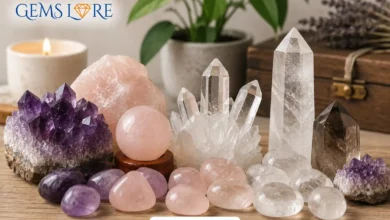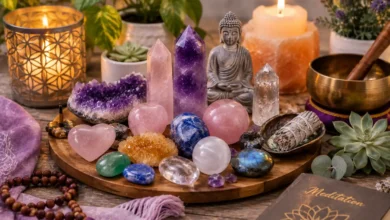

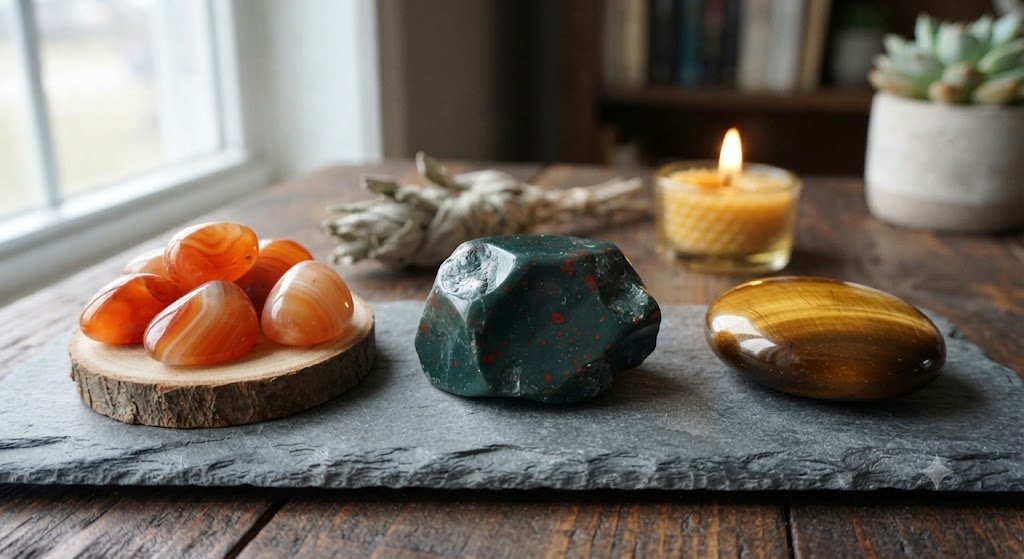

Crystals traditionally associated with strength and courage include carnelian, tiger’s eye, red jasper, garnet, bloodstone, ruby and smoky quartz. Their symbolism centers on beginning despite uncertainty, preparing for risk, maintaining effort and acting according to a chosen value.
Courage does not mean feeling no fear, tolerating every hardship or taking unnecessary risks. Sometimes it involves speaking publicly or attempting a difficult task. In other circumstances, courage means asking for help, admitting an error, ending an unsafe interaction or stopping before an injury becomes worse.
A crystal cannot create bravery, physical strength or protection. Its responsible role is to mark the action that courage requires.
Courage Crystals at a Glance
| Crystal | Traditional courage theme | Grounded practical use |
|---|---|---|
| Carnelian | Initiative and purposeful action | Begin the first manageable step |
| Tiger’s eye | Practical confidence and risk awareness | Assess danger and prepare before acting |
| Red jasper | Endurance and stability | Continue at a sustainable pace |
| Garnet | Commitment and follow-through | Complete a responsibility after motivation changes |
| Bloodstone | Resilience and service | Persist without ignoring physical limits |
| Ruby | Courage and chosen values | Act according to a clearly defined principle |
| Smoky quartz | Grounding and perspective | Return attention to current conditions |
| Black tourmaline | Boundaries and protection symbolism | Leave or restrict access when necessary |
| Aquamarine | Direct communication | State a difficult truth or request clearly |
| Amethyst | Reflection and moderation | Pause before confusing recklessness with bravery |
| Rose quartz | Compassion and self-respect | Protect dignity without dehumanizing others |
| Hematite | Structure and orientation | Check equipment, surroundings and the next action |
Courage, Confidence and Strength Are Different
Confidence concerns belief in the ability to handle a particular situation.
Courage involves acting despite fear, uncertainty or discomfort.
Strength can refer to physical capacity, emotional endurance, moral conviction or the practical support needed to continue.
Someone may feel unconfident and still act courageously. Likewise, a physically strong person may need courage to admit that an injury requires rest.
The drafted confidence crystal guide owns the broader self-esteem and task-confidence intent. This article focuses on action taken when the result remains uncertain or the decision carries a meaningful personal cost.
Best Overall Courage Crystal: Carnelian
The drafted carnelian guide associates orange-to-red chalcedony with initiative, creativity and purposeful action.
Carnelian fits courage because many difficult goals remain abstract until the first step begins.
A useful prompt is:
“What action is small enough to complete but meaningful enough to change the situation?”
Examples include:
- Making an appointment.
- Sending an application.
- Asking one question.
- Reporting a safety concern.
- Beginning a difficult conversation.
- Attending the first class.
- Requesting clarification.
- Telling a trusted person what happened.
The first action does not need to solve the entire problem.
Carnelian cannot increase adrenaline, physical energy or bravery medically. It can represent the point where preparation becomes action.
Tiger’s Eye for Prepared Courage
Tiger’s eye is chatoyant quartz traditionally associated with observation, practical confidence and risk assessment.
Courage is not improved by ignoring obvious danger.
Before acting, ask:
- What is the objective?
- Which risk is unavoidable?
- Which risk can be reduced?
- Who else may be affected?
- What equipment or support is required?
- Is the action reversible?
- What would make me stop?
- What is the safest available method?
The moving band across tiger’s eye offers a useful visual reminder to examine changing conditions.
The stone cannot predict danger or provide physical protection. Preparation, training and appropriate support create the practical safety.
Red Jasper for Sustainable Strength
Red jasper is opaque microcrystalline quartz traditionally associated with stability and endurance.
Strength becomes useful when it can be sustained.
A red jasper practice asks:
- Can this pace be repeated?
- Is recovery included?
- Am I maintaining technique?
- Which responsibility deserves continued effort?
- Am I persisting because the goal remains worthwhile or because stopping feels embarrassing?
- What warning sign am I trying to ignore?
Endurance does not mean continuing through every form of pain, exhaustion or harm.
The stone cannot increase stamina, muscle strength or circulation.
Its symbolism supports steady effort rather than a dramatic display that cannot be maintained.
Garnet for Commitment
Garnet is a mineral group that occurs in red, orange, green, pink and other colors.
Traditional meanings include continuity, commitment and sustained participation.
A courageous beginning may receive attention, while the later work is quieter.
Garnet can represent:
- Returning after an imperfect first attempt.
- Completing the promised task.
- Applying feedback.
- Maintaining a boundary.
- Continuing rehabilitation as advised.
- Following through after making an apology.
- Recording the result honestly.
Commitment must remain ethical and voluntary.
A person does not need to continue an abusive relationship, unsafe role or destructive goal merely because they once made a promise.
Garnet cannot bind anyone to an obligation.
Bloodstone for Resilience With Limits
Bloodstone is dark-green chalcedony containing red inclusions or spots.
It has longstanding symbolic associations with courage, service and resilience.
Bloodstone can represent continuing through ordinary difficulty while remaining attentive to warning signs.
Ask:
- Is this discomfort expected or concerning?
- Has function changed?
- Is the situation becoming unsafe?
- Would I advise someone else to continue?
- Is qualified help available?
- Am I hiding a problem to appear strong?
Resilience includes reporting symptoms, asking for assistance and changing a plan.
Bloodstone cannot stop bleeding, increase oxygen or improve athletic performance medically.
Ruby for Moral Courage
Ruby is red corundum traditionally associated with courage, commitment, vitality and status.
Moral courage involves acting according to a value when doing so may produce discomfort, disagreement or personal cost.
Examples include:
- Correcting false information.
- Reporting dangerous conduct.
- Refusing to participate in discrimination.
- Admitting responsibility.
- Defending another person’s right to speak.
- Protecting confidentiality.
- Declining an unethical instruction.
- Accepting a justified consequence.
Before acting, define the value clearly and consider the safest effective method.
Ruby cannot guarantee that the courageous action will be rewarded.
Natural, treated, filled and laboratory-grown rubies also differ commercially and should be disclosed accurately.
Smoky Quartz for Grounding Fear
Smoky quartz traditionally represents grounding and practical perspective.
Fear often moves attention toward every possible future outcome.
A smoky quartz exercise returns to the present:
- What is happening now?
- Is anyone in immediate danger?
- Which decision must be made today?
- What information is available?
- Who can provide support?
- What is the next physical action?
- Which future concern can wait?
Grounding does not prove that the fear is irrational.
Some fears identify real risks and require planning, distance or professional assistance.
Smoky quartz cannot medically stop panic, trauma responses or anxiety.
Black Tourmaline for the Courage to Leave
The drafted black tourmaline guide associates schorl tourmaline with boundaries and protection symbolism.
Popular culture often treats courage as staying and fighting.
Sometimes the more responsible choice is leaving.
Black tourmaline can represent:
- Ending an abusive conversation.
- Exiting an unsafe place.
- Blocking unwanted access.
- Leaving a role that violates core values.
- Refusing an activity without proper equipment.
- Taking distance from escalating conflict.
- Requesting another person’s presence.
- Contacting appropriate support.
The drafted boundary crystal guide explains how limits become real through words, access and consequences.
Black tourmaline cannot stop violence or physically protect someone from harm.
Aquamarine for Speaking Despite Fear
The drafted aquamarine guide associates blue-to-green beryl with composed communication.
Speaking courageously does not require sounding completely calm.
The goal is to deliver the necessary message clearly enough to be understood.
Useful openings include:
“I need to report…”
“I disagree because…”
“I do not consent.”
“I need help.”
“This situation is unsafe.”
“I made an error.”
“I cannot complete both tasks by the deadline.”
“I need the instructions in writing.”
Aquamarine cannot make the audience respond fairly. Its symbolism supports preparing and stating the sentence within the speaker’s control.
Amethyst for Distinguishing Courage From Impulse
The drafted amethyst guide traditionally represents reflection and moderation.
An action may feel brave because it is intense, visible or immediate.
Before proceeding, ask:
- Does this action serve the stated objective?
- Am I responding to pressure or pride?
- Is another person’s consent involved?
- Have I ignored expert advice?
- Is the risk necessary?
- Would waiting improve the method?
- Is this courage or retaliation?
- What consequence may be irreversible?
A pause does not remove courage.
It can prevent a meaningful value from being expressed through a reckless method.
Amethyst cannot control impulsivity medically.
Rose Quartz for Compassionate Courage
Rose quartz traditionally represents compassion, affection and self-respect.
Courage may involve remaining compassionate without abandoning a boundary.
For example:
“I care about you, and I cannot continue this arrangement.”
“I understand that you are disappointed, but my answer remains no.”
“I made a harmful choice, and I will accept the consequence.”
“I need support rather than another expectation to be strong.”
Compassion does not require constant availability or reconciliation.
Rose quartz cannot repair a relationship or make someone forgive.
Hematite for Practical Orientation
Hematite is iron oxide associated symbolically with structure and grounded attention.
A hematite cue can support a physical and procedural check:
- Where is the exit?
- Is the equipment secure?
- Who knows where I am?
- What step comes first?
- Is communication available?
- Have I reviewed the instructions?
- What protective measure is required?
- Am I physically able to proceed safely?
Strongly magnetic beads sold as hematite are often manufactured hematine or another material.
The mineral’s iron content does not improve strength, blood iron or oxygen delivery through ordinary handling.
Physical Courage and Safety
Physical courage may appear in sport, emergency response, demanding work or rehabilitation.
It should never be defined solely as tolerating pain.
Pain, dizziness, confusion, chest symptoms, breathing difficulty, weakness or altered function can require stopping and obtaining help.
The drafted crystals-for-athletes guide explains why stones cannot improve performance, prevent injury or accelerate recovery.
Jewelry and loose crystals should remain outside contact sports, machinery areas and other environments where they create entanglement, pressure or impact risks.
A courage ritual must not interfere with protective procedures.
Courage in Relationships
Relationship courage can include:
- Stating a need.
- Admitting uncertainty.
- Asking whether another person wants advice.
- Apologizing specifically.
- Accepting a declined invitation.
- Leaving an abusive situation.
- Discussing money honestly.
- Ending a relationship respectfully.
- Requesting counseling when both people consent.
- Recognizing that reconciliation is not always appropriate.
The drafted breakup crystal guide explains recovery and contact boundaries after a relationship ends.
A love crystal cannot create consent or make a difficult conversation safe.
Courage at Work
Professional courage may involve reporting an error, asking for clarification, requesting accommodation or challenging an unsafe instruction.
Risk varies according to power, contract status, workplace culture and local protections.
A courageous response does not always require public confrontation.
Documentation, written communication, representation or confidential reporting may be safer and more effective.
The drafted career crystal guide covers workplace boundaries and professional planning.
A crystal cannot prevent retaliation, discrimination or job loss.
Courage to Ask for Help
Independence is not the only form of strength.
Asking for help can require courage when someone fears judgment, rejection or loss of control.
A direct request might say:
“I cannot manage this safely alone.”
“I need someone to stay with me.”
“I need medical advice.”
“I do not understand the process.”
“I need the workload reduced.”
“I am concerned that I may hurt myself.”
The request should be directed toward someone or a service capable of responding appropriately.
A crystal cannot replace human support.
Courage After Failure
Failure can produce shame, avoidance and the belief that another attempt will confirm permanent inadequacy.
Use a stone beside three questions:
- What specifically failed?
- What information did the result provide?
- Is another attempt appropriate, and what must change first?
Courage does not require repeating the same method endlessly.
Sometimes the result shows that a goal, strategy or environment needs to change.
Rhodonite may add accountability symbolism, while red jasper represents sustainable practice.
The person remains more than one result.
A Four-Stone Courage Set
A coherent courage set could contain:
| Crystal | Role |
|---|---|
| Smoky quartz | Assess the present conditions |
| Tiger’s eye | Review risk and preparation |
| Carnelian | Begin the action |
| Red jasper | Continue sustainably |
The sequence becomes:
Orient → Prepare → Begin → Continue
Add aquamarine when the courageous action is communication.
Add black tourmaline when leaving or restricting access is central.
Using more stones does not make the person braver.
Frequently Asked Questions
1. What is the best crystal for courage?
Carnelian is a strong overall choice because it symbolizes beginning and taking purposeful action.
2. Which crystal represents strength?
Red jasper, garnet, bloodstone and ruby commonly symbolize endurance, commitment and strength.
3. Which crystal is associated with bravery?
Carnelian, tiger’s eye and ruby are frequently connected with courage and deliberate action.
4. What is the difference between courage and confidence?
Confidence is belief in the ability to handle a situation. Courage is acting despite fear or uncertainty.
5. Which crystal may help with fear symbolically?
Smoky quartz can represent grounding, while tiger’s eye symbolizes preparation and risk assessment.
6. Which crystal represents moral courage?
Ruby and lapis lazuli can symbolize acting according to values and speaking truth responsibly.
7. Can black tourmaline physically protect someone?
No. It carries protective symbolism but cannot prevent violence, accidents or environmental hazards.
8. Is stopping or leaving a situation courageous?
Yes. Stopping, leaving or asking for help may be the strongest response when continuing would be unsafe or harmful.
9. Can crystals increase physical strength?
No. Crystals do not increase muscle strength, stamina or athletic performance.
10. Which crystal combination is suitable for courage?
Smoky quartz, tiger’s eye, carnelian and red jasper create an orient-prepare-begin-continue sequence.
11. Can crystals remove fear completely?
No. Fear is a normal response that may identify uncertainty or danger. Crystals cannot eliminate it medically.
12. Are courage-crystal effects scientifically proven?
No. Their strength, courage and protection meanings reflect cultural and spiritual traditions rather than established physical or psychological effects.
Courage Chooses the Action, Not the Appearance
Courage is not measured by how fearless someone appears. It is shown through the action chosen after risk, values, limits and consequences have been considered.
Select one crystal for preparation and another for beginning or maintaining the effort. The stones can organize the process, while judgment, support and follow-through create courageous behavior.
Disclaimer: Crystal courage, strength, energy and protection properties reflect cultural and spiritual traditions rather than established physical or psychological effects. Crystals cannot prevent violence, increase physical strength, treat anxiety or make dangerous conduct safe. Prioritize training, protective measures, qualified support and urgent local assistance whenever safety is at risk.