
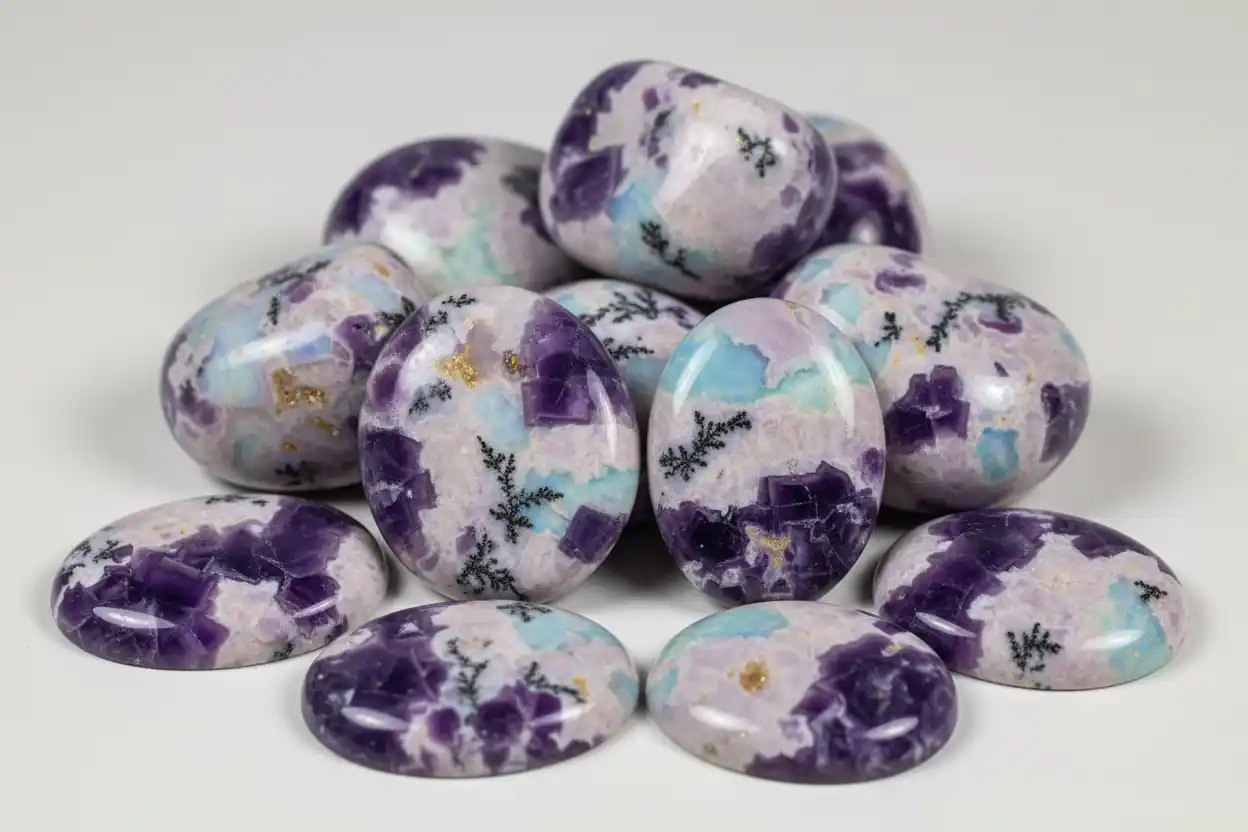

Tiffany Stone is a purple, lavender, cream, blue-grey, white, and black lapidary rock associated with the Spor Mountain beryllium deposit in western Utah. It is not one mineral species and has no fixed formula; instead, it can contain varying proportions of fluorite, opal, chalcedony, quartz, calcite, dolomite, manganese oxides, bertrandite, and other minerals.
The trade name is sometimes used interchangeably with opalized fluorite, Bertrandite, ice cream opalite, and Utah lavender. Those labels can be misleading because the rock’s composition changes from piece to piece, and Bertrandite may form only a small portion of a colorful specimen.
Tiffany Stone at a Glance
| Property | Tiffany Stone |
|---|---|
| Composition | Variable mixture of fluorite, opal, chalcedony, quartz, carbonates, manganese oxides, bertrandite, and other minerals |
| Group or type | Multi-mineral lapidary rock and beryllium-ore-associated trade material |
| Color | Purple, lavender, blue-violet, cream, white, grey, pink, yellow, brown, black |
| Crystal system or texture | Mixed; commonly nodular, brecciated, banded, veined, opaline, or massive |
| Habit | Nodules, vein fillings, geodes, breccia fragments, massive ore, slabs |
| Luster | Waxy, vitreous, pearly, dull, or greasy depending on the mineral zone |
| Transparency | Opaque to translucent, with occasional opal-rich or fluorite-rich translucent areas |
| Mohs hardness | Variable, commonly around 4–7 across different zones |
| Cleavage | Variable; fluorite and calcite zones may cleave readily |
| Tenacity | Brittle and structurally variable |
| Common uses | Cabochons, slabs, beads, pendants, carvings, display pieces, collector specimens |
| Primary care concern | Mixed hardness, cleavage, fractures, porosity, treatments, acids, heat, and beryllium-bearing dust during cutting |
What Is Tiffany Stone?
Tiffany Stone is a commercial name applied to a distinctive multi-mineral rock from the Spor Mountain area of Juab County, Utah.
Purple and lavender zones are commonly associated with fluorite and manganese-bearing components. White, cream, and pale areas may contain opal, chalcedony, quartz, calcite, dolomite, or bertrandite.
Black lines and patches commonly reflect manganese oxides, while iron minerals can create brown, orange, or yellow staining.
Because these components occur in irregular mixtures, it is inaccurate to give Tiffany Stone one universal hardness, refractive index, density, or chemical formula.
The stone belongs in the trade-name and composite-material boundary of types of gemstones, not as a newly discovered purple mineral species.
Its tracker category also places it within the crystals that start with T and gemstones that start with T directories.
Is Tiffany Stone Bertrandite?
Tiffany Stone is often called Bertrandite, but the two terms are not mineralogically equivalent.
Bertrandite is a specific beryllium silicate hydroxide mineral with the formula Be₄Si₂O₇(OH)₂. It is the economically important beryllium ore at Spor Mountain.
Tiffany Stone can contain Bertrandite, but colorful lapidary pieces are usually complex mixtures in which fluorite, opal, chalcedony, carbonates, manganese oxides, and other minerals contribute substantially to the appearance.
A specimen should therefore not be labeled as pure Bertrandite unless laboratory testing demonstrates that composition.
The trade name Tiffany Stone is more appropriate when referring to the patterned purple-and-white ornamental rock as a whole.
Tiffany Stone and Opalized Fluorite
“Opalized fluorite” is another common commercial description. It reflects the frequent intergrowth of fluorite with opal-rich material.
However, not every Tiffany Stone piece is predominantly fluorite, and the phrase does not account for chalcedony, calcite, dolomite, manganese oxides, Bertrandite, or other phases.
The relationship with fluorite helps explain purple, blue-violet, greenish, and fluorescent zones, as well as portions with hardness near 4 and strong cleavage.
Opal-rich areas may show a waxier luster, lighter color, greater porosity, and curved fracture. They should not automatically be compared with transparent precious opal because most Tiffany Stone lacks play-of-color.
Microcrystalline silica can form white, grey, or bluish chalcedony bands. Crystalline quartz may occur in harder veins or small cavities.
The result is a rock whose visual identity comes from mineral intergrowth rather than one dominant gemstone species.
How Tiffany Stone Forms
Tiffany Stone is associated with the volcanic-hosted beryllium deposits of Spor Mountain in Utah’s Thomas Range.
The deposit developed through interactions among volcanic tuff, carbonate rocks, fluorine-rich fluids, beryllium-bearing hydrothermal activity, and later alteration.
Silica-rich and fluorine-rich fluids moved through fractures and porous zones, depositing opal, fluorite, Bertrandite, manganese oxides, carbonates, and other minerals.
Nodules and geodes developed through multiple generations of mineral growth. Some show concentric zones, breccia fragments, vein networks, and cavities recording changing fluid chemistry.
Beryllium is concentrated in ore zones containing Bertrandite and beryllium-bearing opal or clay-related material. Tiffany Stone represents the visually attractive lapidary portion of this broader ore system.
Different pits and alteration zones can produce substantially different colors and mineral ratios. Consequently, a purple cabochon and a cream-black rough nodule can both be genuine Spor Mountain material.
Spor Mountain and Mining Context
Spor Mountain contains the United States’ principal commercial Bertrandite deposit and one of the world’s most important beryllium resources.
Mining focuses on industrial beryllium ore rather than decorative stone. Tiffany Stone is therefore a by-product or collector material associated with the ore system.
The historic Brush Wellman name remains common in mineral labels, although the operation is now associated with Materion.
The active mine is private industrial property. Commercial Tiffany Stone commonly comes from older collections, historic mine access, miner-saved material, dealer stock, or legally released rough.
Claims that a seller personally mined fresh material should be supported by credible documentation. Buyers should not enter restricted mine property or remove material without explicit authorization.
Exact pit and collection history can add value because Spor Mountain contains several mineralized areas with differing patterns.
Tiffany Stone Colors and Patterns
Lavender and purple are the best-known colors. The purple may appear as broad areas, wispy clouds, angular fragments, veins, or narrow outlines around pale nodules.
Cream, white, and ivory commonly create the background. Blue-grey, pink, yellow, tan, and brown zones occur less consistently.
Black manganese-oxide veins can produce bold spiderweb, breccia, dendritic, or landscape-like patterns.
Some slabs resemble abstract paintings, stained glass, clouds, or marbled ice cream. This appearance explains several of the material’s commercial names.
A top-quality cabochon generally balances saturated purple with cream or black contrast. However, rare unusual patterns can be desirable even when purple occupies a smaller area.
The material fits visually within purple gemstones, though its multi-mineral composition separates it from amethyst, purple sapphire, and single-crystal fluorite.
Fluorescence
Some Tiffany Stone fluoresces under ultraviolet light because fluorite, opal, and trace activators occur within the rock.
One zone may glow blue, green, cream, or another color while adjacent areas remain inert.
Shortwave and longwave responses can differ. A seller should state which wavelength was used rather than simply claiming that the stone is fluorescent.
Fluorescence can provide useful information about mineral zoning but does not prove authenticity. Many fluorite-bearing and opal-rich rocks fluoresce.
Likewise, a nonfluorescent cabochon can still be genuine because composition varies across the deposit.
Ultraviolet lamps should be used with proper eye and skin protection.
Tiffany Stone Versus Purple Fluorite
Purple Fluorite is a single mineral variety with cubic crystal structure, hardness 4, and perfect octahedral cleavage.
Tiffany Stone is a rock containing several minerals. A polished piece may include fluorite, but it can also have opal, quartz, carbonates, manganese oxides, and Bertrandite.
Pure purple fluorite commonly shows transparent-to-translucent color zoning and recognizable cleavage or crystal forms. Tiffany Stone usually appears opaque, patterned, brecciated, and veined.
A bulk hardness test can be misleading because a steel point may scratch one Tiffany Stone zone but not another.
The broader Rainbow Fluorite page covers multicolored fluorite crystals, which should not be confused with a mixed Utah lapidary rock.
Tiffany Stone Versus Opalite
Opalite usually refers to manufactured opalescent glass in the modern jewelry market.
It has a comparatively uniform blue-white or orange-transmitted glow and may contain bubbles or flow lines.
Tiffany Stone is natural patterned rock with irregular mineral boundaries. It does not normally show the uniform manufactured glow associated with commercial Opalite glass.
The alternate label “ice cream opalite” can therefore cause confusion. Sellers should use Tiffany Stone or Utah opal-fluorite rock and explain the natural composition.
Other Lookalikes
Charoite can show purple, lavender, white, and black swirling patterns. It is a different silicate mineral from Russia and often has a fibrous, silky appearance.
Purple Variscite and related phosphate-rich rocks can resemble pastel Tiffany Stone but have different chemistry and localities.
Dyed Howlite may show purple color with grey veins. Dye frequently concentrates in cracks and pores.
Purple Morado opal, Fluorite-rich breccia, Lepidolite-bearing rock, dyed marble, resin composites, and polymer clay can all imitate parts of the appearance.
A marketplace name such as Bertrandite Jasper does not prove that the material is either pure Bertrandite or Jasper.
How to Identify Tiffany Stone
Origin and multi-mineral structure are the starting points for identification.
A genuine piece should have credible Spor Mountain or western Utah provenance. Similar purple rocks from other localities may be attractive but do not automatically share the Tiffany Stone trade identity.
Under magnification, natural material commonly shows irregular mineral boundaries, veins, pores, small cavities, grain changes, and zones with different luster.
Hardness varies. Fluorite-rich areas may scratch near Mohs 4, while quartz-rich zones approach 7.
Some areas may show cleavage, while opal or chalcedony-rich zones break more irregularly.
Specific gravity and refractive index are not uniform across the rock. A single reading can describe only the tested zone.
Raman spectroscopy, X-ray diffraction, and elemental analysis can identify individual components. The how to identify crystals guide explains why trade-name materials require several tests and provenance rather than one standard property.
Treatments, Stabilization, and Repair
Tiffany Stone can contain soft, porous, fractured, and cleavable zones, making stabilization commercially useful.
Resin impregnation may strengthen rough, fill pores, reduce undercutting, and allow a smoother polish.
Wax and oil deepen color and create a wet-looking surface. These treatments may temporarily conceal fine scratches or pale porous areas.
Dye is possible in cream, white, opal-rich, or fractured zones. Color concentrated around pits, cracks, and drill holes should be examined carefully.
Backing can strengthen a thin cabochon or improve contrast. Doublets may combine a Tiffany Stone layer with another rock or resin support.
Glue repairs occur in rough slabs and carvings. A seller should disclose repaired fractures and reconstructed pieces.
The general gemstone treatments explained guide defines impregnation, filling, coating, dyeing, backing, and assembly.
Synthetic Tiffany Stone and Imitations
Tiffany Stone’s identity depends on natural geological formation at Spor Mountain, so an engineered product cannot be laboratory-grown Tiffany Stone in the usual gemstone sense.
Manufacturers can create composites from Fluorite, Opal, silica powder, pigment, and resin. Such materials should be labeled as reconstructed or manufactured.
Dyed marble, Magnesite, Howlite, glass, polymer clay, and resin can reproduce lavender-and-black patterns.
Natural purple rocks from other locations may also be sold under the name. They are not synthetic, but their provenance and composition differ from recognized Utah Tiffany Stone.
The distinctions among natural material, composites, simulants, and laboratory-grown products are explained in lab-grown vs natural gemstones.
Cutting and Polishing Behavior
Tiffany Stone is cut into cabochons, tablets, beads, slabs, freeforms, spheres, and carvings.
The lapidary challenge comes from variable hardness. Soft Fluorite or carbonate zones grind faster than quartz and chalcedony.
Undercutting can produce rippled surfaces, pits, and dull patches. Resin stabilization may help maintain an even polish.
Cleavage in Fluorite and Calcite-rich areas can open during sawing. Opal-rich portions may contain hidden drying cracks or porous zones.
A cutter usually selects the face that best balances purple color, black pattern, and cream contrast. The reverse side may look completely different.
Thin slices often require backing. Sharp corners should be avoided because mixed fracture behavior makes them vulnerable.
Unknown rough should be handled conservatively because Bertrandite and other beryllium-bearing phases may be present.
Durability and Jewelry Suitability
Tiffany Stone has no single durability rating.
Quartz-rich material may resist scratches reasonably well, while Fluorite-rich or carbonate-rich zones can abrade quickly.
A blow can follow a mineral boundary, cleavage plane, old fracture, or breccia contact and split the stone.
Pendants, earrings, brooches, and protected cabochons are more practical than daily rings or bracelets.
A low bezel supports the edge and can help keep a composite cabochon together. Nevertheless, pressure from an overly tight setting may open a hidden fracture.
The difference between hardness and breakage resistance is especially relevant, as explained in gemstone toughness vs hardness.
Tiffany Stone Value and July 2026 Asking Prices
Tiffany Stone is generally priced by the cabochon, slab, specimen, or pound rather than through a consistent per-carat scale.
As of July 2026, small commercial cabochons commonly carry asking prices around $10–$35 each.
Well-patterned designer cabochons often appear around $50–$90, with matched pairs commonly offered near $55–$90 per pair.
Large cabochons, rare color combinations, and unusually scenic patterns may ask approximately $100–$350 per stone. Current specialist listings include individual premium pieces above $300.
Lapidary rough often ranges around $30–$100 per pound, although quality, yield, pattern, legal provenance, and shipping materially affect the price.
Large old-stock slabs, display nodules, and documented historic material can exceed $500. Premiums should reflect usable pattern and provenance rather than the unsupported claim that every gram contains abundant Bertrandite.
Buying Tiffany Stone
Ask for the locality and collection history before considering the pattern. Genuine trade material should be connected credibly with Spor Mountain, Utah.
Request dry photographs of the front, back, edge, and any cut slab surface. Wet photographs can exaggerate color and hide pits.
Ask whether the item is solid natural rock, stabilized, dyed, backed, repaired, reconstructed, or resin-bound.
For rough, request approximate dimensions, weight, visible fractures, and whether a test window has been ground to reveal the interior.
Do not assume that a pale rind guarantees vivid purple inside. Likewise, a dark rough surface can conceal excellent internal pattern.
Ask whether the seller legally obtained the material. Active industrial mine property should never be treated as an informal collecting area.
The general how to buy gemstones online guide provides additional checks for seller claims, measurements, returns, and independent testing.
Cleaning and Storage
Clean a stable polished piece with a soft, slightly damp cloth. If necessary, use lukewarm water and a small amount of mild soap, then dry it promptly.
Avoid soaking. Opal-rich areas, fillers, glue, porous zones, carbonates, and mineral boundaries may respond differently to prolonged water exposure. The crystals you can put in water guide explains the difference between brief cleaning and immersion.
Do not use vinegar, acids, bleach, abrasive powder, or commercial jewelry dips. Acids can attack carbonate and Fluorite-rich portions.
Steam and ultrasonic cleaning are inappropriate. The guide to gemstones in ultrasonic cleaners explains why vibration and heat threaten fractured composite materials.
Store Tiffany Stone separately from harder gems. Support large slabs and carvings from underneath rather than lifting them by narrow edges.
Tiffany Stone Meaning and Symbolism
Tiffany Stone’s symbolism is modern and derives primarily from its abstract purple pattern, Utah origin, rarity in lapidary markets, and mixture of several minerals.
Purple and lavender zones are commonly associated with imagination, reflection, personal insight, and creative work.
Its contrasting mineral patches may symbolize complexity, cooperation, or different experiences becoming part of one larger structure.
The material’s geological formation can serve as a metaphor for value emerging through several stages of alteration rather than from one pure component.
Some contemporary crystal traditions associate Tiffany Stone with intuition, communication, change, and integrating practical and imaginative thinking.
These meanings belong to personal and spiritual belief systems. Scientific evidence does not show that Tiffany Stone treats illness, activates glands, changes brain function, or produces guaranteed psychic effects.
Frequently Asked Questions
1. Is Tiffany Stone a mineral?
No. It is a multi-mineral lapidary rock and commercial trade material.
2. What minerals are found in Tiffany Stone?
Common components include Fluorite, Opal, Chalcedony, Quartz, Calcite, Dolomite, manganese oxides, Bertrandite, and other minerals.
3. Is Tiffany Stone the same as Bertrandite?
No. Bertrandite is one specific beryllium mineral that may occur within Tiffany Stone.
4. Is Tiffany Stone the same as Opalized Fluorite?
The names overlap commercially, but Tiffany Stone can contain several minerals beyond Fluorite and Opal.
5. Where does genuine Tiffany Stone come from?
The recognized trade material is associated with the Spor Mountain beryllium deposit in Juab County, Utah.
6. Can the public collect Tiffany Stone at the mine?
The active mine is private industrial property, and collecting requires explicit legal permission.
7. Why does Tiffany Stone have purple color?
Fluorite, manganese-related minerals, and the distribution of several mineral phases can contribute to purple and lavender zones.
8. Does Tiffany Stone fluoresce?
Some pieces do because Fluorite, Opal, and trace activators may fluoresce, but the response varies between zones.
9. Is Tiffany Stone suitable for a daily ring?
Usually not. Its mixed hardness, cleavage, and fractures make lower-impact jewelry safer.
10. Is Tiffany Stone commonly stabilized?
Resin stabilization, waxing, filling, backing, and repair can occur because the rock may be fractured or unevenly hard.
11. Is Tiffany Stone radioactive?
Most pieces should not be assumed radioactive, although the Spor Mountain system includes uranium-bearing minerals and some opal-rich samples may show measurable activity. Individual testing is required for any concern.
12. What most affects Tiffany Stone value?
Pattern, purple saturation, usable cutting yield, size, condition, polish, treatment, legal provenance, and documented Utah origin determine value.
Tiffany Stone is most accurately appreciated as a rare patterned Utah rock rather than a single purple gemstone. Its complexity is the feature: Fluorite, silica, carbonates, manganese minerals, and beryllium-bearing phases record an unusual ore-forming environment in one polished surface.
Tiffany Stone can contain Bertrandite and other beryllium-bearing phases. Normal handling of an intact polished piece presents a different exposure scenario from cutting, but unknown rough should not be dry-sawed, drilled, ground, or pulverized. Use professional wet methods, enclosed local exhaust ventilation, sealed eye protection, suitable respiratory protection, controlled sludge handling, and applicable occupational beryllium procedures.