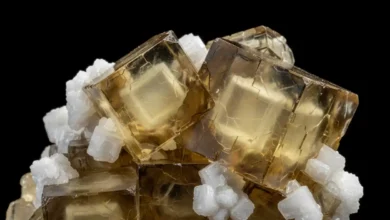

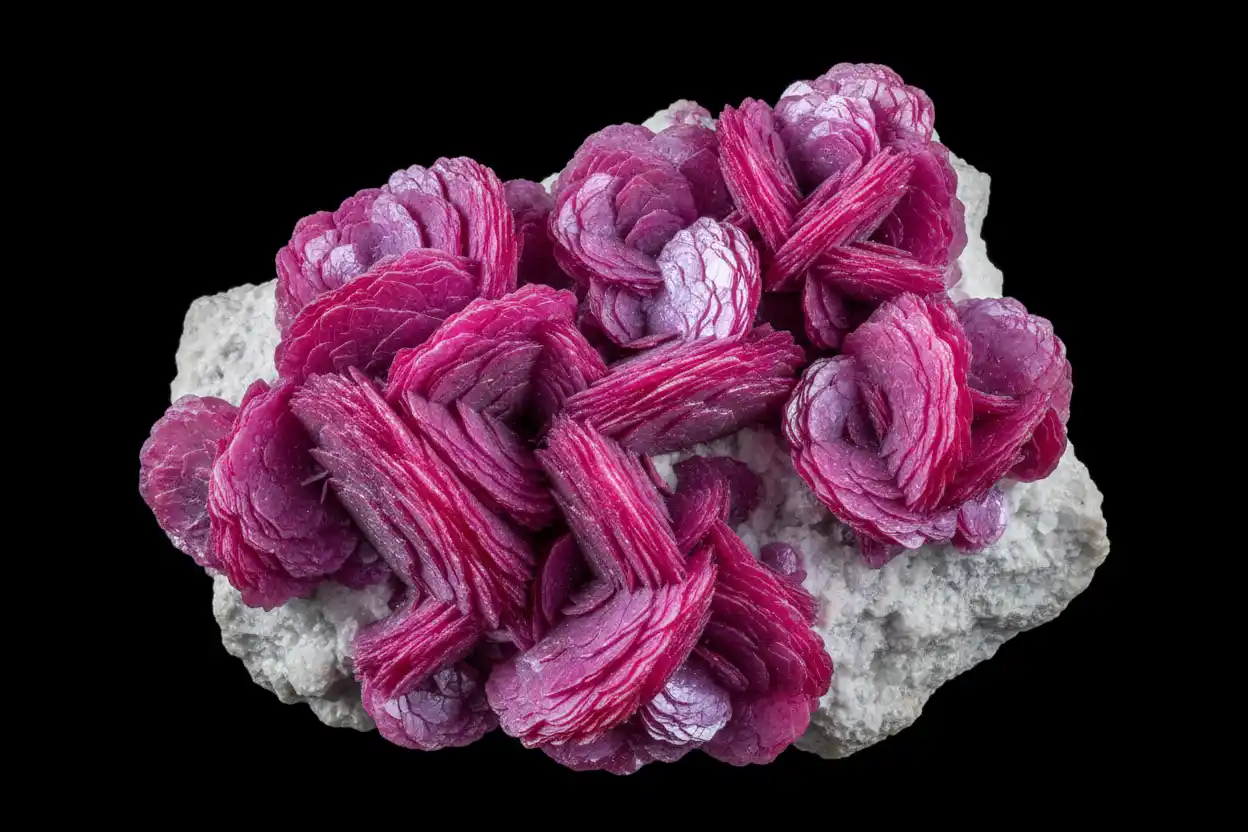

Kammererite is the purple, crimson, pink or violet chromium-bearing variety of clinochlore, a member of the chlorite mineral group. Its unusually saturated color makes it attractive to collectors, yet its softness and perfect basal cleavage limit most material to specimens, delicate cabochons and rare collector-cut gems.
Kammererite at a Glance
| Property | Kammererite Characteristics |
|---|---|
| Material type | Chromium-bearing variety of clinochlore |
| Composition | Approximately Mg₅(Al,Cr)₂Si₃O₁₀(OH)₈ |
| Colors | Pink, magenta, crimson, red violet, purple and violet |
| Crystal system | Monoclinic |
| Habit or texture | Tabular, pseudohexagonal, platy, micaceous, foliated and scaly aggregates |
| Luster | Vitreous to pearly |
| Transparency | Transparent to translucent |
| Mohs hardness | Approximately 2–2.5 |
| Cleavage | Perfect basal cleavage |
| Tenacity | Flexible in very thin flakes but generally fragile and easily separated |
| Common uses | Mineral specimens, collector cabochons, rare faceted gems and protected pendants |
| Main care concern | Extreme softness, perfect cleavage, acid sensitivity and fragile crystals on matrix |
What Is Kammererite?
Kammererite is not currently treated as a separate mineral species.
Instead, it is a chromium-bearing color variety of clinochlore, a magnesium-rich chlorite mineral.
Ordinary clinochlore commonly appears green, pale green, gray or colorless. When chromium substitutes for part of the aluminum in the structure, the mineral can develop pink, red, magenta and violet colors.
The variety name is also written kämmererite, with an umlaut, or kaemmererite in transliterated form.
Kammererite is distinct from the much rarer chromium-dominant chlorite species vakhrushevaite. A strongly purple color does not establish which phase is present; chemical analysis is necessary when exact species-level identification matters.
In normal gem and mineral trade, kammererite remains the accepted name for attractive chromium-bearing purple clinochlore.
Kammererite and the Chlorite Group
Chlorite minerals are sheet silicates with layered structures.
Their layers contain linked silica tetrahedra and magnesium- or aluminum-rich octahedral sheets. This arrangement creates easy separation parallel to the broad basal surface.
Clinochlore is one of the more common magnesium-rich chlorites. Kammererite represents a rare color expression within that larger family.
Seraphinite is another ornamental clinochlore variety. It normally shows deep-green color with silvery feather-like reflections, whereas kammererite is purple to crimson and generally lacks seraphinite’s wing-like sheen.
Both materials share low hardness and cleavage, so neither should be treated like a durable ring gemstone.
What Causes Kammererite’s Purple Color?
Chromium is the principal cause of kammererite’s color.
Cr³⁺ substitutes for aluminum in the clinochlore structure and absorbs parts of the visible spectrum. Depending on concentration, structural position, crystal thickness and associated elements, the remaining transmitted light appears pink, crimson, magenta or violet.
Thin crystals may look bright pink under transmitted light but dark purple against black chromite matrix.
Iron can modify the color toward brown, gray or muted red. Meanwhile, uneven chromium distribution may create zoning between pale pink and deep violet areas.
The color mechanism resembles chromium coloration in several green and red gems, although the host structure determines which wavelengths are absorbed and which color appears.
The material’s intense violet tones place it naturally among purple gemstones and purple crystals, but its durability differs sharply from amethyst or sapphire.
How Kammererite Forms
Kammererite forms in chromium-rich ultramafic geological environments.
The most favorable deposits begin with mantle-derived rocks containing olivine, pyroxene and chromite. Water-rich metamorphic or hydrothermal fluids alter the ultramafic rock and transform much of it into serpentine and chlorite minerals.
Chromium released from chromite or redistributed along fractures enters newly forming clinochlore. Under suitable conditions, the chromium concentration becomes high enough to create the characteristic purple color.
The mineral commonly occurs along fractures, cavities and reaction zones within chromitite and serpentinized ultramafic rock.
Associated minerals may include chromite, ordinary green clinochlore, serpentine, calcite, dolomite, diopside and chromium-rich garnets.
Fine green uvarovite garnet may occur in comparable chromium-rich environments, although it is much harder and belongs to an entirely different mineral group.
Crystal Habit and Appearance
Kammererite commonly forms thin tabular or pseudohexagonal crystals.
The broad faces reflect light with pearly or vitreous luster, while crystal edges may appear more transparent and brightly colored.
Some specimens show individual plates scattered over black chromite. Others contain dense coatings, radiating clusters or overlapping rosettes.
Well-formed crystals are usually small. Even a crystal measuring several millimeters can produce strong specimen value when it has vivid color, sharp shape and attractive contrast.
Because the plates cleave so readily, removing them from matrix often destroys their natural form. Consequently, a bright crystal group on chromite may be more valuable than loose rough of greater total weight.
Important Kammererite Localities
Kop Krom and Kop Mountains, Türkiye
Eastern Türkiye is the best-known source of vivid magenta and purple kammererite.
The Kop Krom mine and related chromite deposits in Erzurum Province have produced outstanding crystals on dark matrix. Fine Turkish specimens dominate the modern collector market.
The same regional name may be applied loosely to material from several workings, so mine-level provenance should come from reliable labels or established dealers.
Tokat, Türkiye
Chromite deposits in northern Anatolia have also produced purple chromium-bearing clinochlore suitable for specimen study and limited lapidary use.
Research on Turkish material confirms its low hardness, moderate density and chromium-related coloration.
Russia
The Ural region has produced kammererite and related chromium-bearing chlorite in serpentinite and chromite deposits.
Russian material can occur as purple scales, masses and occasional crystals.
Finland and Scandinavia
Chromium-bearing chlorites occur in ultramafic and chromite-bearing rocks across parts of Finland, Norway and Sweden.
However, not every occurrence produces material attractive enough for the gem market.
United States and Other Sources
Chromium-bearing clinochlore has been recorded in several ultramafic districts in the United States and elsewhere. Most occurrences remain mineralogical rather than commercial sources.
Kammererite vs Clinochlore
Kammererite is clinochlore distinguished by chromium and color.
Ordinary clinochlore is generally green or pale, while kammererite appears pink, magenta, crimson or violet.
Their structure, low hardness and perfect basal cleavage are closely related. Accordingly, color alone does not create a separate species.
A laboratory may report the material as chromium-bearing clinochlore rather than kammererite. That wording is more precise without denying the established variety name.
Kammererite vs Seraphinite
Seraphinite is usually green clinochlore with aligned reflective inclusions or cleavage-related textures that create silver feather-like patterns.
Kammererite instead relies on chromium-related purple color and often forms more distinct crystals.
Both are soft and cleavage-prone. Therefore, the difference lies mainly in appearance and trace chemistry rather than jewelry durability.
Kammererite vs Lepidolite
Lepidolite is a lithium-bearing mica that occurs in lilac, pink and purple masses.
Both minerals can split into thin flakes, but lepidolite commonly has a paler lavender color, pearly mica texture and pegmatite associations.
Kammererite is linked to chromite and serpentinized ultramafic rocks rather than lithium-rich pegmatites.
Chemical and spectroscopic testing separate them readily.
Kammererite vs Charoite and Sugilite
Charoite is a purple ornamental rock or complex silicate material known for swirling fibrous patterns. Sugilite is a harder purple cyclosilicate commonly cut into compact cabochons.
Kammererite usually forms platy crystals or scaly aggregates and is far softer than either material.
A durable, highly polished purple cabochon marketed as kammererite should therefore be examined carefully. It may be sugilite, charoite, dyed stone or a composite.
How to Identify Kammererite
Color provides an initial clue but cannot prove the variety.
The mineral’s low hardness is distinctive. Kammererite can be scratched easily by metal and may even mark under comparatively gentle contact.
Its perfect basal cleavage allows thin plates to separate parallel to the broad crystal face. However, destructive cleavage testing should never be attempted on a collectible specimen.
A refractometer may provide readings associated with clinochlore, while specific gravity commonly lies around the mid-2.6 range.
Under magnification, crystals often reveal layered growth, fine cleavage steps and color variations.
Raman spectroscopy and chemical analysis confirm clinochlore and detect chromium. The method described in how to identify crystals should therefore combine physical observation with instrumental confirmation.
Common Imitations and Mislabeling
Purple mica, dyed chlorite, lepidolite, charoite, sugilite, resin and coated mineral fragments may be sold as kammererite.
Dyed material may show pigment collecting along cleavage cracks and between flakes. Surface coating can produce an unnaturally even violet sheen.
Resin composites may contain crushed purple mineral in a molded base. Bubbles, seams and a plastic polish provide useful clues.
The broader warning signs in how to spot fake crystals apply, although inaccurate species naming is more common than sophisticated synthetic kammererite.
Is Kammererite a Gemstone?
Transparent pieces can be faceted, while compact material may be cut into cabochons.
However, gem cutting is difficult because the mineral has Mohs hardness around 2–2.5 and perfect cleavage. Facet edges abrade quickly, and pressure during polishing can separate layers.
Accordingly, faceted kammererite is primarily a collector novelty rather than a practical jewelry stone.
Protected pendants, brooches and earrings offer the most realistic wearable uses. Even then, the setting should prevent rubbing against metal, fabric fasteners or harder gems.
The wider rarest gemstones guide places kammererite within the collector-gem market, but rarity should not be confused with durability.
Hardness, Cleavage and Wear
Kammererite ranks only 2–2.5 on the gemstone hardness chart.
A fingernail may not scratch every surface readily, but metal, household dust and nearly all jewelry gems can damage it.
Perfect basal cleavage creates an additional weakness. The gemstone cleavage guide explains why layered minerals can split even when the external shape appears sound.
Furthermore, thin plates may bend slightly before separating, yet thicker crystals remain brittle.
The relationship covered in gemstone toughness versus hardness makes kammererite unsuitable for daily rings and exposed bracelets.
Treatments and Repairs
Most fine kammererite specimens are untreated.
Nevertheless, delicate crystals may be repaired, reattached to matrix or stabilized with clear adhesive. Thick coating can also protect a fragile surface, although it changes the natural luster and collector value.
Cabochons may contain resin where cleavage gaps or friable layers would otherwise break during polishing.
Dye and surface coloring are possible in low-grade material. Therefore, suspiciously uniform neon-purple pieces should be examined under magnification.
The treatment categories in gemstone treatments explained help separate limited repair from extensive reconstruction.
A repaired specimen can remain valuable when the work is minor and disclosed.
Kammererite Price and Value
Kammererite is usually sold as a mineral specimen rather than by standardized price per carat.
| Kammererite Material | Broad Current Asking Range |
|---|---|
| Tiny crystal fragment or low-grade piece | $10–$40 |
| Small Turkish specimen | $30–$120 |
| Better crystal group on matrix | $100–$350 |
| Fine vivid Turkish specimen | $300–$1,500+ |
| Opaque cabochon or polished piece | $10–$75 |
| Small faceted collector gem | $75–$300+ per stone |
Value rises with vivid magenta or violet color, sharp crystals, strong luster and dark contrasting chromite matrix.
Size alone matters less than crystal quality. A small sharp rosette can cost more than a large dull mass.
Damage, heavy glue, pale color, poor locality documentation and extensive resin reduce value. Thin crystals should also be checked for hidden cleavage breaks near the matrix contact.
Buying Kammererite
Request close photographs taken in neutral light.
The seller should identify the material as chromium-bearing clinochlore and provide a locality when known. “Purple chlorite” alone is too broad for a high-value specimen.
Examine whether crystals are naturally attached, re-glued or coated. Adhesive can sometimes be seen as a glossy meniscus around the base.
Faceted stones deserve particular caution because the market is extremely small. A recognized laboratory report is appropriate when the price depends on transparent kammererite identification.
The broader classification in types of gemstones helps distinguish a rare collector cut from a durable conventional jewelry gem.
Cleaning and Storage
Dry cleaning is safest for fine crystal specimens.
Use a hand-operated air blower and a very soft brush. Avoid pushing the brush against the edges of thin plates.
Compact untreated material may tolerate a brief gentle rinse, but acid, prolonged soaking and strong detergents should be avoided. The general crystal water-safety guide cannot account for fragile matrix, repairs and associated minerals.
Never use ultrasonic or steam cleaning. The cautions in gemstones and ultrasonic cleaners apply strongly because vibration can separate cleavage plates and detach crystals from matrix.
Store specimens in an individual padded box with no pressure on the crystal surface.
Kammererite Meaning and Symbolism
Kammererite has little documented ancient symbolism because it is rare, geographically restricted and not widely used in historical jewelry.
Modern interpretations connect its purple color with reflection, individuality and careful judgment.
Its layered structure can symbolize boundaries, while chromium transforming an ordinarily green chlorite into vivid purple may represent change produced by small but meaningful differences.
Some people associate kammererite with patience and appreciating delicate conditions. Those themes suit a material that must be handled slowly and protected from ordinary abrasion.
These meanings remain personal or contemporary cultural interpretations. Scientific evidence does not show that kammererite heals illness, affects consciousness or produces measurable spiritual energy.
Frequently Asked Questions About Kammererite
Is kammererite a separate mineral?
It is generally classified as the chromium-bearing purple variety of clinochlore rather than a separate mineral species.
What causes its purple color?
Chromium substituting within the clinochlore structure produces the pink, crimson and violet coloration.
Where does the best kammererite come from?
Eastern Türkiye, especially the Kop Krom and Kop Mountains chromite districts, is the best-known source of fine crystals.
Is kammererite the same as seraphinite?
No. Both are clinochlore varieties, but seraphinite is green with silver feather-like patterns, while kammererite is purple to crimson.
How hard is kammererite?
It ranks only about 2–2.5 on the Mohs scale.
Does kammererite have cleavage?
Yes. It has perfect basal cleavage and separates readily into plates.
Can kammererite be faceted?
Rare transparent material can be faceted, but the finished stones are delicate collector gems.
Is kammererite suitable for rings?
No practical daily-wear ring use is recommended. Protected pendants and display specimens are safer.
Can kammererite go in water?
Brief contact may be tolerated by compact untreated material, but dry cleaning is preferable for crystals, matrix specimens and repaired pieces.
Can it go in an ultrasonic cleaner?
No. Vibration can split cleavage plates and detach crystals.
Is synthetic kammererite common?
No significant commercial synthetic market exists. Misidentification, dye and resin are more realistic concerns.
What makes kammererite valuable?
Vivid color, crystal sharpness, luster, matrix contrast, condition, locality and limited repair determine value.
Kammererite belongs in both Crystals That Start With K and Gemstones That Start With K, although fine specimens remain more practical than jewelry.
Safety disclaimer: Avoid inhaling dust from kammererite, chromite or serpentinite matrix. Intact chromium-bearing clinochlore is handled as a collector mineral, but cutting and grinding can release fine silicate and chromium-bearing particles. Use wet methods, effective extraction, eye protection and appropriate respiratory protection.