
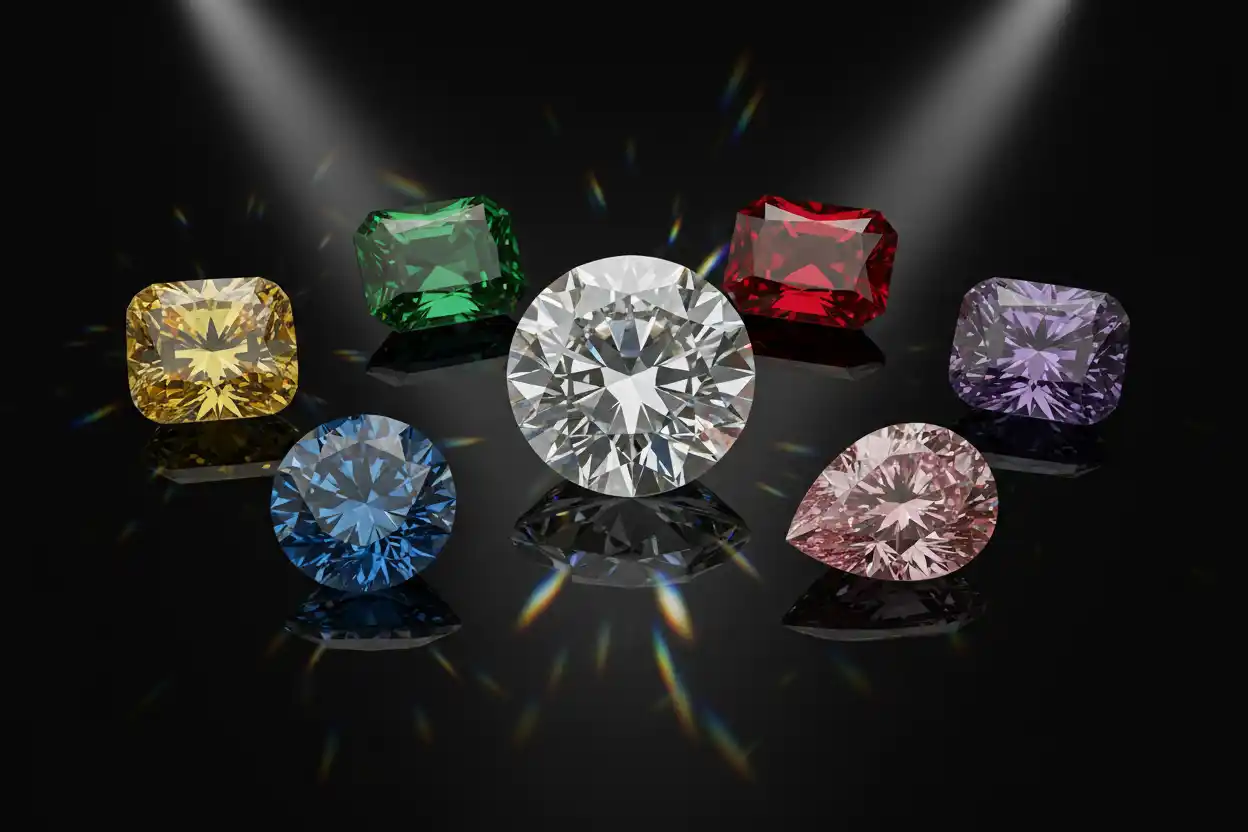

Laboratory-grown diamonds can be colorless, near colorless, yellow, brown, pink, red, blue, green, orange, gray or black. Their color comes from trace elements, atomic vacancies, structural distortion, growth conditions and post-growth treatment, while grading follows either the D–Z absence-of-color scale or a fancy-color system based on hue, tone and saturation.
Lab Diamond Colors at a Glance
| Color Category | Typical Cause or Grading Basis | Modern Symbolic Association |
|---|---|---|
| D–F colorless | Very low visible color from impurities or defects | Clarity, simplicity and precision |
| G–J near colorless | Slight warmth visible under controlled grading | Balance, practicality and understated elegance |
| K–Z warm range | Increasing yellow, brown or gray component | Warmth, individuality and deliberate choice |
| Fancy yellow | Nitrogen-related absorption, sometimes strengthened by treatment | Optimism, confidence and creativity |
| Pink or red | Nitrogen-vacancy centers, irradiation and annealing, or other defect engineering | Affection, individuality and expressive confidence |
| Blue | Boron, irradiation or selected defect-related processes | Perspective, calm expression and innovation |
| Green | Irradiation-created vacancies, combined blue and yellow absorption, or unusual defect centers | Renewal, curiosity and adaptability |
| Brown | Vacancy clusters, strain and growth-related defects | Stability, warmth and practical judgment |
| Gray | Boron, hydrogen-related defects, inclusions or combined absorption | Neutrality, modernity and restraint |
| Black | Dense inclusions, graphitic material, extreme defect concentration or treatment | Resolve, privacy and strong visual contrast |
Lab Diamond Color Uses Two Different Grading Systems
Colorless-to-light-yellow or light-brown diamonds are graded according to the D–Z scale.
D represents the highest absence of visible color, while increasing letters indicate progressively more yellow, brown or gray.
The broad visual groupings are colorless, near colorless, faint, very light and light. Individual laboratories may present exact letter grades or broader descriptive categories depending on the report service.
Fancy-color grading works in the opposite direction. Instead of rewarding the absence of color, it evaluates the presence and visual strength of a hue.
The grader considers hue, tone and saturation. Terms such as Fancy Light, Fancy, Fancy Intense, Fancy Vivid, Fancy Deep and Fancy Dark describe the combined effect of color strength and darkness.
The distinction is central to the diamond color meaning guide, which covers natural diamonds. Lab-grown material uses the same optical concepts but has different growth and treatment considerations.
Are Lab Diamond Colors Natural?
The word natural should be used carefully.
A laboratory-grown diamond is manufactured rather than mined. However, its color can be present as grown, created through post-growth treatment or produced by a combination of both.
An as-grown color develops while the crystal is forming inside an HPHT press or CVD reactor. Nitrogen, boron, growth defects and internal strain can become incorporated into the crystal during that stage.
A post-growth color results when an already-grown diamond undergoes high pressure and high temperature, irradiation, annealing or another process intended to alter atomic defects.
Both stones remain genuine diamond. Nevertheless, the grading report should disclose laboratory-grown origin and identify detectable post-growth treatment when the chosen report service includes that information.
The broader types of lab diamond guide compares HPHT, CVD, colorless and fancy-color products without treating color as the only classification factor.
Colorless Lab Diamonds
Colorless lab diamonds are generally graded D, E or F when a laboratory uses exact D–Z terminology.
These stones contain little visible yellow, brown or gray color under controlled grading conditions.
HPHT growth can produce colorless or near-colorless diamond when impurity incorporation is managed carefully. Modern CVD growth can also create high-color material, although some CVD crystals are brown when removed from the reactor and later undergo HPHT annealing to improve their grade.
Colorless does not mean chemically perfect. A D-color stone can still contain trace elements and optical defects detectable through spectroscopy.
Likewise, color grade does not determine brilliance by itself. Cut quality controls how effectively the diamond returns light, while clarity affects the visibility of inclusions.
Modern symbolism connects colorless lab diamonds with precision, openness and intentional simplicity.
Their clean appearance makes them central to the white gemstones market, although they differ from white sapphire, moissanite and cubic zirconia in optical and physical properties.
Near-Colorless Lab Diamonds
The G–J range contains slight body color that becomes most visible from the side, against a white comparison surface or beside a higher-color diamond.
Face-up, a well-cut G, H or I diamond can appear colorless in many settings. Yellow or rose gold can also make modest warmth less noticeable.
Near-colorless grades often provide better visual value than paying a premium for a difference that is difficult to see after mounting.
The wearer’s sensitivity to warmth, the diamond’s size, shape and setting metal all matter.
Step cuts reveal body color more readily because their broad facets allow longer light paths. Round brilliant cuts can disguise some warmth through strong light return.
Modern symbolism associates near-colorless lab diamonds with balance, practicality and appreciating quality without chasing an invisible specification.
Warm D–Z Lab Diamond Colors
K–Z diamonds show increasingly visible yellow, brown or gray.
These colors are graded for their position within the normal D–Z range until they become strong enough or sufficiently distinct to qualify for colored-diamond terminology.
Warm lab diamonds can offer excellent size and clarity for the price. Their cream, champagne or pale-yellow appearance may also suit vintage and antique-inspired jewelry.
A warm grade should not be hidden through misleading photography. Sellers should show the diamond against a neutral background and identify its report grade clearly.
Modern meanings emphasize individuality, comfort and choosing a distinctive appearance rather than treating every trace of color as a flaw.
The brown gemstones guide provides broader context for champagne and cognac tones, while yellow gemstones covers warmer stones that display color intentionally.
Yellow Lab Diamonds
Nitrogen is the principal cause of yellow color in diamond.
When nitrogen substitutes for carbon or forms particular defect arrangements, it absorbs blue light and allows yellow wavelengths to dominate.
HPHT growth frequently uses nitrogen deliberately to produce yellow diamonds. CVD-grown material can also show yellow when nitrogen-related centers are present.
Post-growth treatment may alter the distribution and charge state of nitrogen-related defects, strengthening or changing the visible hue.
Fancy-yellow lab diamonds are cut to intensify face-up color. Radiant, cushion, oval and pear shapes can retain light within the stone longer than some traditional colorless-diamond proportions.
Modern symbolism associates yellow lab diamonds with optimism, confidence and creative energy.
Unlike natural fancy-yellow diamonds, their color does not carry geological rarity. Value comes from appearance, grading, cutting and manufacturing quality rather than natural scarcity.
Pink and Red Lab Diamonds
Pink and red colors can be created through defect engineering involving irradiation, annealing and nitrogen-vacancy centers.
CVD diamonds containing suitable nitrogen can develop pink-to-red color after post-growth processing. Some stones may also show pinkish brown, purplish pink or orange-pink modifiers.
Pure red remains less common in the commercial lab-grown market than pink. However, laboratory production makes saturated red and pink substantially more accessible than equivalent natural-color diamonds.
Color distribution deserves careful examination. Some diamonds display growth-sector zoning, bands or uneven concentrations that become obvious through the table.
Modern symbolism connects pink with affection, empathy and personal expression. Red commonly represents conviction, intensity and courage.
These meanings are contemporary interpretations rather than traditions inherited from ancient lab-grown jewelry.
The pink gemstones and red gemstones guides help compare colored lab diamonds with sapphire, spinel, ruby and tourmaline.
Blue Lab Diamonds
Blue lab diamonds may owe their color to boron or to post-growth irradiation.
Boron substitutes for carbon and creates type IIb diamond. It absorbs selected wavelengths and can produce blue-to-gray-blue color. Boron-bearing HPHT stones may also show electrical conductivity and phosphorescence.
Irradiation can create blue or blue-green vacancy-related color in other lab diamonds. Consequently, two visually similar blue stones may have different color mechanisms.
A faint unwanted blue modifier in a nominally colorless HPHT diamond is sometimes called blue nuance. It may affect market preference even when the formal color grade remains high.
Fancy-blue diamonds should have a report that states laboratory-grown origin, color description and detectable treatment.
Modern symbolism associates blue with calm communication, perspective and technological innovation.
The blue gemstones guide compares blue lab diamond with sapphire, topaz, zircon and tourmaline.
Green Lab Diamonds
Green lab diamonds can form through irradiation, combined absorption mechanisms or unusual defect centers.
Irradiation creates vacancies where carbon atoms are displaced from their normal lattice positions. These vacancies absorb particular wavelengths and may produce green or blue-green color.
Some stones combine yellow nitrogen-related absorption with blue or blue-green defect absorption, creating a green face-up result.
Laboratories have also documented unusual CVD stones whose greenish color involves silicon-vacancy and nitrogen-related centers after HPHT processing.
Because several mechanisms can create green, the report’s treatment statement matters more than a seller’s simplified description.
Modern symbolism connects green lab diamonds with adaptation, renewal and curiosity.
The green gemstones guide provides comparisons with emerald, tourmaline, sapphire and garnet.
Brown and Champagne Lab Diamonds
Brown is common in as-grown CVD diamond because vacancy clusters, dislocations and structural distortion absorb visible light.
Manufacturers frequently use post-growth HPHT annealing to break up or reorganize those defects and improve the diamond toward a colorless or near-colorless grade.
Not every brown lab diamond is treated away. Some remain intentionally champagne, cognac or brown and are cut for their warm appearance.
Brown stones may show gray, pink, orange or yellow modifiers.
Modern symbolism connects brown lab diamonds with steadiness, warmth and practical confidence.
The color should be evaluated face-up because deep cuts can concentrate brown and produce a darker result than the report description suggests.
Gray Lab Diamonds
Gray may come from boron, hydrogen-related defects, metallic inclusions, graphite or combined broad absorption.
Some stones lean blue gray, green gray or brown gray. Others have a neutral steel-like appearance.
Gray diamonds can fit minimalist, industrial and gender-neutral jewelry styles. Their market value depends more on beauty and evenness than on a conventional desire for colorlessness.
Modern symbolism emphasizes restraint, objectivity and comfort with ambiguity.
Sellers should not use the word salt-and-pepper for every gray lab diamond. That term normally refers to visible dark and light inclusions rather than body color alone.
Black Lab Diamonds
Black lab diamonds may contain dense graphitic inclusions or extensive defects that absorb most visible light.
Treatment can also create black or near-black appearance through irradiation, heating or modification of highly included material.
A faceted black diamond reflects light from its surface rather than returning bright internal brilliance in the manner of a transparent colorless diamond.
Clarity grades become less visually useful when opacity hides the interior. Polish, symmetry, surface condition and even blackness matter more.
Modern symbolism connects black lab diamonds with resolve, privacy and strong visual contrast.
The black gemstones guide compares them with spinel, onyx and black sapphire.
Lab Diamond Color Zoning
HPHT-grown diamonds can show geometric zones because nitrogen, boron and other impurities enter separate growth sectors at different rates.
CVD-grown diamonds develop in layers and may show vertical growth striations, brown bands, pink zones or changes associated with pauses in growth.
Color zoning is not automatically a defect. In a fancy-colored stone, attractive zoning can add character. However, an uneven face-up appearance usually lowers desirability.
Advanced fluorescence imaging reveals growth structures that remain invisible under ordinary light and helps laboratories distinguish HPHT, CVD and natural origin.
A buyer should judge the visible result before becoming concerned with microscopic patterns that do not affect appearance.
Color Treatments and Disclosure
Post-growth HPHT annealing commonly reduces brown coloration in CVD-grown diamonds and can improve the apparent D–Z grade.
Irradiation and annealing can create or modify blue, green, pink, red and yellow colors.
Some treatment sequences are permanent under normal jewelry conditions, but disclosure remains necessary because the treatment affects the stone’s history and market comparison.
Coatings are a separate concern. A surface film can modify color but may scratch or change under heat and chemicals.
The treated diamond guide provides the appropriate framework for distinguishing permanent lattice modification from less stable surface enhancement.
The lab-grown versus natural gemstones page also explains why growth origin and treatment status answer separate questions.
How Color Affects Lab Diamond Price
Lab diamond prices change rapidly as production technology, wholesale supply and retailer margins evolve.
| Lab Diamond Category | Broad Current Loose-Stone Asking Range |
|---|---|
| 0.25–0.75 ct fancy-color stone | Approximately $100–$600 |
| About 1 ct colorless or near-colorless diamond | Approximately $450–$1,500 |
| About 1 ct fancy yellow, blue or green diamond | Approximately $300–$1,500 |
| About 1–2 ct pink, red or purple lab diamond | Approximately $800–$4,000+ |
| About 2–3 ct colorless or near-colorless diamond | Approximately $1,500–$6,000+ |
| Exceptional large, vivid or precision-cut colored diamond | Priced individually and potentially higher |
These ranges exclude settings and finished-jewelry markups.
Unlike natural fancy colors, lab-grown pink, blue or yellow diamonds do not receive extreme rarity premiums merely because of hue. Manufacturers can reproduce color through controlled growth and treatment.
However, saturated color, even distribution, attractive modifiers, strong cut and independent grading still affect price.
The lab diamond price guide should own detailed size and current market comparisons.
Buying a Lab Diamond by Color
The lab diamond buying guide provides the complete purchase framework.
Verify that the report matches the laser inscription, weight, shape and dimensions of the exact stone. Counterfeit or mismatched inscriptions have occurred, so the report number alone is insufficient.
For D–Z diamonds, prioritize cut before paying for a color difference that may be invisible after setting.
For fancy-color stones, judge hue, tone, saturation and distribution. A Fancy Vivid grade is not automatically more attractive than a balanced Fancy Intense stone with better brightness.
Colored diamonds should be viewed in video because face-up color changes with tilt and lighting.
The lab diamond engagement-ring guide can help coordinate color with white, yellow or rose-gold settings.
Lab Diamond Color and Meaning
A lab-grown diamond has the same optical interaction with light as natural diamond, but its symbolic history is modern.
Colorless stones often represent clarity, commitment and deliberate choice. Yellow can symbolize optimism, while pink suggests affection and individuality. Blue may represent perspective, green adaptability, brown steadiness and black resolve.
These meanings do not come from ancient lab-diamond traditions because commercial laboratory-grown jewelry is recent.
Furthermore, symbolism should not be confused with physical effects. No scientific evidence shows that a lab-grown diamond changes luck, relationships, health or emotional state.
The meaning comes from the wearer, the design, the occasion and the choices made during purchase.
Frequently Asked Questions About Lab Diamond Colors
Do lab diamonds use the same color grades as natural diamonds?
They can be evaluated using the same D–Z and fancy-color principles, although report format and terminology vary by laboratory and service.
What is the best color grade for a lab diamond?
There is no universal best grade. D–F offers the least visible color, while G–H often provides a strong balance between appearance and price.
Are fancy-colored lab diamonds real diamonds?
Yes. They have a diamond crystal structure and carbon composition, but their laboratory origin and any treatment must be disclosed.
What causes yellow lab diamonds?
Nitrogen-related defects absorb blue light and produce yellow.
What causes pink lab diamonds?
Nitrogen-vacancy centers and treatment sequences involving irradiation and annealing commonly produce pink or red color.
What causes blue lab diamonds?
Boron can create blue as-grown material, while irradiation can also produce blue or blue-green.
Are green lab diamonds always irradiated?
Many are, but combined defect centers and unusual growth chemistry can also produce greenish color. A laboratory report provides the best explanation available.
What causes brown color in CVD diamonds?
Vacancy clusters, strain and growth-related structural defects commonly create brown coloration.
Is a D-color lab diamond visibly better than G color?
Often not after mounting, particularly in a well-cut round diamond. Size, shape, setting metal and individual color sensitivity affect the difference.
Are colored lab diamonds more valuable than colorless ones?
Not automatically. Their price depends on size, intensity, cut, treatment, demand and retailer margin rather than natural geological rarity.
Can lab diamond color fade?
Properly produced lattice color is generally stable under normal wear. Surface coatings and some unusual treatments require greater caution.
Should a colored lab diamond have a grading report?
Yes. The report should confirm laboratory-grown origin, describe color and state detectable post-growth treatment when that report service includes it.
A professional report and instrument-based testing remain more reliable than home checks from the real versus fake diamond guide. The lab diamond versus moissanite and moissanite versus diamond comparison explain why visual similarity does not make a simulant a lab-grown diamond.
Lab diamond colors appear within the Crystals That Start With L and Gemstones That Start With L directories.