
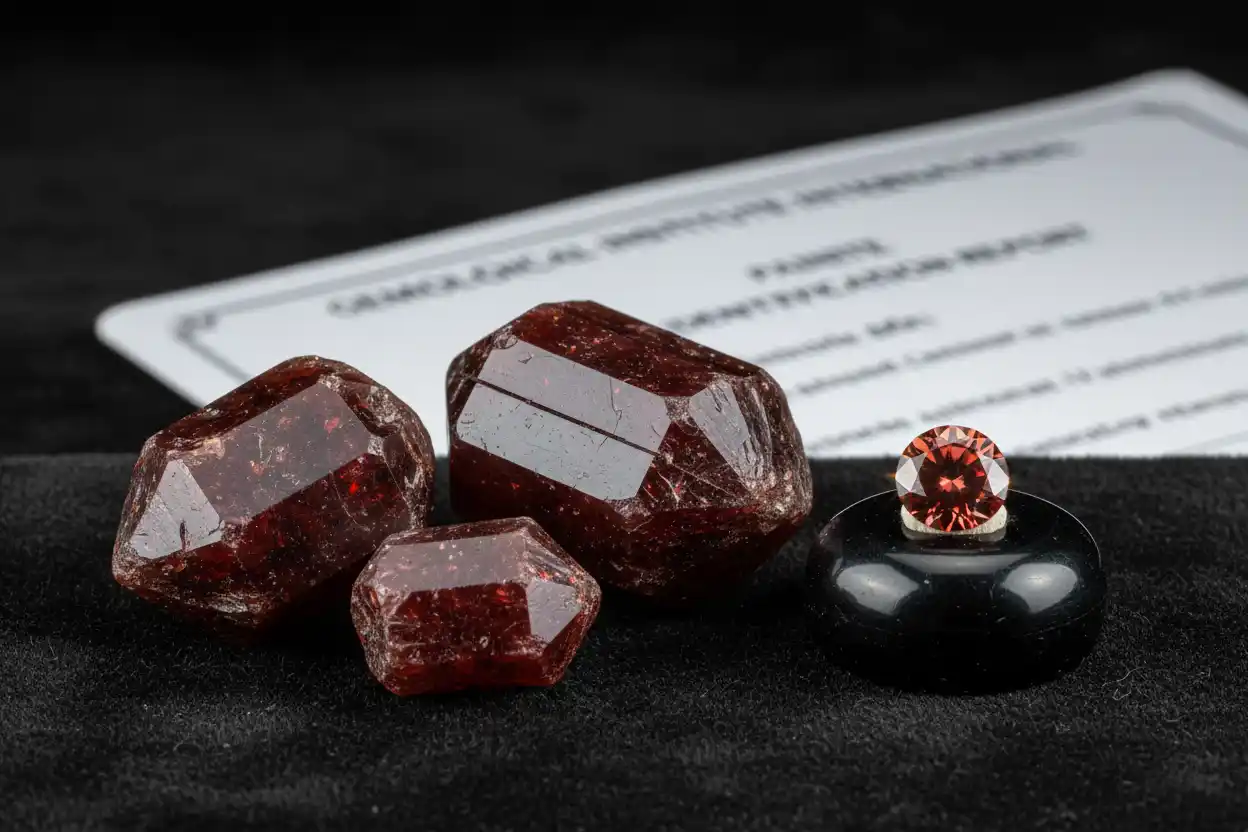

Painite is a rare calcium-zirconium aluminum borate mineral known for red, orange-red, brownish-red, and deep garnet-brown crystals. Transparent pieces can be faceted, although most recovered material is fractured, included, opaque, or better preserved as a mineral specimen.
For decades, painite was represented by only a handful of known crystals and became famous as one of the world’s rarest minerals. Additional Myanmar deposits have since produced considerably more material, but clean facet-grade crystals remain exceptionally scarce.
Painite at a Glance
| Property | Painite |
|---|---|
| Material type | Rare borate mineral and collector gemstone |
| Composition | CaZrAl₉O₁₅(BO₃), also written CaZrB[Al₉O₁₈] |
| Common colors | Red, orange-red, brownish red, reddish brown, dark brown, and deep garnet red |
| Crystal system | Hexagonal |
| Typical habit | Elongated prismatic, pseudo-orthorhombic, striated, embedded, fragmented, or water-worn crystals |
| Luster | Vitreous |
| Transparency | Transparent to opaque |
| Mohs hardness | Approximately 7.5–8 |
| Cleavage | None reported as a significant property |
| Tenacity | Brittle |
| Fracture | Uneven to conchoidal |
| Specific gravity | Approximately 4.0 |
| Optical character | Uniaxial negative with strong birefringence and dichroism |
| Common uses | Rare-mineral collections, scientific specimens, faceted collector gems, and occasional bespoke jewelry |
| Main care concern | Misidentification, edge chipping, fractures, loss of provenance, and damage to irreplaceable material |
What Painite Is
Painite is a formally recognized mineral species rather than a trade name or variety of another gem.
Its unusual chemistry combines calcium, zirconium, boron, aluminum, and oxygen. The idealized formula can be written in more than one structurally equivalent form, including CaZrAl₉O₁₅(BO₃) and CaZrB[Al₉O₁₈].
Trace chromium, vanadium, iron, titanium, and other elements may substitute into natural crystals. Chromium and vanadium contribute significantly to the familiar red-to-brown color range.
Painite belongs to the borate mineral class, but its high aluminum content and dense oxide-like structure give it physical properties unlike softer or more soluble decorative borates.
The mineral’s status within the wider gem market is best understood through the distinction among minerals, rocks, organic materials, and manufactured products in the types of gemstones guide.
Discovery and Naming
British gem collector and mineralogist Arthur Charles Davy Pain acquired the first recognized specimen from the Mogok region of Myanmar during the early 1950s.
The crystal initially resembled ruby or another dense reddish gem. Detailed testing showed that its chemistry and structure did not match any recognized mineral.
Scientists formally described the new species in 1957 and named it painite in Arthur Pain’s honor.
Only two crystals were known for many years. A third specimen was identified later, and additional pieces appeared gradually through the closing years of the twentieth century.
New discoveries around Mogok during the early 2000s changed the rarity narrative. Prospecting exposed additional painite occurrences and yielded thousands of crystals, fragments, and included masses.
Nevertheless, most new material did not possess the transparency, cleanliness, size, and structural integrity needed for fine faceting. Painite became less scarce as a mineral specimen without becoming common as a high-quality gemstone.
Why Painite Became Famous for Rarity
Painite’s early reputation resulted from the extraordinary gap between its discovery and the recognition of additional deposits.
For decades, major museums and researchers could account for only a few specimens. This extreme scarcity led record books and gem publications to describe painite as the world’s rarest gemstone or mineral.
That absolute label is no longer reliable. Mineral rarity changes when new localities are discovered, old specimens are reanalyzed, or newly approved species remain represented by one or two samples.
Painite is still rare, especially in transparent facetable quality, but it should not be promoted automatically as the single rarest mineral known to science.
Its more defensible position is among the specialist materials discussed in the world’s rarest gemstones.
Musgravite, taaffeite, and serendibite occupy similarly thin collector markets, although their chemistry, localities, appearance, and available quantities differ.
Painite’s Crystal Structure
Modern structural analysis places painite in the hexagonal crystal system.
Its crystals can look elongated, tabular, or pseudo-orthorhombic because their visible faces and striations do not always emphasize a simple six-sided outline.
Earlier descriptions sometimes created confusion over its symmetry. Improved single-crystal X-ray diffraction established a hexagonal structure more accurately.
Painite is optically uniaxial negative. It also has substantial birefringence, meaning light traveling through different crystallographic directions separates into rays with noticeably different refractive indices.
Strong dichroism may produce red in one viewing direction and paler brownish-orange or red-orange in another.
A cutter must consider that directional color when orienting transparent rough. The chosen direction affects saturation, darkness, face-up hue, and weight retention.
Color and Pleochroism
Painite typically appears orange-red, brownish red, deep red-brown, or garnet red.
Dark crystals may look almost black in ordinary reflected light but reveal reddish translucency around thin edges or under strong illumination.
Chromium and vanadium contribute to red and orange-red absorption. Iron and other trace elements can deepen or brown the color.
Pleochroism changes the apparent hue with crystal direction. Consequently, a transparent stone may show ruby red along one axis and lighter orange-brown from another.
The most attractive color is not necessarily the darkest. A very deep stone can suffer from extinction and appear nearly opaque after faceting.
Collectors often value crystals that show both strong bodycolor and enough transmitted light to reveal their internal structure.
Geological Occurrence in Myanmar
Confirmed painite localities are concentrated in Myanmar, particularly within and around the Mogok gem region.
The original material came from gem gravels near Ohngaing. Additional occurrences include Wet Loo, Hinthar Hill, and related sites in the broader Mogok mining district.
Painite occurs within a complex metamorphic and granitic gem terrain containing marble, leucogranite, pegmatitic rocks, and weathered deposits.
Many specimens entered the market from secondary gravels or deeply weathered material. Such crystals may be rounded, iron stained, fractured, or partly enclosed by alteration products.
Primary occurrences have also yielded painite attached to or intergrown with ruby-bearing material and associated rocks.
The mineral is found with corundum, spinel, phlogopite, zircon, and other minerals characteristic of the Mogok gem belt.
A seller who claims a completely different country of origin should provide strong analytical and locality evidence. At present, Myanmar provenance remains fundamental to painite’s recognized geological identity.
Painite with Ruby and Corundum
Painite and ruby can appear together in the same specimen.
The high aluminum content of the geological environment supports both painite and corundum formation, although their structures and full chemical requirements differ.
Red corundum can surround painite, grow against it, or form visually similar areas within weathered material.
This association makes painite identification more difficult. An attractive red specimen may contain more ruby than painite, while a commercial seller may label an entire mixed rock according to its rarest component.
The parent ruby guide explains corundum’s aluminum-oxide composition and chromium-related red color.
Painite also resembles spinel and certain dark sapphires in rough or water-worn form, but those minerals have different crystal structures, optical behavior, density, and chemistry.
How Laboratories Identify Painite
Painite should not be identified through color alone. Its red-brown appearance overlaps ruby, sapphire, spinel, garnet, zircon, tourmaline, glass, and several rare minerals.
Refractive-index testing provides an important clue. Painite has high refractive indices, with a large difference between its ordinary and extraordinary rays.
Specific gravity near 4.0 also separates it from many red gems, although zircon and some garnets can overlap in density.
A polariscope can reveal uniaxial behavior when the stone’s cut, transparency, and condition permit observation.
Spectroscopy may detect chromium-, vanadium-, and iron-related absorption features. However, those elements occur in many red minerals and do not establish painite independently.
Raman spectroscopy provides a stronger mineral fingerprint. X-ray diffraction confirms crystal structure, while chemical analysis can detect calcium, zirconium, aluminum, boron-related composition, and trace elements.
Because boron is a light element, not every routine elemental instrument measures it effectively. A laboratory must interpret the complete data rather than relying on one handheld reading.
The broader methodology in how to identify crystals explains why several independent observations must agree.
Painite Lookalikes
Ruby is one of the most obvious lookalikes because both can occur in Myanmar and display chromium-related red color.
Ruby is harder, belongs to the trigonal corundum structure, and has lower density and different refractive properties.
Spinel commonly forms red, brown-red, or purple-red crystals in Mogok gravels. It is singly refractive and cubic, which separates it from painite under laboratory testing.
Garnets can look remarkably similar after faceting. They are singly refractive and generally lack painite’s strong dichroism and birefringence.
Red zircon overlaps painite’s high density and strong optical behavior but has different dispersion, inclusions, chemistry, and spectra.
Brown tourmaline, dark topaz, glass, synthetic corundum, and synthetic spinel may also be mislabeled.
Extremely large, clean, cheap “painite” stones sold with generic laminated certificates are particularly suspicious. Warning signs of renamed common gems and fabricated reports appear in how to spot fake crystals.
Is Painite Suitable for Jewelry?
Painite’s hardness of approximately 7.5–8 gives it useful resistance to ordinary scratches.
It ranks above quartz and most feldspars on the gemstone hardness chart.
However, the mineral remains brittle. A sharp impact can chip facet junctions, points, or a thin girdle.
The distinction between surface hardness and resistance to breakage is explained in gemstone toughness versus hardness.
Rarity creates another practical limitation. Replacing a documented painite of matching size, color, and shape may be impossible.
For that reason, loose collection storage, pendants, earrings, brooches, and protected occasional-wear rings are more sensible than an exposed everyday setting.
A bezel or halo can reduce edge exposure, although setting pressure must remain controlled. Any fracture reaching the girdle should be evaluated before mounting.
The laboratory report, photographs, measurements, weight, and provenance should remain with the gem throughout its life.
Treatments and Synthetic Painite
No routine treatment defines painite’s appearance. Fine stones are valued for their natural color and mineral rarity.
Fracture filling, coating, oiling, dyeing, or surface repair remain possible in principle, particularly when an imitation or low-grade fragment is being misrepresented.
A transparent filler could reduce the visibility of cracks, while a dark coating could strengthen bodycolor. Both would require disclosure.
Laboratory synthesis has produced complex borate and related research materials, but synthetic painite is not a normal mass-market jewelry product.
The more realistic market risk is substitution. Sellers can label inexpensive garnet, spinel, zircon, corundum, tourmaline, or glass as painite and attach an unverifiable certificate.
A respected independent laboratory should examine any faceted stone whose value depends on painite identity.
The differences among filling, coating, dyeing, heating, and laboratory growth are covered in gemstone treatments explained.
Current Painite Asking Prices
Painite does not have a stable, liquid price structure. Verified transactions are infrequent, and much of the material listed online under the name is doubtful.
| Painite product | Broad retail asking context |
|---|---|
| Tiny confirmed crystal or fragment | About $100–$1,000 |
| Small documented specimen with visible crystal form | About $500–$5,000 |
| Larger aesthetic or associated specimen | Several thousand dollars or more |
| Small documented faceted stone below about 0.25 ct | Commonly several thousand dollars total |
| Fine transparent faceted material | Frequently promoted from about $10,000 to $60,000 per carat or more |
| Exceptional large documented gemstone | Individually negotiated with too few comparables for a dependable range |
These figures are broad July 2026 asking contexts rather than appraisals or guaranteed transaction values.
Published per-carat claims often repeat from one website to another without identifying an actual comparable gem. Meanwhile, marketplace listings may offer supposed multi-carat painites for the price of ordinary glass.
Detailed price segmentation belongs on the dedicated painite price guide.
What Gives Painite Value?
Correct identification comes first. A rare-looking red stone without a credible laboratory report cannot support a painite-level valuation.
Transparency matters because most recovered crystals are opaque, heavily included, weathered, or fractured.
Color influences appeal. Strong red, orange-red, or garnet-red material generally attracts more interest than dull brown, provided it does not become excessively dark.
Size has a disproportionate effect. Transparent rough large enough to produce a clean faceted gem remains extraordinarily scarce.
Cut quality affects brightness, pleochroic orientation, extinction, symmetry, weight retention, and edge durability.
Mineral specimens are judged differently. Crystal completeness, termination, striations, associated ruby, matrix, locality, and condition may matter more than transparency.
Provenance also influences confidence. An old collection label, mine record, laboratory analysis, or documented Mogok acquisition can materially affect value.
Repair, filling, chips, limonite-filled cracks, and detached matrix should be disclosed.
Buying Painite
Begin with the laboratory report rather than the seller’s rarity story.
The report should identify the material as natural painite and list weight and measurements matching the offered stone. A photograph or identifying plot is especially useful.
Verify the report directly with the issuing laboratory when a report-check service exists.
An in-house seller certificate provides limited protection unless the laboratory operates independently and has recognized expertise in rare minerals.
Ask for magnified videos under transmitted and reflected light. These can reveal fractures, dark extinction, inclusions, surface damage, and pleochroism.
For mineral specimens, request exact locality wording, crystal dimensions, repair disclosure, and photographs of every side.
Avoid pressure-based claims that the stone must be purchased immediately because no other painite exists. Fine material is rare, but urgency does not replace due diligence.
The dedicated painite buying guide owns laboratory selection, seller verification, transaction safeguards, and return-policy checks.
Painite is indexed through the crystals beginning with P directory and the gemstones beginning with P directory.
Cleaning and Storage
Clean an intact loose gemstone with lukewarm water, mild soap, and a soft brush. Rinse carefully and dry it with a lint-free cloth.
Avoid steam and ultrasonic cleaning unless a qualified gemologist has confirmed that the stone has no dangerous fractures, repairs, coatings, or fillings.
Store the gem in a padded compartment away from diamond, ruby, sapphire, topaz, and other hard materials.
Specimens should be supported by their strongest matrix or base rather than by a projecting painite crystal.
Keep the laboratory report, purchase record, locality label, weight, dimensions, and photographs together. Losing documentation can reduce market confidence even when the gem itself remains unchanged.
A mounted piece should receive periodic setting inspection from a jeweler familiar with rare colored stones.
Painite Meaning and Symbolism
Painite has little established historical gemstone folklore because scientists recognized it only during the twentieth century and very little material entered jewelry.
Modern symbolism commonly connects it with perseverance, rarity, discernment, and recognizing value that is not immediately visible.
Its long period of extreme scarcity can represent patience and the possibility that additional information may overturn an accepted conclusion.
The difficulty of distinguishing it from ruby, spinel, and garnet also supports themes of careful examination and refusing to judge identity from surface appearance.
These meanings remain modern, artistic, personal, or spiritual interpretations. Scientific evidence does not show that painite treats illness, removes pain, changes luck, or produces guaranteed emotional effects.
Frequently Asked Questions
Is painite still the rarest gemstone in the world?
It remains exceptionally rare in fine gem quality, but the absolute title is outdated because new painite deposits and many extremely rare mineral species have since been documented.
What is painite made from?
Its ideal composition is CaZrAl₉O₁₅(BO₃), containing calcium, zirconium, aluminum, boron, and oxygen.
Is painite hexagonal or orthorhombic?
Modern structural analysis classifies painite as hexagonal. Its elongated crystals can look pseudo-orthorhombic externally.
Where is genuine painite found?
Confirmed occurrences are concentrated in Myanmar, particularly the Mogok gem region and related localities such as Ohngaing and Wet Loo.
Why is painite red?
Chromium and vanadium contribute much of its red-to-orange-red color, while iron and other trace elements can deepen brown tones.
Is painite harder than ruby?
No. Painite is approximately 7.5–8 on the Mohs scale, while ruby has a hardness of 9.
Can painite occur with ruby?
Yes. Painite has been found associated or intergrown with ruby-bearing material in the Mogok region.
How do laboratories confirm painite?
They combine refractive index, birefringence, density, spectroscopy, Raman analysis, X-ray diffraction, and chemical testing.
Is synthetic painite common?
No. Commercial jewelry markets do not have a significant supply of synthetic painite. Misidentified common gems are a more realistic concern.
Can painite be worn in a ring?
A documented sound gem can be set in a protected occasional-wear ring, but brittleness, rarity, and replacement difficulty make lower-impact jewelry safer.
Why are cheap multi-carat painite listings suspicious?
Transparent large painite is exceptionally scarce. Very low prices, vague certificates, and mass-produced cuts usually indicate misidentification or imitation.
What makes painite valuable?
Laboratory-confirmed identity, transparency, red color, size, cut, condition, crystal form, Myanmar provenance, and complete documentation all influence value.
Painite belongs to the rare-gem market in which a report and provenance can matter as much as visible beauty. Its place among high-value collector stones can be compared with the materials discussed in the most expensive gemstone guide.
Cutting, grinding, or crushing painite can generate fine borate- and oxide-mineral dust. Preserve valuable material intact whenever possible and use professional wet methods, effective extraction, eye protection, and suitable respiratory protection if preparation is necessary.