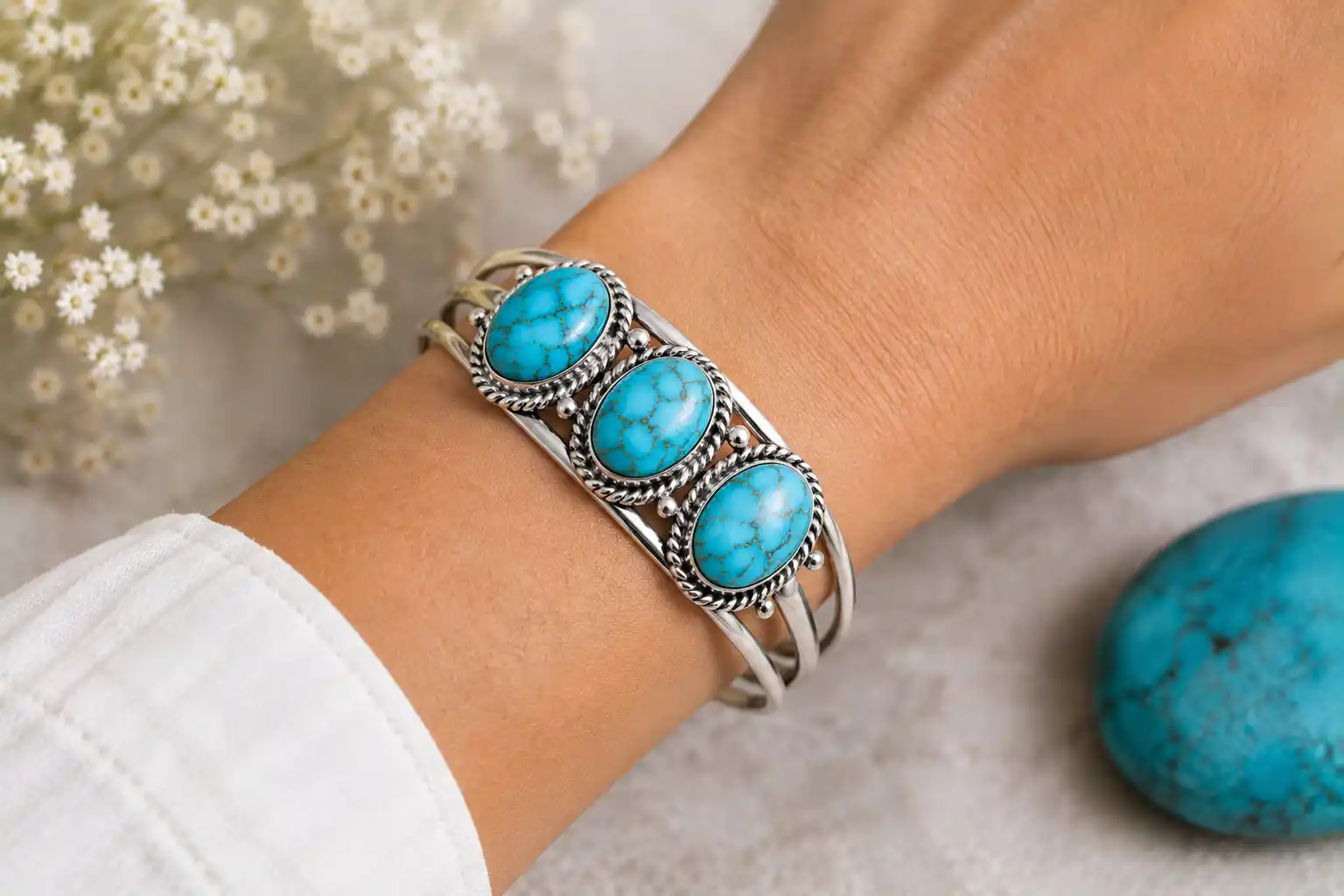
Turquoise Bracelets: How to Choose and Wear
Turquoise bracelets can feature polished blue beads, green matrix-rich cabochons, silver-set clusters, mosaic inlay or one understated station along a chain. Because Turquoise is opaque, its beauty comes from body color, matrix pattern, polish and craftsmanship rather than transparency or faceting.
The gemstone also requires more care than its sturdy appearance suggests. Turquoise ranks only about 5–6 on the Mohs scale and is often porous. Skin oil, lotion, perfume, heat and chemicals can alter untreated material, while dye, wax, resin and stabilization create additional care considerations.
A good bracelet should therefore be judged as both gemstone jewelry and a constructed object. Accurate treatment disclosure, secure settings, smooth drill holes, reliable stringing, respectful maker attribution and comfortable fit all matter.
Turquoise Bracelets at a Glance
| Feature | What to Consider |
|---|---|
| Mineral | Turquoise |
| Composition | Hydrated copper-aluminum phosphate |
| Common colors | Blue, greenish blue, blue-green and green |
| Mohs hardness | Approximately 5–6 |
| Transparency | Opaque to rarely semitranslucent |
| Common patterns | Solid color, mottling, brown matrix and spiderweb matrix |
| Popular styles | Bead, cuff, bangle, station, cluster, charm and inlay |
| Common treatments | Wax, oil, dye, polymer stabilization and reconstruction |
| Best protective setting | Low bezel |
| Main wear concern | Scratching, porosity, chemical exposure and treatment wear |
| Safest cleaning | Brief warm soapy-water cleaning when appropriate |
| Birthstone connection | December |
What Is a Turquoise Bracelet?
A Turquoise bracelet contains natural, treated, reconstructed, synthetic or imitation material represented in a wrist-worn design.
Natural Turquoise forms in dry geological environments where copper-bearing groundwater interacts with aluminum- and phosphorus-rich minerals.
Its color can range from sky blue to green. Brown, black, tan or golden matrix may cross the stone.
The planned Turquoise meaning guide owns the complete mineral and cultural profile. This page focuses on bracelet construction, treatment, fit and buying.
Is Turquoise Durable Enough for Bracelets?
Turquoise can be worn in bracelets, but it is softer and more chemically sensitive than Quartz, Garnet, Topaz or Sapphire.
At Mohs 5–6, the surface can be scratched by common household dust containing Quartz.
Untreated porous material may also absorb oils, cosmetics and moisture, leading to darkening or uneven color.
Stabilized Turquoise can be more durable because polymer fills its pore structure. That practical advantage does not make it equivalent in value to fine untreated material.
A low protected design and careful wearing habits remain important for every type.
The completed gemstone hardness chart and toughness-versus-hardness guide explain the wider durability context.
Turquoise Bead Bracelets
Bead bracelets are among the most common Turquoise formats.
Round beads provide a traditional continuous line. Barrel, disk, heishi-style and irregular nugget shapes create different profiles.
Inspect the drill holes closely. Chips, fractures and pale interiors may reveal weak material or surface-concentrated dye.
Beads should show a finish appropriate to the material. A high polish is possible on compact or stabilized Turquoise, while porous untreated material may retain a softer waxy luster.
The stringing method should support the bead weight and prevent unnecessary contact.
Elastic Turquoise Bracelets
Elastic bracelets are convenient but expose the cord to skin oil, sweat and repeated stretching.
Roll the bracelet over the hand rather than pulling it outward forcefully.
Large beads require thicker, high-quality elastic. A fine cord that looks nearly invisible may be unable to support the strand safely.
Replace the elastic when it becomes loose, discolored, flattened or frayed.
Avoid wearing an elastic Turquoise bracelet in showers, pools or hot tubs. Water, chlorine and heat can affect the cord, gemstone treatment and metal spacers.
Knotted Turquoise Beads
Knots between beads reduce direct contact and limit loss if the cord breaks.
This construction is useful for valuable untreated, named-mine or artist-made strands.
The knots should remain close to the beads and consistent in size.
Silk provides an elegant drape but can absorb moisture and cosmetics. Synthetic cord may offer stronger resistance, depending on quality.
Professional restringing is appropriate when knots become stretched, soiled or loose.
A strand should not be valued only by the amount of Turquoise; stringing workmanship also contributes to longevity.
Wire-Strung Bracelets
Flexible jewelry wire supports a clasp and provides more structure than elastic.
The wire should curve smoothly without sharp kinks.
Crimp beads and covers need clean finishing so they do not scratch the wrist.
A heavy strand requires a clasp and connecting rings proportionate to its total weight.
Metal spacers should have smooth edges. Rough silver, steel or plated components can abrade the relatively soft Turquoise surface.
Turquoise Cuff Bracelets
Cuffs commonly feature one large cabochon or a cluster of stones in silver or gold.
A full bezel protects each cabochon’s edge and suits Turquoise’s opaque character.
The cuff should fit without being repeatedly bent open and closed. Constant reshaping weakens the metal and can loosen settings.
A large central stone needs a strong supporting plate and balanced shoulders.
Examine the back for maker marks, structural repairs and sharp solder areas.
The complete piece may have artistic or cultural value beyond the gemstone’s raw material price.
Cluster Bracelets
Cluster bracelets arrange multiple cabochons into floral, geometric or radiating designs.
The stones may match closely or deliberately vary in color and matrix.
Every bezel should remain intact. One loose cabochon can collect dirt, move or eventually fall out.
The framework must distribute the weight across the wrist rather than concentrating it in one uncomfortable point.
Large clusters are often better for occasional wear because their broad surfaces strike surrounding objects more easily.
Turquoise Station Bracelets
A station bracelet places one or several bezel-set cabochons along a chain.
This format provides greater separation between stones and uses less total gemstone weight than a cuff or strand.
Bezel stations offer strong edge protection and can keep the cabochons facing outward.
The chain and connections should remain strong enough for the settings.
An adjustable station bracelet is practical when the wearer’s exact wrist size is unknown.
The extension should not allow the bracelet to hang so loosely that the stones strike desks continually.
Turquoise Charm Bracelets
A charm may contain a small cabochon, bead, carved symbol or polished drop.
The attachment ring must remain securely closed. Soldered or mechanically locked connections are preferable for valuable pieces.
A bezel-set charm is safer than a thin drilled slab.
Multiple charms should not collide constantly. Hard metal or gemstone components can scratch Turquoise.
One well-made charm can provide better durability and attribution than a crowded bracelet assembled from poorly identified blue stones.
Turquoise Inlay Bracelets
Inlay places thin Turquoise pieces into channels or recessed designs.
The stones may form stripes, mosaics, geometric patterns or figurative images.
Inlay depends on precise fitting and adhesive. Gaps, raised edges and missing sections indicate wear or weak construction.
Thin pieces are more vulnerable than thick cabochons.
Avoid soaking inlay jewelry because moisture and cleaning products can affect adhesive and backing material.
Repair should be handled by someone experienced with stone inlay rather than ordinary metal polishing alone.
Heishi and Disk Beads
Heishi-style necklaces and bracelets use thin drilled disks arranged into a smooth strand.
Traditional heishi work requires labor-intensive cutting, drilling and grinding, and genuine artist-made material should not be reduced to a generic mass-market label.
The disks should lie evenly without sharp projections.
Very thin beads can chip around the holes. Strong stringing and a comfortable fit reduce movement.
When cultural attribution is given, verify the maker and community rather than treating distinct Indigenous traditions as interchangeable.
Natural Turquoise Color
Natural color ranges from blue to blue-green and green.
Copper contributes blue, while iron and other compositional or geological factors can shift the appearance toward green.
Fine sky blue is highly recognized, but attractive green Turquoise has its own collector market.
A uniform body is not automatic proof of treatment. Fine natural material can be remarkably even.
Judge color in daylight-equivalent and ordinary indoor light. Photography can make a stone appear brighter, bluer or more saturated than it looks in person.
The completed types-of-Turquoise guide owns the detailed color, matrix and variety discussion.
Matrix Patterns
Matrix consists of host-rock remnants or mineral-filled fractures within the Turquoise.
Patterns can appear as irregular patches, brown veins, black lines or fine spiderweb networks.
Matrix does not automatically increase or reduce quality. Its appeal depends on contrast, pattern, structural condition, locality traditions and buyer preference.
Artificial matrix can be painted, injected or molded into imitation material.
Repeated patterns across many beads, lines that remain unnaturally uniform and matrix confined only to the surface deserve closer examination.
Named-Mine Turquoise
Turquoise is often marketed using mine or district names.
A documented locality can affect collector interest, particularly when a deposit produced recognizable material or is no longer actively supplying the market.
Color and matrix cannot prove mine origin on their own. Similar appearances occur in unrelated deposits.
A premium locality claim should be supported by seller records, provenance or an established chain of ownership.
The completed Turquoise buying guide owns detailed provenance and quality evaluation.
Untreated Turquoise
Untreated Turquoise has not been intentionally waxed, dyed, stabilized or reconstructed.
Fine compact material can accept a good polish and resist ordinary discoloration better than chalky porous rough.
Untreated status can support higher value, especially when combined with strong color, documented origin and skilled workmanship.
It does not make the stone indestructible. Cosmetics, oils and chemicals can still alter the surface.
A seller should state whether “natural” means naturally mined or specifically untreated, because the terms are not always used consistently.
Stabilized Turquoise
Stabilization introduces polymer, resin or wax into porous material.
The process improves durability, color saturation and polish.
Stabilized Turquoise can be an excellent practical bracelet material because the wrist exposes stones to repeated contact and skin oil.
However, it should normally cost less than fine untreated material of comparable appearance.
Treatment needs to be stated clearly on the invoice.
The drafted treated Turquoise guide explains stabilization, dyeing, reconstruction and synthetic products in detail.
Dyed Turquoise
Dye can strengthen pale color or create a preferred blue appearance.
It may be applied alone or combined with polymer stabilization.
Color concentrated around fractures, pores and drill holes can provide a clue.
An intensely colored surface with a pale chipped interior deserves investigation.
Some dyes fade in sunlight or react to solvents. Avoid alcohol, acetone and abrasive cleaning when treatment is known or uncertain.
Reconstructed and Block Material
Reconstructed Turquoise combines powdered or fragmented material with a binder.
“Block Turquoise” often refers to resin or plastic manufactured to imitate Turquoise and may contain little or no natural mineral.
Composite material can be attractive and durable when disclosed.
It should not be valued as one natural cabochon or bead.
Under magnification, reconstructed products may reveal granular fragments, bubbles, repeated matrix or continuous polymer areas.
The completed real-versus-fake Turquoise guide owns the broader authentication workflow.
Howlite and Magnesite Imitations
Howlite and Magnesite are porous pale minerals frequently dyed blue.
Darkened veins can create a convincing matrix-like appearance.
Neither mineral becomes Turquoise after dyeing.
Color may concentrate in pores and drill holes, while chipped areas can reveal white interiors.
Do not use acid or scratch tests on jewelry. Controlled gemological testing provides safer separation.
Glass, Ceramic and Resin Imitations
Glass can reproduce blue-green color and artificial matrix.
Round bubbles, flow structures and mold seams may appear under magnification.
Ceramic material can show printed-looking patterns or a grainy surface.
Resin may feel light and contain bubbles or repeated webbing.
Subjective touch and temperature observations are not conclusive. High-quality imitations can be visually convincing.
The seller should identify the actual material rather than using phrases such as “Turquoise style” in place of disclosure.
Amazonite and Larimar Lookalikes
Amazonite is blue-green Microcline feldspar.
The planned Amazonite versus Turquoise guide owns their direct identification differences.
Larimar is blue Pectolite from the Dominican Republic. The completed Larimar versus Turquoise guide separates its white cloud-like patterns from Turquoise matrix.
Lapis Lazuli and Sodalite may also appear in mixed blue bracelets but have different composition, durability and treatment histories.
A multistone design should list each material separately.
Evaluating Bracelet Quality
Begin with material disclosure.
Next, inspect color, matrix, surface finish and structural condition.
Cabochons should fit their bezels without gaps. Beads need clean drill holes and sound edges.
Check whether the bracelet lies comfortably and whether the clasp or elastic can support the weight.
Craftsmanship can matter more than raw stone quantity. A modest bracelet made by a skilled artist may hold greater long-term value than a heavy mass-produced strand.
Maker Attribution and Cultural Context
Turquoise holds deep significance in numerous cultures, including distinct Indigenous communities of the American Southwest.
Diné, Zuni, Hopi and other artistic traditions should not be collapsed into one generic category.
A bracelet attributed to a particular artist or community should carry credible documentation, signatures or provenance.
Buy directly from artists, tribally affiliated businesses, established galleries or transparent secondary-market sellers when cultural authorship affects the purchase.
Respectful attribution protects both buyers and makers.
Bracelet Fit
Measure the wrist where the bracelet will sit.
A close but comfortable fit reduces impact. An excessively loose bracelet swings into desks and surrounding objects.
A tight bracelet strains elastic, cord, hinges and clasp components.
Large beads and cabochons reduce internal circumference, so outside length alone may not predict fit.
Try normal movements such as typing and bending the wrist. The bracelet should not pinch, rotate constantly or restrict circulation.
Choosing the Metal
Sterling silver is strongly associated with many Turquoise jewelry traditions and creates clear contrast with blue and green stones.
Yellow gold produces a warmer luxury appearance.
Rose gold can emphasize greenish shades, while oxidized silver highlights pale blue cabochons and matrix.
The metal should be selected for construction quality rather than color alone.
Thin prongs, weak bezels and open jump rings undermine any precious-metal advantage.
Nickel sensitivity should be considered in plated or mixed-alloy components.
Clasps and Hinges
Lobster clasps work well for light chain and station bracelets.
Box clasps with safety catches suit valuable bead and line designs.
Toggle clasps are decorative but may open when the bracelet becomes slack.
Magnetic clasps offer convenience but can release unexpectedly.
Cuff hinges should move smoothly without excessive side play.
Test every closure several times before purchase. The mechanism should engage clearly without sharp edges or looseness.
December Birthstone Bracelets
Turquoise is one of December’s birthstones, alongside Tanzanite and Zircon.
The planned December birthstone guide explains the calendar tradition.
A Turquoise bracelet offers an opaque, historically significant alternative to transparent blue gems.
The planned December birthstone jewelry guide compares bracelet, ring, necklace and earring gifts.
An adjustable station design is easier to size, while an artist-made cuff may carry stronger individual character.
Color-Category Context
Turquoise appears in both blue and green gemstone discussions.
The planned blue gemstones guide compares it with Sapphire, Aquamarine, Tanzanite, Lapis Lazuli and other materials.
The planned green gemstones guide provides context for greener Turquoise alongside Jade, Emerald, Tourmaline and related choices.
Color categories help comparison but do not prove mineral identity.
Symbolism
Turquoise has long been associated with protection, status, travel, communication and connection to land and sky in different cultural and modern spiritual traditions.
These meanings are not uniform across every community.
A bracelet can carry personal, family, cultural or spiritual significance without being presented as medical treatment.
The planned Turquoise healing-properties guide will own modern crystal-healing intent rather than duplicating it here.
Comparing Other Turquoise Jewelry
Planned Turquoise earrings will provide low-impact wear and pair-matching guidance.
A planned Turquoise necklace can display large cabochons, beads and pendants with less desk contact.
A planned Turquoise ring will require maximum setting protection because of hand-level impact.
Bracelets offer strong visibility but expose Turquoise to more skin oil, cosmetics and surface contact than earrings.
Cleaning a Turquoise Bracelet
Put the bracelet on only after applying lotion, perfume, sunscreen and cosmetics.
For routine maintenance, wipe the stone with a soft dry cloth.
When the material and treatment allow, use a cloth or soft brush lightly dampened with warm mild soapy water. Avoid prolonged soaking.
Do not use steam, ultrasonic equipment, bleach, ammonia, acids, alcohol or acetone.
Dry the bracelet immediately and completely.
The completed Turquoise jewelry-cleaning guide owns the detailed care process.
Spiritual Cleansing
Spiritual cleansing should remain physically compatible with the material.
Sound, visualization and placement on a clean dry cloth are conservative choices.
Water immersion, salt and prolonged sunlight can damage porous, dyed, waxed or stabilized Turquoise.
The completed Turquoise cleansing guide covers symbolic methods separately.
The planned water-safety guide and sunlight guide provide broader material context.
Daily Wear
A well-made Turquoise bracelet can be worn regularly with care.
Remove it before washing dishes, cleaning, exercise, gardening, swimming and applying skincare products.
Do not stack it tightly beside Diamond, Sapphire, Topaz or rough metal bangles.
A watch case can also strike cabochons or beads repeatedly.
Inspect settings and stringing after any noticeable impact.
Stabilized material may tolerate regular wear better than porous untreated stone, but it still requires chemical caution.
Storage
Store Turquoise in a separate padded compartment.
Keep it away from harder gemstones, metal edges, heat and direct prolonged sunlight.
Do not seal damp jewelry inside a plastic bag.
Fasten clasps before storage and lay bead strands in their natural curve.
Avoid storing dyed pieces against pale absorbent fabric if color transfer is suspected.
A cuff should be supported without being bent or compressed.
Final Perspective
A Turquoise bracelet should be purchased with a more precise question than “Is it real?” The buyer needs to know whether the material is untreated, waxed, stabilized, dyed, reconstructed, synthetic or an imitation.
Each category can produce attractive jewelry when represented honestly. Value depends on natural quality, treatment, provenance, artistry and construction rather than blue color alone.
Once the material is understood, inspect fit, settings, stringing and clasp strength. Those practical details determine whether the bracelet can be enjoyed without unnecessary damage.
Frequently Asked Questions
1. Is Turquoise durable enough for bracelets?
Yes, with careful wear. Its hardness of approximately 5–6 and porosity make it more vulnerable than Quartz, Garnet or Sapphire.
2. Is stabilized Turquoise real?
Yes. It contains natural Turquoise whose pores have been filled with polymer, resin or wax.
3. Is stabilized Turquoise good for bracelets?
It can be practical because stabilization improves strength and resistance to skin oils, although it normally has lower value than fine untreated material.
4. How can dyed Turquoise beads be recognized?
Look for concentrated color around fractures, pores, drill holes and chipped areas. These clues are not conclusive by themselves.
5. Is Turquoise matrix a sign of low quality?
No. Matrix may be desirable or undesirable depending on pattern, structural condition, locality, tradition and buyer preference.
6. How should a Turquoise bracelet fit?
It should sit comfortably without constant tension or excessive looseness that causes repeated impact.
7. Can Turquoise bracelets get wet?
Brief careful cleaning may be acceptable, but soaking should be avoided, especially when dye, wax, resin, elastic or glue is present.
8. Can a Turquoise bracelet be worn every day?
Careful regular wear is possible. Remove it before cleaning, bathing, swimming, exercise and applying cosmetics.
9. Is dyed Howlite real Turquoise?
No. Howlite is a different mineral that is commonly dyed blue to imitate Turquoise.
10. Are named-mine Turquoise claims reliable?
They require provenance. Color and matrix alone cannot prove a specific mine.
11. Can Turquoise be cleaned ultrasonically?
No. Warm, gentle hand cleaning is safer, and steam should also be avoided.
12. How should a Turquoise bracelet be stored?
Keep it dry in a separate padded compartment away from harder gems, chemicals, heat and prolonged sunlight.