
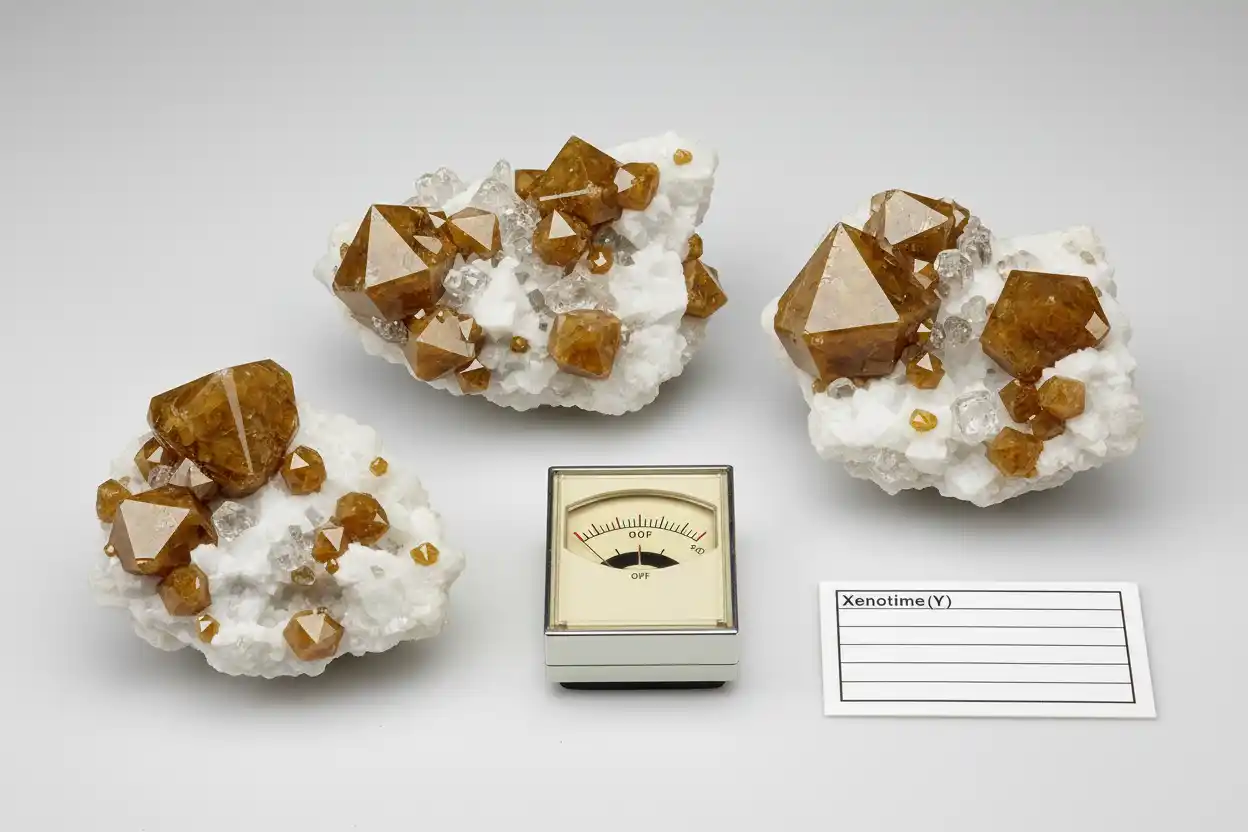

Xenotime is a rare-earth phosphate best represented by xenotime-(Y), whose ideal formula is YPO₄. Its brown, yellow, gray or greenish crystals can resemble zircon because the two minerals share closely related tetragonal structures, yet xenotime is softer, denser in some compositions and enriched in yttrium and heavy rare-earth elements.
Some specimens also contain uranium or thorium and may be measurably radioactive. That radioactivity is variable rather than inherent to the ideal YPO₄ formula, so individual material should be assessed rather than treated with either panic or complacency.
Xenotime at a Glance
| Property | Xenotime-(Y) |
|---|---|
| Mineral class | Anhydrous phosphate |
| Chemical formula | YPO₄ |
| Principal element | Yttrium |
| Common substitutions | Dysprosium, erbium, ytterbium, gadolinium, terbium, uranium, thorium and zirconium |
| Crystal system | Tetragonal |
| Structural type | Zircon-type structure |
| Typical colors | Yellowish brown, reddish brown, brown, gray, greenish brown and rarely pale yellow |
| Common habit | Short prisms, dipyramids, elongated tetragonal crystals, radial groups and granular masses |
| Luster | Vitreous to greasy or resinous |
| Transparency | Transparent in rare crystals; usually translucent to opaque |
| Refractive indices | Approximately 1.72–1.82 |
| Birefringence | Strong, approximately 0.095 |
| Optical character | Uniaxial positive |
| Specific gravity | Approximately 4.4–5.1 |
| Mohs hardness | About 4–5 |
| Cleavage | Perfect in a prismatic direction |
| Tenacity | Brittle |
| Common use | Rare-earth ore, mineral specimens, geological dating and exceptionally rare collector gems |
| Main care concern | Perfect cleavage, low hardness and variable uranium or thorium content |
What Is Xenotime?
Xenotime is the traditional name used mainly for xenotime-(Y), a yttrium-dominant phosphate.
The species suffix identifies the dominant rare-earth element occupying the principal cation site.
Xenotime-(Yb), dominated by ytterbium, is extremely rare. Xenotime-(Gd), dominated by gadolinium, received formal recognition much more recently.
Most specimens encountered by collectors are xenotime-(Y), so the shorter name xenotime usually refers to that species.
The xenotime group also contains structurally related phosphates, vanadates and an arsenate. However, these are separate mineral species rather than color varieties of one stone.
Why Is Xenotime a Rare-Earth Mineral?
Yttrium behaves chemically like the heavy rare-earth elements despite appearing separately on the periodic table.
Its ionic size allows dysprosium, erbium, ytterbium, holmium, terbium, gadolinium and related elements to substitute into xenotime’s crystal structure.
Consequently, natural xenotime rarely consists of perfectly pure YPO₄.
Some deposits contain enough heavy rare-earth elements for xenotime to become an economically important ore.
Its rare-earth distribution differs from monazite, which generally concentrates more light rare-earth elements such as cerium, lanthanum and neodymium.
The mineral’s chemistry also links it conceptually with yttrium-bearing yttrian fluorite, although fluorite is a cubic halide rather than a tetragonal phosphate.
How Xenotime Got Its Name
The name is associated with Greek words that have been translated as vain honor or empty honor.
It refers to an early scientific misunderstanding in which the yttrium within the mineral was thought to represent a newly discovered element.
The naming history is complicated by nineteenth-century analytical limitations and changing rare-earth nomenclature.
Modern mineral labels should use xenotime-(Y) when species-level precision matters.
The type locality is at Hidra, historically called Hitterø, in southern Norway.
Xenotime’s Crystal Structure
Xenotime has a zircon-type structure.
Phosphate tetrahedra in xenotime occupy positions structurally comparable with silicate tetrahedra in zircon.
This structural similarity explains why the two minerals can develop comparable tetragonal prisms and dipyramids.
It also allows zirconium and silicon to enter xenotime in limited amounts, while yttrium and rare-earth elements may enter zircon.
Despite this relationship, the minerals remain chemically and physically distinct.
The complete range of zircon forms belongs to types of zircon, while xenotime owns the yttrium-phosphate and rare-earth intent.
Xenotime Colors
Yellow and Golden-Brown Xenotime
Yellowish-brown and golden-brown crystals are among the most attractive collector forms.
Fine Zagi Mountain and Brazilian material can show translucent edges and vitreous luster.
Color may vary across growth zones as rare-earth and actinide concentrations change.
Reddish-Brown Xenotime
Reddish or cinnamon-brown crystals can resemble zircon, monazite or rare brown phosphate gems.
Thick sections may appear much darker than thin edges.
Gray and Greenish Xenotime
Gray, gray-brown and greenish-brown material occurs in granites, pegmatites and metamorphic rocks.
Greenish tones can result from trace-element absorption and structural effects.
Pale and Nearly Colorless Xenotime
Pale yellow or nearly colorless crystals are rare.
Transparent material suitable for faceting is exceptionally scarce and usually remains small.
Crystal Habits
Short Tetragonal Prisms
Many xenotime crystals form short prisms terminated by pyramidal faces.
Their square cross-sections and pointed terminations can resemble miniature zircon crystals.
Elongated Crystals
Zagi Mountain in Pakistan has produced unusually elongated, twisted and complex crystals.
These pieces may occur on white albite, quartz or darker matrix.
Bipyramidal Crystals
Some crystals consist largely of two pyramids joined base to base.
Rounded or altered surfaces can obscure the original tetragonal form.
Radial Aggregates
Needle-like or prismatic crystals may grow outward from a common center.
In certain rocks, xenotime and zircon produce flowerlike radial patterns visible on polished surfaces.
Granular Xenotime
Most geological xenotime occurs as small accessory grains rather than collector-quality crystals.
These grains can survive erosion and concentrate in heavy-mineral sands because of their high density and chemical resistance.
How Xenotime Forms
Xenotime forms as an accessory mineral in silica-rich igneous rocks, including granite, alkaline granite and syenite.
It also crystallizes in granitic and alkaline pegmatites, where late-stage fluids concentrate yttrium, phosphorus and heavy rare-earth elements.
The mineral occurs in high-grade metamorphic rocks such as gneiss and mica-rich schist.
During metamorphism, xenotime can grow along grain boundaries or replace earlier phosphate material.
Weathering releases durable xenotime grains from their host rocks. Streams and coastal processes then concentrate them with zircon, monazite, rutile and other heavy minerals.
Xenotime can also form microscopic overgrowths on detrital zircon during sediment burial and diagenesis.
These different generations are valuable to geologists because their uranium, thorium and lead systems can record geological age.
Important Localities
Norway
Hidra in southern Norway is the type locality.
Norwegian granites and pegmatites also contain xenotime with feldspar, quartz and rare-earth minerals.
Pakistan
Zagi Mountain in Khyber Pakhtunkhwa is famous for well-formed yellow-brown, reddish and dark xenotime crystals.
Specimens commonly occur with albite, quartz, aegirine and rare-earth minerals.
Fine crystals from older discoveries are highly sought after because comparable material appears irregularly.
Brazil
Novo Horizonte in Bahia and several districts in Minas Gerais have produced sharp brown, golden and partly gemmy xenotime crystals.
Brazilian pieces may form attractive isolated prisms or groups on quartz-rich matrix.
Malawi
Mount Malosa has yielded unusually large golden-yellow xenotime crystals associated with alkaline-rock minerals.
Namibia
The Brandberg and other granitic complexes contain xenotime as both microscopic grains and visible crystals.
Additional Sources
Madagascar, Sweden, Finland, Russia, Japan, Australia, Canada and the United States contain important occurrences.
A country name alone does not establish quality or radioactivity. Mine-level provenance remains more useful.
Associated Minerals
Xenotime commonly occurs with quartz, feldspar, mica, zircon, monazite, apatite, rutile, brookite and anatase.
Quartz can form the principal pegmatite matrix.
Muscovite may occur as pale books or plates beside xenotime crystals.
Rutile and other titanium minerals appear with xenotime in heavy-mineral sands.
Apatite supplies another phosphate comparison, while types of apatite remain structurally and chemically distinct.
Zircon is particularly significant because the two minerals can intergrow, overgrow one another or appear as composite crystals.
Xenotime Versus Zircon
Both minerals crystallize in the tetragonal system and share a zircon-type structural arrangement.
Zircon has the formula ZrSiO₄, while xenotime-(Y) has the formula YPO₄.
Zircon is considerably harder, commonly measuring about 7.5 compared with xenotime’s 4–5.
Xenotime has strong birefringence and a high refractive index, which can make transparent material brilliant.
Both may contain uranium and thorium, although their response to radiation damage differs.
Raman spectroscopy, chemical analysis and X-ray diffraction provide a dependable distinction.
Destructive scratch testing should not be used on a rare crystal.
Xenotime Versus Monazite
Monazite is commonly a cerium-dominant rare-earth phosphate with monoclinic structure.
Xenotime is tetragonal and dominated by yttrium and heavy rare earths.
Both can occur as yellow, brown or reddish accessory grains in granites, pegmatites and heavy-mineral sands.
Both may contain uranium and thorium and can be radioactive.
Chemical analysis and X-ray diffraction are normally necessary for small grains.
Xenotime Versus Apatite
Apatite generally forms hexagonal crystals, has lower density and contains calcium as an essential element.
Its hardness of 5 overlaps the upper end of xenotime’s range.
Transparent yellow or brown apatite can resemble xenotime visually, but refractive index and specific gravity differ substantially.
The minerals may occur together in phosphate-rich pegmatites.
Xenotime Versus Yttrian Fluorite
Yttrian fluorite is calcium fluoride containing yttrium substitution.
It is cubic, singly refractive and has perfect octahedral cleavage.
Xenotime is a tetragonal yttrium phosphate with strong birefringence.
Both can appear pale brown, gray, yellow or green and may occur in rare-earth-rich igneous environments.
Chemical and structural analysis separates them reliably.
Identifying Xenotime
The tetragonal crystal form provides an initial clue, particularly when the specimen shows a square prism and pyramidal termination.
High density distinguishes it from many ordinary silicates.
Its refractive indices of approximately 1.72–1.82 and strong birefringence create visible facet doubling in transparent material.
Xenotime is uniaxial positive and can show dichroism between yellow, pinkish, brown and greenish directions.
Raman spectroscopy distinguishes its phosphate structure from zircon’s silicate structure.
X-ray diffraction establishes the xenotime-type lattice, while electron-microprobe analysis determines the dominant rare-earth element.
The general approach appears in how to identify crystals.
Radioactivity in Xenotime
Ideal YPO₄ contains no radioactive element.
Natural xenotime may incorporate uranium and thorium in place of yttrium. Their concentration varies widely among deposits and individual crystals.
Some specimens show little measurable activity above natural background. Others can be weakly or significantly radioactive.
Color and locality cannot provide a dependable radiation assessment.
A calibrated survey meter can screen a specimen, though professional analysis may be needed for quantitative results.
Radiation dose generally falls as distance increases. Enclosed storage away from continuously occupied areas is prudent for elevated specimens.
Avoid carrying potentially radioactive xenotime in a pocket, wearing it as jewelry or keeping it beside a bed or desk.
The broader handling principles appear in the toxic crystals safety list.
Xenotime and Geological Dating
Xenotime can incorporate uranium and thorium during growth while excluding most initial lead.
Radioactive decay later produces lead isotopes at predictable rates.
Geologists can measure uranium, thorium and lead to calculate when a xenotime crystal or overgrowth formed.
Microscopic xenotime grains may therefore record metamorphism, hydrothermal alteration or sediment burial.
The mineral can preserve multiple growth zones with different ages.
This scientific use often exceeds the decorative importance of an ordinary brown grain.
Treatments and Synthetic Xenotime
Collector xenotime is normally untreated.
Heating or irradiation is not used routinely to create a standardized commercial color.
Repairs can occur in matrix specimens, particularly where a heavy crystal rests on fragile albite.
Clear coatings may improve luster temporarily, while resin can consolidate damaged matrix.
Synthetic YPO₄ crystals are manufactured for optical, luminescent, ceramic and research applications.
Rare-earth-doped synthetic material can produce controlled fluorescence and other technical properties.
There is no significant mainstream synthetic xenotime gemstone market. Glass or another brown mineral is a more likely imitation.
The distinction follows lab-grown versus natural gemstones.
Cutting and Faceting
Transparent xenotime has enough refractive index and birefringence to create an interesting collector gem.
However, suitable rough is exceptionally rare.
Perfect cleavage can split a crystal during preforming or polishing.
Hardness 4–5 allows rapid abrasion and makes a lasting polish difficult.
Strong birefringence can produce obvious doubling of rear facets, so orientation affects visual sharpness.
Most faceted xenotime gems remain small and are purchased for rarity rather than jewelry performance.
A fine complete crystal normally carries more mineral-specimen value than a cut stone.
Hardness, Cleavage and Jewelry Suitability
Xenotime falls between fluorite and apatite on the gemstone hardness chart.
It scratches too easily for ordinary exposed jewelry.
Perfect cleavage creates an additional splitting risk, as explained in gemstone cleavage explained.
The distinction between scratching and breaking appears in gemstone toughness versus hardness.
Potential uranium or thorium content provides another reason to avoid wearable use.
Faceted material belongs in a gem collection, while natural crystals should remain in enclosed specimen boxes.
Xenotime Prices in 2026
Xenotime has no standardized price system.
Small crystal fragments and modest labeled specimens commonly retail for approximately $20–$100.
Better thumbnails with recognizable tetragonal crystals often range from $100–$500.
Fine Zagi Mountain, Novo Horizonte or Mount Malosa specimens commonly sell for approximately $500–$2,500, depending on crystal size, form, condition and provenance.
Exceptional large or highly aesthetic crystals can exceed $2,500–$5,000.
Faceted xenotime is extremely rare. Small collector gems may be offered for several hundred dollars per carat, while unusually clean or large stones can exceed $1,000 per carat.
Radioactivity does not automatically increase value. An elevated specimen may instead require additional storage and shipping considerations.
What Determines Value?
Species confirmation is essential because zircon, monazite and other brown crystals can resemble xenotime.
Crystal form is the leading visual factor. Sharp tetragonal prisms, dipyramids and unusual elongated crystals command premiums.
Transparency and golden-yellow color add interest, especially in material suitable for gem collections.
Locality matters considerably. Classic Zagi Mountain and Novo Horizonte specimens have established collector followings.
Damage, repair and matrix preparation affect value.
Old labels, analytical results and radiation measurements improve documentation.
Large size adds value only when the crystal remains complete and aesthetic.
Buying Guidance
Purchase from a dealer experienced with rare-earth minerals.
Ask whether the label identifies xenotime-(Y) specifically and how the determination was made.
Request the exact locality and mine when available.
Inspect photographs for glued crystals, repaired matrix and incomplete terminations.
Ask whether the specimen has been checked with a radiation meter.
Do not assume a seller’s statement of nonradioactive means that laboratory testing was performed.
For a faceted stone, request an independent mineralogical report.
Avoid buying xenotime for direct-contact spiritual practices, jewelry or crystal water.
Cleaning, Water and Storage
Keep cleaning to a minimum.
Use a hand air bulb or very soft brush while supporting the matrix.
Do not soak xenotime. Water can affect matrix minerals, labels, repairs and radioactive or rare-earth-bearing dust.
The general guidance in which crystals can and cannot go in water should be applied conservatively.
Avoid ultrasonic and steam cleaning because cleavage and brittle matrix can fail.
Do not use acid, bleach or aggressive household chemicals.
Store the specimen inside a labeled box. If a survey meter shows elevated activity, increase distance from occupied spaces and seek local radiation-safety guidance.
Natural color is generally stable in ordinary light, but coatings and matrix minerals may not be. The display principles in crystals that fade in sunlight remain useful.
For symbolic cleansing, use a non-contact approach from how to cleanse crystals.
Meaning and Symbolism
Xenotime has little traditional gemstone symbolism because gem-quality crystals are exceptionally rare.
Modern interpretations associate it with discernment, specialist knowledge, patience and recognizing value that exists at a microscopic or structural level.
Its use in geological dating encourages symbolism involving deep time, memory and the reconstruction of past events from small surviving clues.
Its rare-earth chemistry can also represent complexity hidden within a seemingly simple brown crystal.
These meanings are cultural, spiritual or personal rather than scientifically proven effects.
Frequently Asked Questions
1. What is xenotime made of?
Xenotime-(Y) is primarily yttrium phosphate with the formula YPO₄.
2. Why is it written xenotime-(Y)?
The suffix identifies yttrium as the dominant rare-earth element in that mineral species.
3. Is xenotime a rare-earth mineral?
Yes. It contains yttrium and commonly includes heavy rare-earth elements such as dysprosium, erbium and ytterbium.
4. Is xenotime radioactive?
Pure YPO₄ is not radioactive, but natural specimens can contain uranium or thorium and may range from near-background to significantly radioactive.
5. How can xenotime be distinguished from zircon?
Xenotime is softer and has phosphate chemistry, while zircon is a harder zirconium silicate. Spectroscopy and chemical analysis provide reliable separation.
6. What color is xenotime?
It is commonly yellowish brown, reddish brown, gray or greenish brown. Pale transparent crystals are rare.
7. Where is xenotime found?
Important sources include Norway, Pakistan, Brazil, Malawi, Namibia, Madagascar and several granitic or pegmatite regions worldwide.
8. Is xenotime used as an ore?
Yes. Some deposits are mined or processed as sources of yttrium and heavy rare-earth elements.
9. Can xenotime be faceted?
Rare transparent crystals can be faceted for collectors, but the mineral is soft, cleavable and unsuitable for normal jewelry.
10. Can xenotime go in water?
Soaking is not recommended, especially when the specimen contains matrix, repairs or potentially radioactive dust.
11. How much is xenotime worth?
Small specimens may cost tens of dollars, while fine crystals commonly sell for hundreds or thousands. Faceted examples can command high collector prices.
12. Does xenotime have scientifically proven healing properties?
No. Its symbolism may carry personal meaning, but it should be treated as a rare-earth mineral specimen rather than a therapeutic stone.
Xenotime can look like a modest brown accessory crystal, yet its structure stores heavy rare-earth elements and isotopic records capable of dating geological events. The most responsible collection preserves that scientific context while accounting for cleavage, rarity and the possibility of uranium or thorium substitution.
Xenotime appears in Crystals That Start With X.
Safety disclaimer: Some xenotime contains uranium or thorium and may be radioactive. Keep specimens labeled and enclosed, avoid prolonged close contact, never ingest or use them in crystal water, and do not cut, grind or drill them. Consider survey-meter screening and professional radiation-safety advice for elevated specimens.