
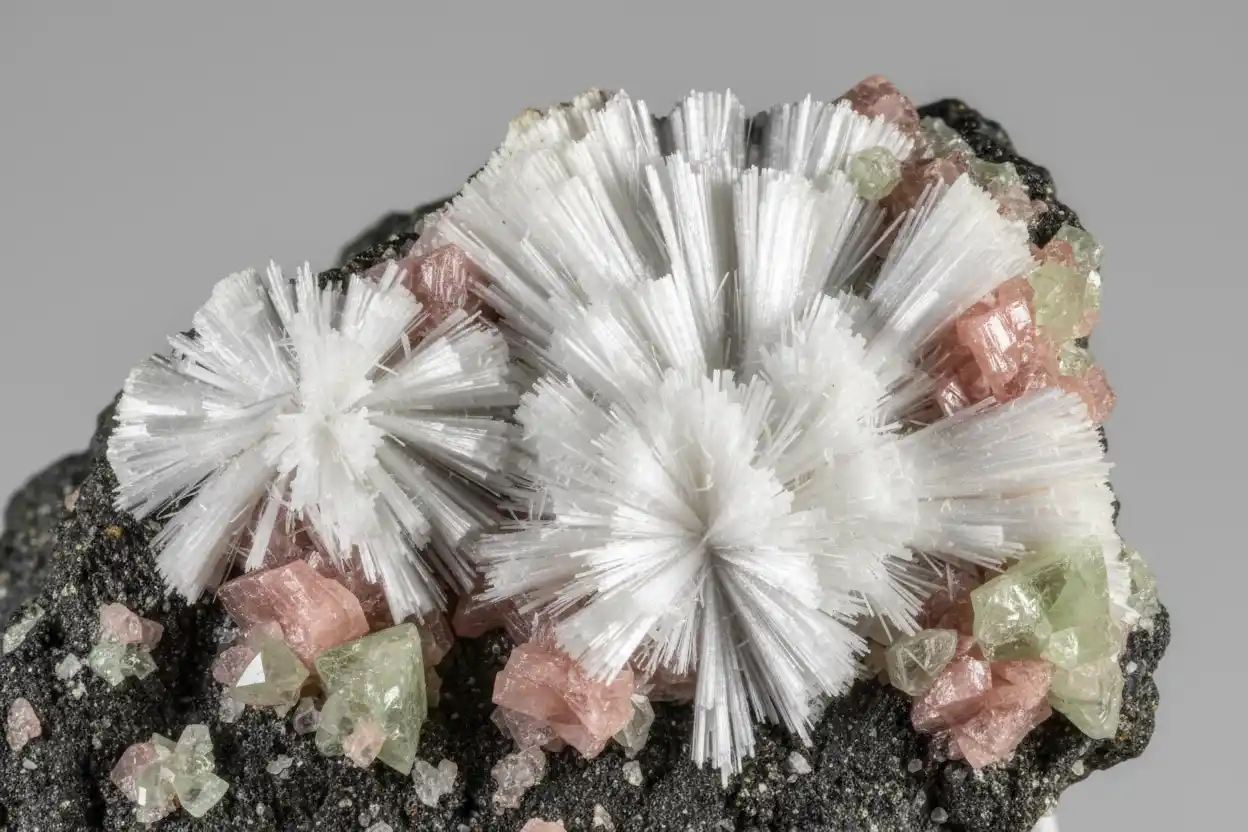

Xonotlite is a calcium silicate hydroxide that usually forms white, gray or pale pink fibers, needles and radiating sprays. Although its silky aggregates can resemble zeolites and other delicate fibrous minerals, xonotlite is relatively hard and belongs to a separate chain-silicate structural family.
Natural specimens are uncommon and generally appeal to systematic mineral collectors. Synthetic xonotlite, meanwhile, is manufactured industrially for high-temperature insulation and calcium-silicate products, creating an important distinction between naturally crystallized specimens and engineered material.
Xonotlite at a Glance
| Property | Xonotlite |
|---|---|
| Mineral class | Inosilicate or chain silicate |
| Chemical formula | Ca₆Si₆O₁₇(OH)₂ |
| Structural description | Calcium silicate hydrate with double silicate chains |
| Typical colors | Colorless, white, lemon-white, pale gray and pale pink |
| Crystal system | Monoclinic |
| Common habit | Acicular, fibrous, hairlike, radiating, felted and massive |
| Luster | Vitreous, silky or pearly |
| Transparency | Transparent in individual fibers; commonly translucent in aggregates |
| Refractive indices | Approximately 1.583–1.595 |
| Birefringence | Approximately 0.012 |
| Optical character | Biaxial positive |
| Specific gravity | Approximately 2.70–2.72 |
| Mohs hardness | Approximately 6–6.5 |
| Cleavage | Perfect in one direction and good in another |
| Fracture | Splintery |
| Common use | Mineral specimens, rare lapidary material and synthetic industrial calcium silicate |
| Main care concern | Fragile fibrous aggregates, cleavage and inhalable dust from cutting or damaged material |
What Is Xonotlite?
Xonotlite is a hydrated calcium silicate whose structure contains linked chains of silicate tetrahedra.
Its formula includes calcium, silicon, oxygen and hydroxyl. Unlike many zeolites, xonotlite does not have a highly open framework filled with easily exchangeable water and ions.
Natural xonotlite frequently appears as fine needles or fibers gathered into sprays, tufts, mats and compact masses. Individual crystals can be too narrow to examine without magnification.
The mineral’s hardness of approximately 6–6.5 is surprisingly high for a white fibrous material. Consequently, appearance alone can be misleading when distinguishing it from softer minerals.
Xonotlite is generally treated as a collector mineral rather than a mainstream stone within the broader types of gemstones guide.
How Xonotlite Got Its Name
Xonotlite was named for its discovery area near Tetela de Xonotla in Puebla, Mexico.
The pronunciation varies among collectors, but the name is commonly rendered approximately as “zo-NOT-lite” or “sho-NOT-lite.”
Older references may use the synonym eakleite. Modern mineralogical records retain xonotlite as the accepted name.
The locality-derived name does not indicate one color or crystal form. White fibrous material from other countries can still be xonotlite when its chemistry and structure match the species.
Xonotlite’s Crystal Structure
Xonotlite belongs to the chain-silicate class.
Its silicate tetrahedra connect into double chains sometimes described as double dreier chains. Calcium ions and hydroxyl groups occupy positions around those chains.
This structure differs from the sheet arrangement in mica, the isolated tetrahedra in garnet and the framework structure in quartz.
It also explains xonotlite’s close relationship to calcium-silicate-hydrate phases studied in cement science and industrial insulation.
Several structural polytypes have been described. These differ in the stacking and orientation of similar structural units rather than representing ordinary color varieties.
Species-level confirmation normally requires X-ray diffraction or Raman spectroscopy because the chain arrangement cannot be judged from external appearance.
Xonotlite Colors
White Xonotlite
White and snow-white material is the most familiar. Fine fibers scatter light strongly, creating an opaque or silky surface even when individual needles are transparent.
Bright white sprays can contrast dramatically with dark manganese-ore matrix.
Gray and Lemon-White Xonotlite
Pale gray and cream-to-lemon-white specimens occur where trace impurities, inclusions or surface alteration modify the otherwise colorless mineral.
Subtle yellowish color should not be confused with iron staining or artificial coating.
Pale Pink Xonotlite
Pale pink specimens can contain manganese-related impurities or occur beside strongly colored manganese silicates.
At South African manganese deposits, white xonotlite may grow with pink or orange inesite when that destination is available in the tracker; where no dedicated page exists, the associated mineral should remain an unlinked mention.
Color alone does not prove xonotlite because several fibrous minerals occur in similar pink-white associations.
Colorless Xonotlite
Individual crystals can be colorless and transparent under magnification. However, grouped fibers usually appear white because numerous surfaces scatter light.
Crystal Habits
Acicular Crystals
Acicular means needle-like. Xonotlite needles may form as isolated crystals, parallel bundles or tangled groups.
The crystals can appear sharp but may bend slightly or form curved sprays during growth.
Radiating Sprays
Many attractive specimens contain fibers growing outward from one point. These sprays can resemble small fans, stars or frost patterns.
Radiating groups are visually appealing but vulnerable where they attach to matrix.
Felted and Fibrous Masses
Extremely fine crystals may interlock into woolly, felted or compact masses.
Such material can resemble okenite, pectolite or fibrous zeolite. Identification requires more than a visual comparison.
Veins and Compact Material
Xonotlite can fill fractures as dense fibrous veins.
Compact material may accept a polish, although it usually lacks the dramatic form of natural crystal sprays.
Pseudomorphs and Replacement Textures
Xonotlite can replace or grow through earlier calcium silicates. The final specimen may preserve an earlier outline while containing fine xonotlite internally.
Laboratory analysis becomes important when the original and replacement minerals remain intergrown.
How Xonotlite Forms
Xonotlite forms in calcium- and silica-rich environments under hydrothermal or metamorphic conditions.
One important setting occurs along contacts between carbonate rocks and igneous intrusions. Heat and chemically active fluids transform limestone or related rocks into calc-silicate assemblages.
Xonotlite can also form in veins cutting serpentinite and other altered ultramafic rocks. Calcium-bearing fluids react with silica introduced through fractures.
In manganese deposits, late hydrothermal fluids can deposit xonotlite beside inesite, datolite and other secondary minerals.
The mineral also occurs in skarn-like and contact-metamorphic environments alongside wollastonite, garnet and pyroxene.
Temperature, fluid composition and the ratio of calcium to silica determine whether xonotlite forms instead of another calcium silicate hydrate.
Important Xonotlite Localities
Tetela de Xonotla, Mexico
The Puebla locality gave xonotlite its name and remains historically important.
Material can occur in calc-silicate and hydrothermal associations, although modern commercial specimens from the type region are limited.
Crestmore Quarry, California
The Crestmore quarries in Riverside County produced diverse contact-metamorphic calcium silicates.
White radiating xonotlite occurs with green diopside, pale wollastonite and reddish grossular garnet.
Crestmore specimens appeal strongly to locality and systematic-mineral collectors.
Kalahari Manganese Field, South Africa
The N’Chwaning and Wessels mines have produced some of the most attractive modern xonotlite specimens.
White acicular sprays may occur with pink-to-orange inesite, datolite and manganese-rich matrix.
Fine combinations can command substantial prices because of their color contrast and rarity.
Fuka and Sampo Mines, Japan
Japanese calc-silicate deposits have yielded xonotlite with calcite, wollastonite, garnet, pyroxene and other uncommon calcium minerals.
Locality labels are particularly valuable because many Japanese specimens are small and visually subtle.
Other Occurrences
Xonotlite is also reported from Italy, Scotland, Romania, Russia, New Zealand, Canada and additional contact-metamorphic or serpentinite-associated localities.
Most occurrences produce microscopic or massive material rather than display-quality crystal sprays.
Associated Minerals
Xonotlite commonly occurs with calcium silicates, carbonates and hydrothermal cavity minerals.
Calcite may form white rhombohedra or massive matrix near xonotlite.
Quartz can occur in surrounding veins, although high-silica quartz crystals are not present in every xonotlite environment.
Apophyllite and prehnite may occur in related low-temperature calcium-rich systems.
Scolecite, natrolite and other zeolite minerals can resemble xonotlite visually, though their structures differ.
Zeolite remains a family-level page and should not be used as xonotlite’s mineral classification.
Xonotlite Versus Okenite
Okenite is a hydrated calcium silicate famous for soft, cotton-ball-like aggregates.
Okenite is generally softer than xonotlite and commonly forms flexible-looking white fibers inside basalt cavities.
Xonotlite has a higher hardness near 6–6.5 and commonly occurs in calc-silicate, manganese or serpentinite-related settings.
The fibers of both minerals are fragile, so destructive scratch testing should not be attempted on collector specimens.
Raman spectroscopy and X-ray diffraction provide dependable separation.
Xonotlite Versus Scolecite and Natrolite
Scolecite and natrolite belong to the zeolite family.
They commonly form white radiating needles in basalt cavities, creating a strong visual resemblance to xonotlite.
Zeolites are generally softer and have open framework structures containing water and exchangeable ions.
Xonotlite has chain-silicate structure and greater thermal stability.
Crystal habit, locality and associated minerals provide clues, but laboratory testing may be necessary for fine white sprays.
Xonotlite Versus Pectolite
Pectolite is another fibrous calcium silicate and can appear white, gray or pale green.
It usually has lower hardness and different optical and structural properties.
Dense blue copper-bearing pectolite is marketed as larimar, while ordinary white pectolite commonly forms splintery fibers.
Xonotlite and pectolite can occur in similar hydrothermal settings and may be difficult to separate in massive material.
Xonotlite Versus Wollastonite
Wollastonite is a calcium silicate with the formula CaSiO₃.
It commonly forms bladed, fibrous or massive material in contact-metamorphic rocks.
Xonotlite contains hydroxyl and has a hydrated calcium-silicate structure.
The two can occur together and may form through related reactions at different temperatures or fluid conditions.
X-ray diffraction provides a more reliable distinction than color or fiber shape.
Xonotlite Versus Gypsum
Gypsum can appear white, fibrous and silky.
However, gypsum has a hardness near 2, while xonotlite is much harder.
Fibrous gypsum may show obvious parallel structure and can be scratched easily with a fingernail.
Both should still be identified without damaging valuable finished specimens.
Fluorescence
Some xonotlite shows weak white or gray-white fluorescence under ultraviolet light.
The response can vary with locality, impurities and associated minerals.
A strong ultraviolet glow may originate from calcite, datolite or another mineral on the specimen rather than from xonotlite itself.
Fluorescence is therefore a supporting observation rather than a diagnostic test.
How to Identify Xonotlite
Visual identification should begin with habit, locality and associated minerals.
Xonotlite’s hardness near 6–6.5 separates it from many soft white fibrous minerals. However, scratch tests can destroy delicate sprays and spread dust.
Its specific gravity near 2.71 is similar to calcite and several silicates, so density alone is not conclusive.
Under a microscope, individual crystals may show splintery form, silky luster and parallel fiber growth.
Raman spectroscopy identifies the calcium-silicate-hydroxide vibration pattern.
X-ray diffraction is particularly useful for separating xonotlite from related calcium silicate hydrates, zeolites and fibrous lookalikes.
The broader sequence in How to Identify Crystals should be followed without relying on one home test.
Natural and Synthetic Xonotlite
Natural xonotlite crystallizes through geological hydrothermal or metamorphic processes.
Synthetic xonotlite is produced by reacting lime and silica under pressurized hot-water conditions.
Industrial material commonly consists of very fine fibers or interlocking crystals engineered into lightweight, heat-resistant structures.
It is used in calcium-silicate insulation boards, furnace linings, pipe insulation and related products.
Synthetic industrial xonotlite is chemically and structurally related to the natural mineral, but it should not be sold as a naturally mined specimen.
The distinction follows the framework in Lab-Grown vs Natural Gemstones, although most synthetic xonotlite is an industrial material rather than a jewelry product.
Treatments, Repairs and Imitations
Natural xonotlite is not routinely heated, irradiated or dyed.
Matrix specimens may be repaired with adhesive when fragile sprays detach during mining or shipping.
Clear resin can consolidate crumbly matrix or fibrous masses. Such treatment may improve stability but affects scientific and collector value.
Artificially assembled pieces can use white fibers glued onto unrelated matrix.
Okenite, scolecite, natrolite and other white minerals may be misidentified rather than deliberately imitated.
The main commercial concern is therefore incorrect labeling or undisclosed repair, not a sophisticated synthetic-gem market.
Cutting and Lapidary Use
Natural crystal sprays should remain intact because cutting destroys the habit that creates their collector value.
Dense massive xonotlite can theoretically be cut into cabochons, slabs or small carvings.
Interlocking fibrous texture may create a silky surface or limited chatoyant effect after polishing.
Cleavage, fiber pullout and variable matrix can cause pits and uneven polish.
Because commercially available massive material is uncommon, most polished “xonotlite” should receive laboratory confirmation before carrying a rarity premium.
Wet cutting is essential to suppress fine calcium-silicate dust.
Hardness, Cleavage and Durability
Xonotlite’s hardness near 6–6.5 places it above fluorite, calcite and most zeolites on the gemstone hardness chart.
However, its fibrous habit and cleavage create weaknesses not reflected by the Mohs number.
The distinction between surface hardness and breakage resistance is explained in Gemstone Toughness vs Hardness.
Cleavage-related damage is discussed in Gemstone Cleavage Explained.
Dense material may resist ordinary scratches reasonably well, while thin radiating sprays can break from slight pressure.
Natural specimens should be handled by their matrix rather than by the white fibers.
Jewelry Suitability
Xonotlite is rarely used in jewelry.
Dense, confirmed material could be worn in a protected pendant, brooch or enclosed cabochon setting.
Exposed rings and bracelets are inappropriate because impact can open fibers, cleavage surfaces or matrix fractures.
White fibrous crystal clusters should never be attached directly to wearable jewelry. Their delicate projections can break and release particles.
A display case or specimen box offers the most appropriate use for fine natural material.
Xonotlite Prices in 2026
The xonotlite market is thin and specimen-focused.
Small labeled fragments, micromounts and modest white fibrous specimens commonly retail for approximately $20–$100.
Better miniature specimens with distinct radial sprays or desirable locality labels often range from $100–$500.
Fine Crestmore, Japanese or Kalahari specimens with attractive associations can sell for approximately $500–$1,500.
Current high-quality South African xonotlite-and-inesite specimens can reach around $1,000 or more, particularly when crystal coverage and color contrast are strong.
Exceptional historic, unusually large or museum-quality pieces may exceed $2,000.
Polished xonotlite has no standardized per-carat market. A seller’s rarity claim should be supported by mineral identification rather than appearance alone.
What Determines Value?
Correct identification comes first because several white fibrous minerals resemble xonotlite.
Crystal form matters. Sharp radial sprays and separated needles generally command more than featureless compact masses.
Color contrast adds value, especially when white xonotlite occurs with pink inesite, green diopside or reddish garnet.
Locality and provenance are important because fine specimens come from a limited number of recognized deposits.
Condition requires close inspection. Crushed fibers, glue, repaired matrix and missing sprays reduce value.
An old label or analytical documentation can materially strengthen a rare specimen’s collector significance.
Buying Guidance
Purchase from a mineral dealer who provides exact locality and dimensions.
Ask how the xonotlite was identified, especially when the piece resembles a zeolite or okenite.
Request close photographs of the fibers, matrix attachment and any repaired areas.
Do not pay a premium for a polished white stone without laboratory confirmation.
Check whether the specimen is natural mineral material or an industrial synthetic calcium-silicate product.
For valuable South African or Crestmore pieces, preserve all labels and collection history.
Shipping should support the matrix without allowing padding to press directly against crystal sprays.
Cleaning, Water and Storage
Routine cleaning should use a hand air bulb or extremely soft brush.
Avoid compressed air because it can break fibers and spread particles.
Do not soak delicate specimens. Water can enter matrix fractures, loosen adhesive and leave deposits between fibers.
The general advice in Which Crystals Can and Cannot Go in Water should be applied conservatively.
Avoid ultrasonic and steam cleaning.
Natural white color is generally stable in ordinary indoor light. However, glue and associated minerals may respond differently, so prolonged direct sunlight is unnecessary.
The display guidance in Crystals That Fade in Sunlight remains useful for mixed specimens.
For symbolic cleansing practices, use contact-free options from How to Cleanse Crystals.
Meaning and Symbolism
Xonotlite has little ancient gemstone lore because it is uncommon, visually subtle and only relatively recently studied as a distinct mineral.
Modern crystal traditions associate its radiating fibers with organization, cooperation and several small actions contributing to one stable structure.
Its natural and synthetic forms also encourage symbolism involving the difference between origin and function: two materials may share a structure while carrying very different histories.
Some collectors connect white xonotlite with patient analysis and the willingness to look beyond superficial resemblance.
These interpretations are cultural, spiritual or personal rather than scientifically demonstrated effects.
Frequently Asked Questions
1. Is xonotlite a mineral?
Yes. Xonotlite is a recognized calcium silicate hydroxide mineral with the formula Ca₆Si₆O₁₇(OH)₂.
2. Is xonotlite a zeolite?
No. It can resemble white zeolite sprays, but xonotlite is a chain silicate with a different structure.
3. Why does xonotlite look fibrous?
Its crystals commonly grow as narrow needles that gather into bundles, mats and radiating sprays.
4. How hard is xonotlite?
It measures approximately 6–6.5 on the Mohs scale, although fibrous aggregates can still be fragile.
5. Where is xonotlite found?
Important localities include Puebla in Mexico, Crestmore in California, the Kalahari Manganese Field in South Africa and calc-silicate deposits in Japan.
6. Is synthetic xonotlite real xonotlite?
It can share the same mineral structure and chemistry, but it is manufactured industrially rather than formed through natural geology.
7. What is synthetic xonotlite used for?
It is used in high-temperature calcium-silicate insulation, lightweight boards and related industrial materials.
8. How can xonotlite be distinguished from okenite?
Xonotlite is generally harder and occurs in different geological settings. Raman spectroscopy or X-ray diffraction provides dependable identification.
9. Can xonotlite be polished?
Dense massive material can be polished, but most collectible xonotlite consists of natural fibrous sprays that should remain intact.
10. Can xonotlite go in water?
Brief contact may not immediately damage dense material, but soaking is not recommended for fibrous, repaired or matrix specimens.
11. How much is xonotlite worth?
Small pieces may cost $20–$100, while fine locality specimens commonly sell for hundreds of dollars. Exceptional South African combinations can exceed $1,000.
12. Does xonotlite have scientifically proven healing properties?
No. Its symbolism may hold personal meaning, but scientific evidence does not establish healing effects.
Xonotlite’s appearance can be deceptive: a fragile-looking white spray may have relatively hard individual fibers, while an industrial board can contain synthetic crystals related to the same rare natural mineral. The most useful description therefore includes its origin, structure, locality and complete mineral association rather than only the word fibrous.
Xonotlite appears in Crystals That Start With X.
Safety disclaimer: Fibrous xonotlite should not be treated as asbestos without evidence, but cutting, crushing or grinding any fine fibrous calcium-silicate material can produce inhalable dust. Keep natural sprays intact and enclosed, and use wet methods, ventilation, eye protection and appropriate respiratory protection for professional lapidary work.