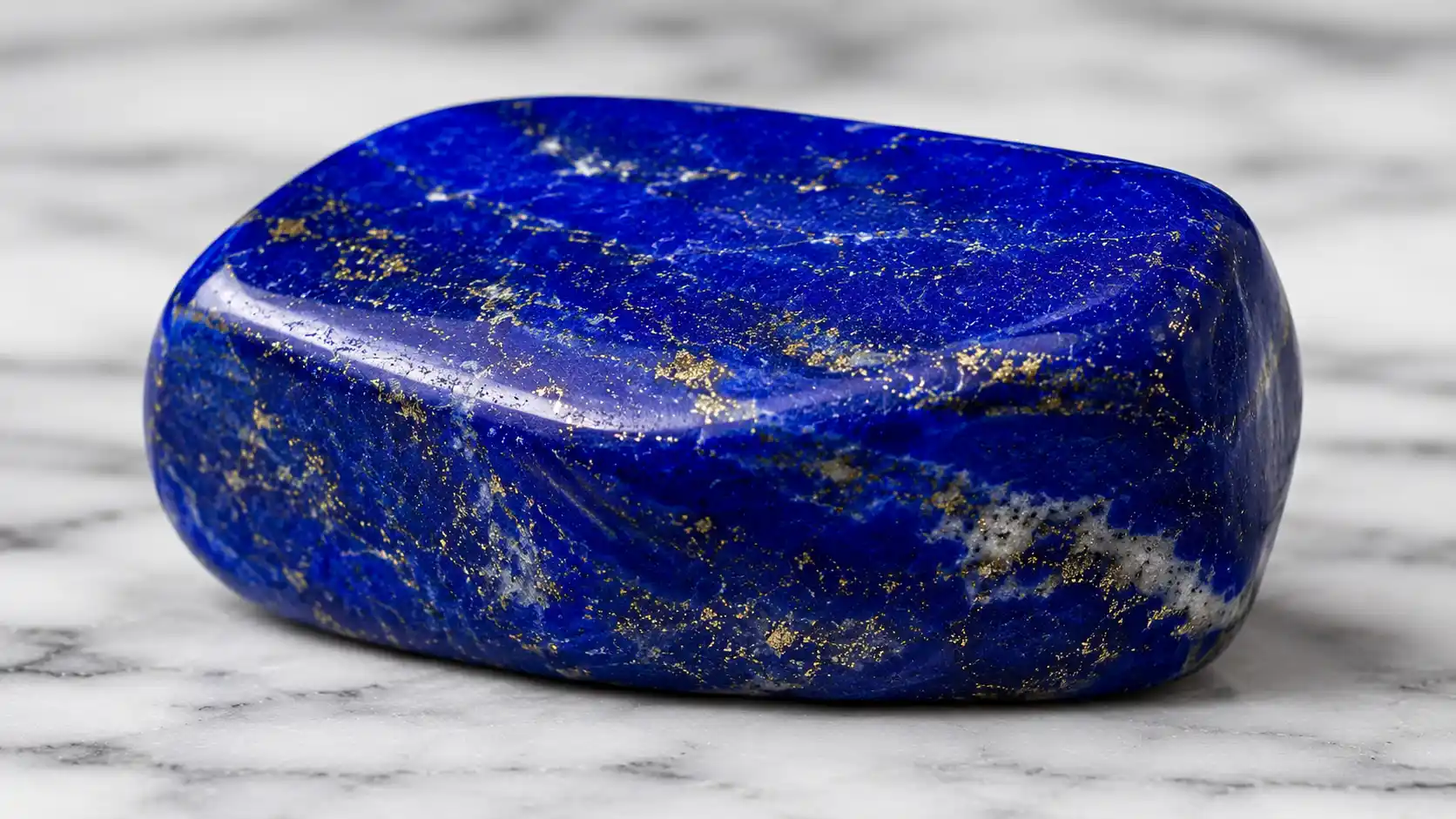
Lapis Lazuli Meaning: Mineral Identity, History & Symbolism
Lapis lazuli meaning begins with a detail that many simplified gemstone descriptions miss: lapis lazuli is primarily a rock composed of several minerals, not one single blue mineral crystal. GIA describes lapis as an aggregate whose principal visual components commonly include blue sodalite-group material traditionally called lazurite, white calcite, and metallic yellow pyrite. Other minerals can occur according to locality and geological history. This mixed composition explains why one piece can be nearly uniform royal blue while another contains white bands, golden pyrite grains, pale-blue areas, or contrasting mineral patches.
That material distinction is central to responsible interpretation. The blue is physically real, the pyrite is physically real, and the rock’s ancient use in jewelry, carvings, inlays, and pigment is well documented. Symbolic associations with truth, wisdom, royalty, protection, insight, communication, or spiritual awareness belong to cultural and personal traditions rather than measurable properties of the rock. A person can use lapis as a reminder of honesty or reflection without claiming that sulfur-bearing feldspathoid minerals alter the brain, cure illness, or transmit an invisible force.
The same evidence boundary applies throughout the wider Healing Crystal collection: first establish what the material is, then separate documented history from later symbolic interpretation.
Lapis Lazuli at a Glance
| Feature | Evidence-based description |
|---|---|
| Material type | Metamorphic rock / ornamental gem aggregate |
| Single mineral? | No |
| Principal blue component | Traditionally described as lazurite; modern mineralogical work recognizes important sulfur-rich haüyne and related sodalite-group material in many specimens |
| Common associated minerals | Calcite, pyrite, afghanite and other silicate/feldspathoid minerals depending on source |
| Typical color | Strong blue to violetish blue; paler or greenish material also occurs |
| Metallic gold-colored grains | Usually pyrite |
| White areas | Commonly calcite |
| General hardness | About Mohs 5–6, depending on aggregate composition |
| Toughness | Fair |
| Transparency | Usually opaque to semitranslucent |
| Luster | Waxy, greasy, sub-vitreous to vitreous depending on component and polish |
| Main blue-color mechanism | Sulfur radical species in blue sodalite-group phases, especially the trisulfur radical S₃⁻ |
| Famous historical source | Badakhshan, Afghanistan |
| Other sources | Chile, Russia and additional localities |
| Ancient use | Beads, seals, inlays, amulets, carvings and decorative objects |
| Pigment use | Source material for natural ultramarine |
| Treatment possible? | Yes; dyeing and wax/oil impregnation occur |
| Scientifically proven healing effect | None established |
Lapis Lazuli Is a Rock, Not Simply a Mineral
Calling lapis lazuli “a blue mineral” is convenient but technically incomplete. Mindat describes it as an uncommon metamorphic rock historically defined by its blue sodalite-group component together with calcite, pyrite, and other minerals. GIA likewise describes lapis as an aggregate rather than an individual mineral species.
This distinction explains several features that otherwise seem contradictory.
A polished lapis cabochon can contain regions with slightly different hardness.
A white vein can be part of the natural rock rather than contamination.
Metallic pyrite can occur inside genuine material without being an artificial glitter additive.
Different blue areas can represent variations in mineral species, sulfur chemistry, grain size, and mineral proportions.
Consequently, identifying lapis requires evaluating an aggregate rather than expecting every microscopic area to give one identical mineral result.
A Modern Mineralogical Nuance: “Lazurite” Is More Complicated Than Older Guides Suggest
Traditional gemological references often say that lazurite is the principal blue mineral responsible for high-quality lapis. That remains useful reader-facing shorthand and appears in established GIA material.
More recent mineralogical classification adds an important complication. Mindat notes that many lapis lazuli occurrences historically described as containing lazurite actually contain sulfur-rich haüyne or closely related sodalite-group phases, while strictly defined lazurite appears much rarer than older terminology implied.
That does not make traditional lapis descriptions fraudulent. Mineral species definitions evolve as crystal chemistry and analytical methods improve.
For a practical article, the safest wording is:
Lapis lazuli is a blue metamorphic rock whose color is produced largely by sulfur-bearing sodalite-group minerals traditionally referred to as lazurite, with modern mineralogical work refining the exact species assignments in many specimens.
This is more accurate than treating every blue grain as automatically proven lazurite.
Lapis Lazuli Identity Table
| Observation or claim | Evidence-based interpretation | Diagnostic strength |
|---|---|---|
| Rich blue opaque rock | Compatible with lapis lazuli | Moderate |
| Blue sodalite-group grains | Central component | Strong |
| White calcite | Common natural component | Supporting |
| Metallic yellow pyrite | Common component | Supporting |
| No visible pyrite | Does not rule out lapis | Weak negative evidence |
| Abundant pyrite | Can occur, but does not prove authenticity | Supporting only |
| Completely uniform artificial-looking blue | Raises treatment/imitation questions | Screening clue |
| Hardness around 5–6 | Compatible with aggregate | Supporting |
| Several minerals under magnification | Expected | Strong aggregate evidence |
| S₃⁻ sulfur chromophore | Explains intense blue in relevant sodalite-group phases | Strong scientific evidence |
| Seller says “Afghan” | Locality claim only | Requires provenance |
| Seller says “natural” | Commercial representation | Treatment still needs consideration |
| “Healing energy” claim | Spiritual/marketing statement | Not mineralogical evidence |
| “Pyrite means real lapis” | Overstated | Genuine lapis may have little visible pyrite |
| “White calcite means fake” | Incorrect | Calcite is a normal component |
How Lapis Lazuli Forms
Lapis is a metamorphic rock associated with unusual carbonate-rich geological environments. Mindat describes lapis lazuli as a metamorphic material formed through recrystallization and metasomatic processes, while classic deposits contain assemblages of blue sodalite-group minerals, calcite, pyrite, diopside, afghanite, and other associated phases.
The famous Badakhshan deposits in Afghanistan occur in a region that has supplied lapis for an exceptionally long span of human history. Other economically important material occurs in Chile and around Lake Baikal in Russia, with additional occurrences in several countries. GIA identifies Afghanistan as the traditional source of much of the most prized intensely blue material.
Formation is therefore not simply “blue mineral grows in a cavity.” Multiple minerals develop and recrystallize within a metamorphic rock system, producing the heterogeneous aggregate later cut as lapis.
The detailed host-rock relationships, metamorphic reactions, locality differences, and mineral assemblages belong in Lapis Lazuli Formation and Deposit Geology.
What Makes Lapis Lazuli So Blue?
The intense blue of lapis is one of the clearest cases where chemistry is more interesting than a vague statement about “natural pigment.”
Research on lazurite-type and related sodalite-group minerals shows that sulfur occurs in several chemical forms inside structural cages. The trisulfur radical anion, S₃⁻, is a major chromophore responsible for intense blue coloration. Modern spectroscopy has directly identified S₃⁻ together with other sulfur species in lazurite, haüyne, and ultramarine-type materials.
Recent American Mineralogist research further confirms the importance of the S₃⁻ chromophore and shows that sulfur speciation, grain behavior, and associated mineral textures can influence color stability and tone.
This means the blue is not created by copper, as it is in some other blue minerals.
It also is not simply reflected blue light from pyrite.
The sulfur-bearing framework of the blue sodalite-group phase is doing the optical work.
More detailed spectroscopy, absorption behavior, color zoning, and mineral-component relationships are reserved for Lapis Lazuli Optical Properties and Color Behavior.
Why Some Lapis Looks Violetish, Pale, or Greenish
Lapis is an aggregate, so its visible color reflects more than one variable.
The blue component itself can vary in hue and saturation according to sulfur chemistry and mineral composition. The proportion of white calcite can lighten the overall appearance. Other pale-blue minerals such as afghanite can contribute lighter regions. Abundant pyrite and other associated phases can change the visual balance of the rock.
GIA describes lapis colors ranging from deep violetish blue and royal blue through lighter blue and greenish-blue material and emphasizes that the aggregate’s mineral mixture influences the final appearance.
Color should therefore be recorded as an observation rather than used to infer mystical potency.
A vivid violetish-blue stone is visually different from pale blue material.
It is not scientifically “more spiritually powerful.”
What Are the Gold Flecks?
The metallic yellow-to-brassy particles commonly seen in lapis lazuli are pyrite, FeS₂.
Fine scattered pyrite can create an attractive star-like contrast against deep blue material. GIA notes that small, attractively distributed pyrite particles do not necessarily reduce the appeal of lapis, while excessive amounts can interfere with the preferred blue appearance.
Pyrite is helpful as supporting evidence, but one popular shortcut should be rejected:
Pyrite does not automatically prove a stone is genuine lapis lazuli.
Imitations can incorporate metallic-looking particles.
And genuine lapis can have little obvious pyrite.
Authenticity comes from the complete mineral assemblage and physical evidence.
What Are the White Areas?
White veins, patches, or streaks in lapis are commonly calcite.
Calcite is a normal part of many lapis rocks and reflects their carbonate-rich geological environment. In commercial gem evaluation, however, prominent white calcite often reduces preference for a uniform saturated blue face. GIA specifically notes that highly prized lapis usually contains little conspicuous calcite.
That is a quality preference, not an authenticity rule.
A natural specimen with obvious calcite can be completely genuine.
The same stone may also be more useful to a geology collector because its different mineral components are visible.
Diagnostic Traits
Lapis lazuli is normally opaque to semitranslucent and can show a waxy, greasy, or vitreous-looking polish depending on composition and surface finish. Because it is a rock, hardness varies with the proportion and distribution of its constituent minerals. GIA gives an overall Mohs hardness range of approximately 5–6 and rates toughness as fair.
Useful identification evidence can include:
aggregate rather than single-crystal texture;
rich blue sodalite-group mineralization;
calcite;
pyrite;
other associated minerals;
appropriate hardness;
characteristic spectroscopy or Raman signatures;
heterogeneous behavior under magnification.
The full microscopic workflow—including mineral contacts, pyrite morphology, calcite boundaries, possible dye concentrations, cracks, polishing residue, and imitation clues—belongs in the Lapis Lazuli Microscope Inclusion Notebook.
Original Source-Comparison Table: Common Lapis Claims Tested
| Common claim | Evidence status | More defensible interpretation |
|---|---|---|
| “Lapis lazuli is a mineral.” | Incomplete | It is primarily a multi-mineral metamorphic rock |
| “Lazurite is always the blue mineral in lapis.” | Traditional shorthand, now more nuanced | Modern mineralogy identifies sulfur-rich haüyne and related sodalite-group material in many specimens |
| “Pyrite proves lapis is real.” | Incorrect as an absolute rule | Pyrite is common but neither necessary nor sufficient for authentication |
| “White calcite means fake lapis.” | Incorrect | Calcite is a normal natural component |
| “The blue is caused by copper.” | Incorrect | Sulfur radical chromophores, especially S₃⁻, produce the intense blue in relevant sodalite-group phases |
| “More pyrite means higher quality.” | Incorrect | Excessive pyrite can reduce preferred blue appearance |
| “No pyrite means fake.” | Incorrect | Fine genuine lapis may have little visible pyrite |
| “Uniform blue always means top natural quality.” | Too simplistic | Dyeing or other enhancement can also create more uniform color |
| “Afghan appearance proves Afghan origin.” | Incorrect | Geographic origin requires provenance or appropriate analysis |
| “All lapis has identical hardness.” | Incorrect | It is an aggregate; different mineral proportions matter |
| “Lapis has been used since ancient civilizations.” | Supported | Archaeological and museum objects document extensive early use |
| “Ancient people universally assigned one spiritual meaning to lapis.” | Unsupported generalization | Symbolic use differed among cultures and contexts |
| “Lapis directly improves communication.” | Unsupported as a physical effect | It can be used symbolically as a reminder to communicate clearly |
| “Lapis treats anxiety or blood pressure.” | Unsupported medical claim | No established clinical mechanism follows from the rock |
| “Cleansing changes the mineral’s measurable energy.” | Unsupported as a physical claim | Cleansing rituals are personal practices, separate from mineral physics |
| “Dyeing never occurs.” | Incorrect | Dyeing and impregnation are documented treatments |
| “Natural lapis needs no care.” | Incorrect | Hardness, fair toughness, porosity and possible treatment require sensible maintenance |
The table shows why lapis lazuli meaning becomes more useful when documented facts and symbolic traditions are kept in different columns.
Original Specimen and Photo Checklist
A strong lapis record should preserve details that remain useful even after the stone changes hands.
| Field | What to record | Why it matters |
|---|---|---|
| Overall body color | Blue, violetish blue, pale blue, greenish blue | Basic appearance |
| Saturation | Weak, moderate, strong, vivid | Separates actual color from marketing words |
| Calcite | None visible, minor, moderate, extensive | Documents aggregate texture |
| Pyrite | None visible, sparse, moderate, abundant | Records metallic component |
| Pyrite distribution | Fine specks, patches, veins, coarse masses | More informative than “has gold flecks” |
| Other mineral zones | Color and texture | Supports aggregate identification |
| Transparency | Opaque or semitranslucent | Useful comparison field |
| Surface luster | Waxy, greasy-looking, vitreous polish | Finish and material character |
| Fractures | Location and severity | Durability |
| Dye concentration | Surface cracks, pores, uneven zones if visible | Treatment screening |
| Surface impregnation | Wax-like or polymer-like appearance if suspected | Treatment screening |
| Dimensions | Millimeters | Scale |
| Weight | If measured | Documentation |
| Cut | Cabochon, bead, carving, tablet, rough | Market context |
| Claimed locality | Record seller wording exactly | Do not infer locality from color |
| Provenance evidence | Label, invoice, collection record | Supports origin claims |
| Photo lighting | Neutral daylight-balanced / other | Prevents artificial color comparisons |
| Image saturation | None or disclosed | Blue stones are easily overprocessed |
| Magnification | Record level used | Makes inclusion photos repeatable |
| Treatment report | Laboratory/seller statement | Separates appearance from enhancement |
This checklist is deliberately more useful than assigning an unsupported “AAA++++” grade.
Treatment Is Separate From Natural Identity
Natural lapis lazuli can still be treated.
GIA documents dyeing used to deepen blue color or reduce the visual impact of pale calcite. Wax or oil impregnation can also improve color and luster, and some material may be sealed with plastic or wax after dyeing.
A treated piece is therefore not automatically an imitation.
The correct description might be:
natural lapis lazuli, dyed
or
natural lapis lazuli, impregnated
rather than simply “fake.”
Conversely, treatment can matter to durability, appearance stability, and value, so it should not be hidden.
Detailed recognition and disclosure boundaries belong on Treated Lapis Lazuli.
Documented History: Lapis Was a Long-Distance Luxury Material
Lapis lazuli has an unusually deep archaeological history. GIA describes Badakhshan as the traditional source of important lapis and notes that the material was valued by ancient Mesopotamian, Egyptian, Chinese, Greek, and Roman cultures.
The archaeological record is more specific than a generic statement that “ancient people loved blue stones.”
The Metropolitan Museum of Art preserves Sumerian necklace beads from Ur made with lapis lazuli and gold, and its curatorial record identifies Badakhshan as the likely source of the blue material.
The Met also holds Egyptian lapis lazuli amulets from Middle Kingdom and later contexts, documenting the stone’s use within religious, protective, decorative, and elite material culture.
These objects demonstrate actual use.
They do not prove that every civilization assigned one identical metaphysical meaning to lapis.
Lapis Lazuli and Ancient Mesopotamia
Mesopotamian archaeological objects show lapis used for beads, inlays, seals, ornaments, and elite decorative material.
Its presence is especially significant because important lapis sources were far from southern Mesopotamian urban centers. Transporting the stone required long-distance exchange networks connecting Central and South Asia with regions farther west. GIA’s historical review treats lapis as an early luxury trading material whose movement reveals extensive ancient exchange.
This gives lapis a documented association with prestige and long-distance value.
Turning that into a universal claim that lapis “automatically creates wealth” goes beyond the evidence.
Lapis Lazuli in Ancient Egypt
Museum collections document lapis in Egyptian amulets and other small luxury objects across multiple periods. The material’s intense blue color fitted a wider Egyptian visual vocabulary in which blue could carry religious and symbolic significance, but specific meaning depended on object type and context rather than simply on the stone name.
A lapis amulet therefore provides evidence that lapis participated in symbolic material culture.
It does not establish the modern claim that every polished lapis stone emits one fixed form of “protective energy.”
Context matters.
From Stone to Ultramarine Pigment
Lapis lazuli also became historically important as a source of natural ultramarine pigment.
Producing high-quality pigment required crushing the rock and separating the valuable blue component from calcite and other associated minerals. GIA’s historical pigment review describes lapis from the Badakhshan region as a major source for ultramarine used in artistic traditions far beyond the mining area.
Modern spectroscopy provides a satisfying connection between gemstone and pigment science: the same sulfur radical chemistry responsible for the rich blue mineral component also underpins ultramarine’s famous color.
This is a documented transformation of lapis.
It is chemical and artistic, not metaphysical.
The Meaning of Blue
Blue is one reason lapis accumulated symbolic importance.
Across different historical contexts, dark saturated blue could signal rarity, distance, wealth, sacred associations, celestial imagery, authority, or refinement. Lapis was particularly suited to such uses because intensely blue natural materials were difficult to obtain and transport.
Modern symbolism often condenses this complicated history into words such as:
wisdom;
truth;
insight;
communication;
self-awareness;
dignity;
intellectual clarity;
spiritual reflection.
Those themes can be reasonable symbolic interpretations.
They are not laboratory measurements of lapis.
Symbolism Boundary
A mineralogical statement can say lapis is a metamorphic rock containing several minerals.
A chemical statement can say sulfur radicals contribute to its intense blue.
A historical statement can document Sumerian beads, Egyptian amulets, long-distance exchange, and pigment use.
A symbolic statement can associate blue lapis with truth, wisdom, or reflection.
A medical statement claiming that lapis treats illness requires clinical evidence that the previous four categories do not provide.
Keeping those categories separate allows symbolism to remain meaningful without disguising belief as material science.
Lapis Lazuli Healing Traditions
Modern crystal-healing sources often associate lapis with communication, emotional expression, headaches, sleep, anxiety, blood pressure, immunity, throat-related conditions, concentration, or spiritual insight.
Historical and contemporary ritual practices are worthy of documentation, but they do not establish clinical efficacy.
A person may hold lapis during meditation, use it as a visual focus, wear it as a symbolic reminder, or include it in a personal ritual. Those activities can have subjective meaning without proving that lapis itself causes a therapeutic physiological response.
The dedicated Lapis Lazuli Healing Properties reference owns the deeper comparison of historical claims, modern practices, reflective uses, and evidence limits.
Communication Symbolism Without a Medical Claim
One of the most widespread contemporary associations connects lapis with communication or speaking truth.
There is a responsible way to use this symbol.
A person preparing for a difficult conversation might use a lapis object as a prompt to ask:
What do I actually need to say?
Which part is fact and which part is assumption?
Am I listening as carefully as I am speaking?
What would clear communication look like here?
The stone functions as a cue.
No invisible mechanism needs to be claimed.
“Cleansing” Has Two Different Meanings
The phrase cleansing lapis can refer either to ordinary physical care or to a symbolic ritual.
Physical cleaning removes dirt, skin oils, cosmetics, and residue.
Symbolic cleansing is a personal practice intended to reset the meaning attached to an object.
These should not be confused.
A ritual does not remove measurable “negative energy” from sulfur-bearing feldspathoid cages in a way recognized by mineral physics. People who use ritual practices can still do so as symbolic behavior. Those traditions are handled separately in How to Cleanse Lapis Lazuli.
Safe Ownership
GIA places lapis lazuli around Mohs 5–6 and rates its toughness as fair. That makes it sufficiently durable for many types of jewelry and carvings but considerably more susceptible to abrasion than quartz, sapphire, or diamond.
Because lapis is an aggregate, different mineral zones may respond differently to wear. Calcite-rich regions can be softer than other components, while fractures and mineral boundaries can create local weaknesses.
Routine ownership does not require treating lapis as hazardous.
However:
do not intentionally ingest powdered lapis;
do not prepare gemstone drinking water from crushed material;
do not grind or sand stone casually without appropriate workshop dust controls;
do not use harsh chemical exposure as an authenticity test.
The safest jewelry maintenance method and treatment-sensitive precautions are covered in How to Clean Lapis Lazuli Jewelry.
Jewelry Use Depends on Construction
Lapis is well suited to many low-to-moderate impact jewelry formats, but construction matters because the rock is softer than many familiar transparent gemstones.
A Lapis Lazuli Bracelet needs attention to bead matching, drill holes, cord abrasion, clasps, sizing, and repeated contact with hard surfaces.
Lapis Lazuli Earrings experience less impact but introduce pair matching, weight, posts, backs, setting security, and metal considerations.
A Lapis Lazuli Necklace can use beads, tablets, pendants, or carvings while shifting practical attention toward strand construction, chain balance, drill holes, and clasp security.
A Lapis Lazuli Ring places the material in a more demanding environment because hands experience frequent abrasion and impact.
These construction issues do not change lapis lazuli meaning, but they strongly affect ownership.
Cutting Lapis Lazuli
Lapis is usually cut as cabochons, beads, tablets, carvings, inlays, seals, boxes, or other polished objects rather than precision-faceted transparent gems.
The cutter works with a heterogeneous rock rather than one perfectly uniform crystal.
Useful decisions include:
where calcite bands will appear;
whether pyrite improves or disrupts the composition;
whether fractures threaten the finished piece;
how strongly blue areas are saturated;
which orientation produces the best face;
how much material can be removed without weakening the object.
The detailed lapidary process belongs in Lapis Lazuli Cutting, Orientation and Polish.
Value Is Not Spiritual Potency
Commercial lapis value generally rises with attractive saturated blue color, pleasing uniformity, limited conspicuous calcite, appropriate pyrite distribution, sound material, competent cutting, size, provenance, and retail context. GIA identifies intense medium-to-dark blue or violetish blue as the most prized color range.
These are market characteristics.
They do not establish that an expensive stone has more wisdom, stronger protection, greater healing capacity, or higher “vibration.”
The dedicated Lapis Lazuli Price page owns documented market samples, quality bands, origin premiums, treatment effects, and pricing methodology.
Buying With Better Evidence
A strong listing should show more than one carefully lit hero photograph.
Useful evidence includes:
front and back views;
neutral-light color;
pyrite distribution;
calcite distribution;
dimensions;
weight;
surface condition;
fractures;
treatment disclosure;
provenance when locality is part of the premium.
The Buy Lapis Lazuli guide owns the transaction-specific evaluation. For this meaning reference, the essential point is that deep blue color alone is not enough to prove untreated natural lapis, source locality, or high quality.
Evidence Limits
This article does not claim personal mine visits, unpublished specimen testing, private Raman analysis, direct archaeological excavation, or first-hand laboratory authentication of individual stones.
The mineralogical discussion relies on published gemological and mineralogical sources.
The history section distinguishes actual museum objects and documented trade from generalized folklore.
The symbolism section labels interpretations as symbolic.
Individual high-value or technically unusual specimens may require professional gemological, mineralogical, spectroscopic, or provenance analysis.
That boundary is particularly important for a rock whose commercial name, mineral components, treatment possibilities, and cultural history are all more complicated than a single blue label suggests.
Frequently Asked Questions
What is lapis lazuli?
Lapis lazuli is primarily a blue metamorphic rock composed of several minerals rather than one single mineral species. Blue sodalite-group material, calcite, and pyrite are common components.
Is lapis lazuli a mineral?
Not strictly. It is better classified as a multi-mineral rock or gem aggregate.
Is lazurite the same thing as lapis lazuli?
No. Lazurite is a mineral name historically associated with the blue component of lapis, while lapis lazuli refers to the whole rock. Modern mineralogical work has also refined how sulfur-rich haüyne and related sodalite-group phases are classified within many lapis specimens.
What makes lapis lazuli blue?
Sulfur radical species within its blue sodalite-group minerals produce the intense coloration. The trisulfur radical anion S₃⁻ is a major blue chromophore.
What are the gold flecks in lapis lazuli?
They are usually pyrite, an iron sulfide mineral.
Does pyrite prove lapis lazuli is real?
No. Pyrite is common in genuine lapis but is not required, and metallic particles can also be added to imitations.
What are the white streaks in lapis?
They are commonly calcite, which is a normal mineral component of many natural lapis lazuli rocks.
Does calcite mean lapis lazuli is fake?
No. Visible calcite can lower commercial preference for an evenly blue stone, but it is entirely compatible with natural lapis.
How hard is lapis lazuli?
GIA gives an approximate Mohs hardness range of 5–6 depending on composition.
Why does lapis hardness vary?
It is a rock made of multiple minerals, so different proportions and textures can influence overall behavior.
Where does lapis lazuli come from?
Afghanistan, particularly the Badakhshan region, is its most famous historic source. Important material also occurs in Chile, Russia, and other areas.
Is all fine lapis from Afghanistan?
No. Afghanistan is historically famous for top-quality material, but appearance alone cannot establish origin and lapis occurs elsewhere.
Was lapis lazuli used in ancient Mesopotamia?
Yes. Museum collections contain Sumerian lapis objects, including beads from Ur, documenting its use as a luxury material.
Was lapis lazuli used in ancient Egypt?
Yes. Egyptian lapis amulets and other objects survive in major museum collections.
Was lapis used to make ultramarine?
Yes. Historically, carefully processed lapis lazuli supplied natural ultramarine pigment.
Is lapis lazuli dyed?
Some material is dyed to deepen the blue or reduce the visibility of light calcite. Wax or oil impregnation is also documented.
Is dyed lapis fake?
Not necessarily. Genuine natural lapis can be dyed; the accurate description should disclose both natural material identity and treatment.
Can lapis lazuli be imitated?
Yes. GIA notes that glass, plastic, and ceramic materials have been used as lapis imitations.
What does lapis lazuli symbolize?
Modern symbolism commonly includes truth, wisdom, insight, communication, dignity, self-reflection, and spiritual awareness. Those are cultural or personal associations rather than mineralogical properties.
Does lapis lazuli improve communication?
It can be used symbolically as a reminder to communicate clearly, but no established physical mechanism shows that wearing lapis directly changes communication ability.
Does lapis lazuli have healing properties?
No established clinical evidence shows that wearing or holding lapis lazuli treats physical or psychological illness.
Does lapis lazuli help with anxiety?
There is no established evidence that the rock itself treats anxiety. A person may still use it as part of a personal reflective or meditative practice.
Does lapis lazuli protect against negative energy?
That is a spiritual belief, not a scientifically measured property of the rock.
Is lapis safe to wear?
Yes under ordinary jewelry use. Its moderate hardness and fair toughness mean it benefits from protection against abrasion, strong impact, heat, and harsh chemicals, especially when treatment status is unknown.
Can I put lapis lazuli in drinking water?
Using lapis or gemstone powders as a health drink is not supported. Avoid intentional ingestion or preparation of gemstone elixirs.
Can a photo prove lapis lazuli is natural?
No. A photograph can show compatible blue color, pyrite, calcite, texture, and surface condition, but it cannot reliably determine treatment, exact mineral assemblage, or geographic origin in every case.
What is the most responsible interpretation of lapis lazuli meaning?
Start with what can be established: lapis is an ancient blue metamorphic rock whose remarkable color comes from sulfur-bearing sodalite-group minerals and whose documented history includes long-distance trade, jewelry, amulets, carvings, and pigment. Symbolically, people can use that history and blue color to represent wisdom, truth, reflection, or communication without presenting those metaphors as medical or supernatural facts.