

Moonstone is a feldspar gem defined by adularescence, a floating glow that seems to move beneath the surface as the stone turns. Classic moonstone forms when microscopic layers within alkali feldspar scatter light, although the modern market also includes adularescent plagioclase sold as rainbow moonstone.
The major types of moonstone are classified by feldspar composition, body color, sheen color, transparency, optical phenomenon, locality, and trade usage. Those categories overlap, so a single gem might be transparent, colorless, blue-sheen, cat’s-eye, and Sri Lankan at the same time. The parent moonstone meaning and properties guide covers its broader identity and symbolism.
Moonstone at a Glance
| Property | Moonstone |
|---|---|
| Composition | Feldspar, commonly orthoclase with albite intergrowths; some trade material is plagioclase labradorite |
| Mineral group | Feldspar |
| Main body colors | Colorless, white, cream, yellow, peach, orange, pink, gray, brown, green, and black |
| Optical colors | Blue, white, silver, yellow, orange, and multicolored flashes |
| Crystal system | Monoclinic or triclinic depending on feldspar species |
| Typical habit | Massive feldspar, blocky crystals, cleavage fragments, cabochons, beads, and faceted gems |
| Luster | Vitreous to pearly |
| Transparency | Transparent to opaque |
| Mohs hardness | Approximately 6–6.5 |
| Cleavage | Two prominent directions |
| Tenacity | Brittle |
| Common uses | Cabochons, rings, earrings, pendants, bracelets, beads, carvings, and faceted collector gems |
| Main care concern | Cleavage, scratches, surface-reaching fractures, heat, ultrasonic vibration, and confusion with rainbow labradorite or glass |
Moonstone Within the Feldspar Family
Moonstone belongs to the broad feldspar family, which includes potassium-rich and sodium-calcium minerals.
Classic moonstone commonly involves orthoclase and albite. As the feldspar cools, those components separate into microscopic layers.
Light enters the gem and scatters between the layers, producing a diffuse floating sheen. Thin layers favor blue light, while thicker structures may create white, silver, or warmer adularescence.
Adularescence differs from play-of-color in opal and labradorescence in labradorite, even though all three involve interactions between light and internal structure.
Classic Orthoclase Moonstone
Traditional moonstone is generally associated with potassium-rich orthoclase containing fine albite lamellae.
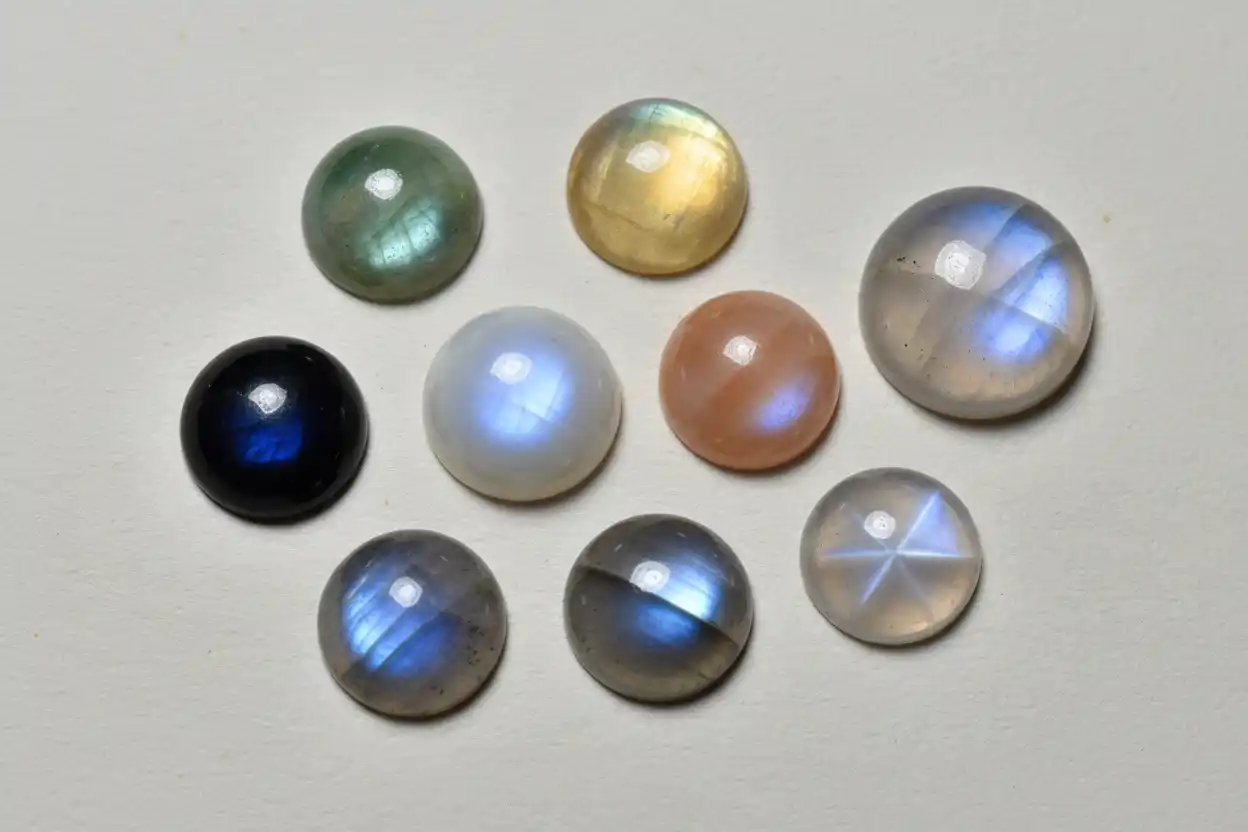
The best material has a colorless or nearly colorless body and a centered blue sheen. When the cabochon moves, the blue glow appears to travel smoothly across the dome.
Less transparent material may show white or silver adularescence. Yellow, cream, peach, and gray body colors also occur.
Orthoclase moonstone has two cleavage directions, so cutters must orient the dome and girdle carefully. A strike along a weak plane can split the stone.
Albite and Peristerite-Type Moonstone
Some adularescent feldspar is richer in albite or closely related plagioclase compositions.
Peristerite is a trade and mineralogical term associated with albite-oligoclase feldspar that shows blue or white iridescence from internal exsolution structures.
The visual effect can resemble classic moonstone, but the feldspar chemistry differs. Retailers seldom distinguish these compositions without laboratory testing.
The nearby plagioclase mineral oligoclase also forms attractive gem material and overlaps with some historic moonstone terminology.
Colorless Blue-Sheen Moonstone
Transparent colorless moonstone with a strong blue sheen is the classic premium type.
Fine stones should show high transparency, minimal yellow or brown tint, a centered blue glow, and useful visibility across a broad range of viewing angles.
A narrow flash visible only when the gem tilts sharply has less value than a broad sheen that moves smoothly across the top.
Large clean stones are rare because feldspar commonly contains fractures, cloudy layers, cleavage features, and inclusions. Blue-sheen material from Sri Lanka has long held a strong reputation, although quality matters more than a country name alone.
White Moonstone
White moonstone ranges from transparent near-colorless gems to milky, translucent, and opaque white material.
Its adularescence may appear blue, silver, white, or cream. A cloudy body can soften the glow, while cleaner material creates stronger contrast.
Commercial white moonstone is widely cut into cabochons, beads, palm stones, and carvings. Bright polish and a centered sheen separate better pieces from chalky or weakly reflective material.
Some white feldspar sold as moonstone shows only a general pearly luster rather than true moving adularescence. Video under a single light source reveals the difference more clearly than a still photograph.
Peach Moonstone
Peach moonstone ranges from pale blush and cream-peach to apricot, salmon, and orange-pink.
Iron-bearing components and fine inclusions contribute to the warm body color. Sheen may be white, silver, cream, or occasionally bluish.
Most commercial peach moonstone is translucent rather than fully transparent. Internal veils, reflective lamellae, and cloudy areas can create an attractive soft glow.
Fine material has even color, a visible moving sheen, and few dark inclusions. The dedicated peach moonstone buying guide retains the detailed transaction intent.
Pink Moonstone
Pink moonstone overlaps with peach material but leans more toward rose, mauve, or pinkish beige.
The market applies the name inconsistently. Some sellers use pink for pale peach feldspar, while others apply it to dyed or coated material.
Natural pink stones usually display soft, nuanced color rather than intense bubblegum saturation. Concentrated color within fractures can indicate dye.
Pink body color does not guarantee strong adularescence. A quality description should state the body tone and sheen separately.
Cream and Yellow Moonstone
Cream moonstone has warm ivory, beige, pale yellow, or buttery body color.
Yellow moonstone ranges from straw and honey to stronger golden tones. Iron-related components and internal scattering can contribute to the appearance.
White, silver, or pale-gold sheen may cross the surface. Strong orange or brown color can reduce the visibility of adularescence if the body becomes too opaque.
Golden trade names should not be confused automatically with sunstone, whose aventurescence usually comes from reflective inclusions rather than moonstone’s billowing layered glow.
Gray Moonstone
Gray moonstone ranges from pale silver and dove gray to smoky charcoal.
Its sheen may be white, silver, blue, or cream. Darker body color creates stronger contrast when the flash appears.
Natural gray material may contain black mineral inclusions, white clouds, or uneven color zones. Fine cabochons position those features so they enhance rather than interrupt the sheen.
Gray moonstone is often more affordable than transparent blue-sheen material but can be equally distinctive in contemporary jewelry.
Black Moonstone
Black moonstone describes dark gray, brown-black, green-black, or nearly black feldspar with silver, peach, cream, or blue sheen.
Some material has a dark translucent base rather than a completely opaque body. Peach or tan streaks may cross the surface.
The term is commercial rather than a narrowly defined mineral species. Dark labradorite and other feldspars can be mislabeled as black moonstone.
Fine pieces show a clear moving flash, attractive body pattern, and few surface-reaching fractures. The dedicated black moonstone buying guide covers authenticity and seller claims.
Green Moonstone
Green moonstone may appear pale mint, gray-green, olive, or yellow-green.
Most material has white or silver sheen rather than a saturated green optical flash. Body color may come from included minerals, trace chemistry, or alteration.
Strongly colored green pieces should be inspected for dye or misidentification. Prehnite, green chalcedony, serpentine, labradorite, and glass can enter the market under moonstone-like labels.
Transparent green adularescent feldspar is uncommon and may attract collector interest when laboratory identification is secure.
Brown and Orange Moonstone
Brown moonstone includes tan, bronze, cinnamon, chocolate, and gray-brown material.
Orange moonstone overlaps with deeper peach and yellow types. Its sheen may be pale cream, silver, or gold.
These colors occur naturally, although dye and coatings can intensify low-grade material. A seller should disclose whether the color is natural, treated, or uncertain.
Patterned brown and orange pieces are often used for beads and larger cabochons because their body color remains attractive even when the sheen moves out of view.
Rainbow Moonstone
Rainbow moonstone is usually transparent to translucent plagioclase labradorite rather than classic orthoclase moonstone.
Its body is commonly colorless, white, or slightly milky. Blue, green, yellow, orange, and rainbow flashes may appear as it turns.
The market retains the moonstone name because the effect resembles adularescence. Mineralogically, however, it belongs within the plagioclase side of the feldspar family.
The dedicated types of labradorite guide explains this relationship. A direct distinction appears in labradorite versus moonstone.
Fine rainbow moonstone combines transparency, vivid blue or multicolored flash, strong coverage, good orientation, and few distracting fractures.
Blue Moonstone Versus Blue-Flash Moonstone
“Blue moonstone” usually means a colorless or pale body with blue adularescence, not a stone whose entire body is blue.
A seller should ideally describe both characteristics: colorless body with blue sheen, gray body with blue sheen, or white body with blue flash.
Uniform blue glass and dyed feldspar can imitate the appearance in photographs. True sheen moves beneath the surface and changes position as the stone rotates.
Cat’s-Eye Moonstone
Cat’s-eye moonstone contains aligned inclusions or structural features that reflect a narrow band of light.
The effect appears best in a high cabochon oriented perpendicular to the inclusions. A sharp eye should move smoothly across the dome under a single point light.
Cat’s-eye material may be white, gray, peach, yellow, greenish, or brown. Some stones display both chatoyancy and broader adularescence.
A broad weak band is less valuable than a centered, distinct eye with attractive body color.
Star Moonstone
Star moonstone displays asterism, usually as a four-rayed star and more rarely with additional rays.
Intersecting inclusion directions reflect light into the star. The effect becomes visible under a concentrated point source rather than diffuse room illumination.
Fine examples have a centered star, straight rays, strong movement, and enough translucency to reveal depth.
Star moonstone is uncommon and should be tested carefully because synthetic star materials, fiber-optic glass, and surface scratches can imitate the phenomenon.
Faceted Moonstone
Moonstone is most often cut as a cabochon because a smooth dome displays adularescence clearly.
Transparent material can also be faceted. Facets add sparkle while an internal blue or rainbow flash moves through the stone.
Successful faceting requires clean rough, proper orientation, and enough thickness to preserve the optical layers. Poor orientation can leave the flash visible only from the side.
Faceted rainbow moonstone has become especially prominent in modern designer jewelry, although cleavage still limits durability.
Moonstone Crystal and Carving Material
Moonstone usually reaches the market as massive feldspar rough rather than complete transparent crystals.
Large translucent blocks can be carved into beads, animals, freeforms, spheres, and decorative objects. Carving grade often contains more cloudiness and fewer centered optical effects than cabochon rough.
Natural cleavage surfaces may show a flash before cutting. However, the best layer can lie below the surface, so lapidaries inspect and grind cautiously.
Formation and Geology
Moonstone forms in igneous environments where feldspar crystallizes and cools slowly enough for internal components to separate.
Pegmatites, granites, syenites, and related rocks can produce moonstone-bearing feldspar. As the crystal cools, sodium-rich and potassium-rich layers develop at microscopic scale.
Light scattering between those layers creates adularescence. The thickness, regularity, and spacing of the layers determine the sheen’s color and strength.
Later deformation, weathering, fractures, and alteration can weaken the material or reduce transparency.
Major Moonstone Localities
Sri Lanka is renowned for transparent classic moonstone with blue sheen. Important material has also come from India, Myanmar, Tanzania, Madagascar, Brazil, the United States, and parts of Europe.
India supplies large quantities of white, peach, gray, black, and rainbow material, often suitable for cabochons and beads.
Madagascar has become prominent for highly transparent rainbow moonstone-type labradorite, including faceted stones and matched layouts.
A country name does not guarantee quality. Origin claims should be based on reliable supply records rather than inferred from body color or flash.
Inclusions and Internal Features
Moonstone commonly contains cleavage feathers, parallel lamellae, stress fractures, mineral crystals, needles, centipede-like inclusions, and cloudy zones.
Some classic moonstones display characteristic stress-related inclusion patterns under magnification. However, no single inclusion establishes origin or rules out treatment.
Internal fractures can brighten the stone temporarily by reflecting light, but surface-reaching fractures also weaken it.
Transparent stones require a stricter clarity assessment than opaque peach or black material. Even so, adularescence usually matters more than complete flawlessness.
How Moonstone Is Identified
Moonstone generally has hardness 6–6.5, two cleavage directions, feldspar refractive indices, moderate birefringence, and a specific gravity lower than many sapphire and spinel imitations.
Plagioclase varieties can show fine parallel twinning lines under magnification. Orthoclase-rich material has different optical behavior.
Adularescence should move within the stone rather than remain as a fixed painted patch. The dedicated real versus fake moonstone guide owns consumer-level identification.
The moonstone versus opal guide explains why opal’s structure, hardness, transparency, and play-of-color differ from feldspar.
Treatments, Synthetics, and Imitations
Most natural moonstone is sold without routine color enhancement.
Dye can alter fractures or porous material. Clear oils and resins may reduce the visibility of surface-reaching cracks, while coatings can add stronger blue or rainbow effects.
Glass is a common imitation. Molded cabochons may contain bubbles, flow lines, foil, uniform glow, or repeated patterns.
Opalite is manufactured glass and should not be represented as natural moonstone. Synthetic spinel, coated quartz, plastic, and assembled stones also imitate the appearance.
The general gemstone treatments guide explains disclosure terminology.
Cutting Behavior
Moonstone must be oriented so the optical layers sit approximately parallel to the cabochon base.
A dome cut at the wrong angle may show its sheen only near the girdle. Grinding too deeply can remove the strongest layer entirely.
High domes concentrate cat’s-eye effects, while lower domes often produce broader moonstone sheen. Transparent faceting rough requires careful planning around cleavage and inclusions.
Sharp corners and thin girdles chip easily. Ovals, rounds, cushions, and soft freeforms generally offer better durability than pointed shapes.
Durability and Jewelry Suitability
Moonstone’s hardness of 6–6.5 gives moderate resistance to scratching. The gemstone hardness chart places it below quartz, topaz, sapphire, moissanite, and diamond.
Cleavage presents the greater risk. The gemstone cleavage guide explains why a hard blow can split a feldspar along a weak structural plane.
Pendants, earrings, necklaces, and brooches are safer than exposed bracelets and rings. A moonstone ring benefits from a bezel, halo, or recessed setting.
Moonstone earrings and moonstone necklaces normally experience fewer impacts. Moonstone bracelets require particular care around desks and hard surfaces.
Moonstone Prices in 2026
Commercial opaque or weak-sheen moonstone commonly costs approximately $2–$10 per carat, with small cabochons and tumbled stones often priced by piece.
Better white, peach, gray, and black cabochons commonly fall near $5–$50 per carat, depending on sheen, pattern, size, and transparency.
Fine transparent blue-sheen classic moonstone may reach approximately $50–$300 per carat. Exceptional large stones with a centered intense blue glow can exceed that range.
Commercial rainbow moonstone commonly ranges around $10–$50 per carat, while highly transparent full-flash material, precision-cut gems, and matched stones may reach $50–$150-plus per carat.
Cat’s-eye and star moonstone vary widely. A sharp optical phenomenon, good body color, large size, and documented natural origin create substantial premiums.
The dedicated moonstone price guide should retain detailed and frequently updated pricing.
Buying Guidance
Evaluate body color and sheen separately.
A fine stone should show attractive color when the flash is absent, then reveal a centered moving glow as it rotates. Request video under one fixed neutral light rather than relying on edited still photographs.
Check how far the stone must tilt before the effect appears. Broad viewing range generally improves both wearability and value.
Inspect cleavage fractures, chips, flat polish, dye concentrations, resin, and dark backing. Ask whether the stone is classic alkali-feldspar moonstone or rainbow labradorite when that distinction matters.
The complete purchase checklist belongs in the moonstone buying guide. Remote-shopping safeguards appear in how to buy gemstones online.
Cleaning and Storage
Clean moonstone briefly with lukewarm water, mild soap, and a very soft brush or cloth.
Avoid steam, sudden temperature changes, abrasive cleaners, and ultrasonic equipment. Vibration may enlarge cleavage fractures or loosen a damaged stone.
The dedicated moonstone jewelry cleaning guide retains the complete care process.
Store each piece in a padded compartment away from quartz, topaz, sapphire, diamond, and harder metal edges.
Spiritual cleansing practices should avoid salt, prolonged soaking, heat, and strong impact. Non-contact approaches are covered in how to cleanse and charge moonstone.
Meaning and Symbolism
Moonstone has long been connected with lunar imagery, changing cycles, intuition, travel, affection, and new beginnings.
Modern spiritual traditions often associate blue-sheen material with calm reflection, peach with warmth, black with personal boundaries, and rainbow moonstone with creativity or openness.
Moonstone is also recognized alongside pearl and alexandrite in the June birthstone guide. Its detailed metaphysical claims belong in the dedicated moonstone healing properties guide.
These meanings reflect history, culture, color symbolism, and personal belief. They are not scientifically demonstrated effects of feldspar layers or adularescence.
Frequently Asked Questions
1. What are the main types of moonstone?
Major practical types include classic orthoclase moonstone, albite-rich material, white, blue-sheen, peach, gray, black, green, yellow, rainbow, cat’s-eye, and star moonstone.
2. Which moonstone type is most valuable?
Transparent colorless classic moonstone with a strong centered blue sheen generally occupies the highest traditional tier. Exceptional cat’s-eye, star, and rainbow material can also be valuable.
3. Is rainbow moonstone a true moonstone?
It is accepted as moonstone in the jewelry trade, but mineralogically it is generally plagioclase labradorite rather than classic orthoclase moonstone.
4. What is the difference between white and rainbow moonstone?
White moonstone may be orthoclase-rich and commonly shows white, silver, or blue adularescence. Rainbow moonstone is usually transparent white labradorite with blue or multicolored flash.
5. Is black moonstone naturally black?
Natural dark gray, brown-black, and green-black feldspar exists. However, the term is commercial, and dark labradorite or treated material may be mislabeled.
6. What causes peach moonstone’s color?
Iron-bearing components and microscopic inclusions commonly contribute to its peach, apricot, and salmon body colors.
7. Can moonstone show a cat’s-eye?
Yes. Aligned inclusions or internal structures can create a moving reflective band when the rough is correctly cut as a cabochon.
8. Does star moonstone exist?
Yes. Rare material can show a four-rayed or occasionally more complex star caused by intersecting inclusion directions.
9. Is moonstone usually treated?
Most material is sold untreated, but dye, oil, resin, coatings, backing, and assembled construction may occur.
10. Why does moonstone sometimes look plain?
Adularescence is directional. The stone may look ordinary when the internal layers are not aligned with the light and viewing angle.
11. Is moonstone suitable for daily-wear rings?
It can be worn in a protective setting, but its cleavage and moderate hardness make it less forgiving than sapphire, spinel, or diamond.
12. How is moonstone different from opal?
Moonstone is crystalline feldspar with adularescence, whereas opal is hydrated amorphous silica and may display play-of-color from a different internal structure.
Moonstone’s varieties are defined by the interaction between feldspar chemistry, microscopic layers, body color, and cutting direction. A transparent Sri Lankan blue-sheen cabochon, opaque peach bead, dark black moonstone, star stone, and rainbow labradorite may share the moonstone market, yet their mineral structure and optical character differ. Related M entries appear in the crystals that start with M directory and the gemstones that start with M guide.