
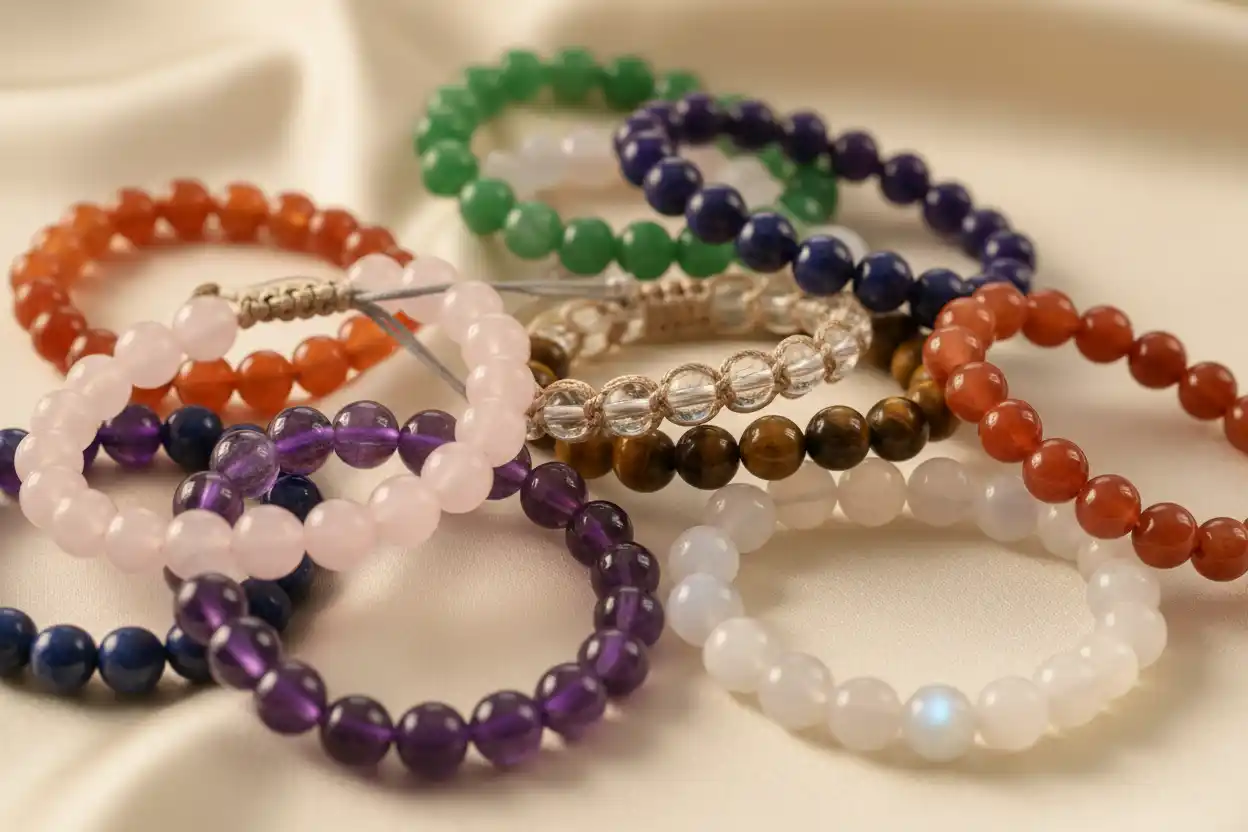
Crystal Bracelets: Meanings, Wrist Guide, Sizing, Safety & Care

Crystal bracelets combine gemstones, minerals, ornamental materials, or manufactured alternatives with elastic, cord, wire, chain, or metal settings. People choose them for color, jewelry style, birthstone traditions, mineral interest, personal symbolism, or simply because a bracelet provides an easy way to wear a favorite stone.
Good crystal bracelets need more than attractive beads. Material identity, hardness, toughness, drill-hole quality, treatments, elastic condition, clasp construction, fit, skin sensitivity, and daily activity all affect how comfortably and safely a bracelet can be worn.
Their symbolic meanings require equally careful treatment. Rose quartz is commonly associated with compassion, tiger’s eye with measured confidence, amethyst with reflection, and jade with continuity and stewardship. These associations can make crystal bracelets meaningful personal reminders, but they do not scientifically transmit healing energy, control another person, guarantee protection, attract money, or determine future events.
At Gems Lore, crystal bracelets are approached as wearable objects where mineral properties, jewelry construction, cultural symbolism, and contemporary spiritual practice can overlap without treating metaphysical interpretations as established physical effects.
Crystal Bracelets at a Glance
| Bracelet type | Main advantage | Main concern |
|---|---|---|
| Elastic bead bracelet | Easy to wear without a clasp | Elastic eventually stretches or breaks |
| Knotted bead bracelet | Reduces bead-to-bead contact | Thread can absorb moisture and stretch |
| Beading-wire bracelet | Strong support for heavier beads | Crimps and wire coating need inspection |
| Tennis bracelet | Refined line of individually set gems | Many settings and links can loosen |
| Chain-and-station bracelet | Adjustable and lightweight | Jump rings and fine links may open |
| Cuff or bangle | Strong visual style | Correct wrist size and setting security |
| Wrap bracelet | Adjustable layered appearance | Cord or leather wears with moisture and friction |
| Charm bracelet | Easy personalization | Hard charms can strike softer gemstones |
| Chip bracelet | Affordable and textural | Sharp edges and weak drill holes |
| Mixed-stone bracelet | Combines several colors or themes | Materials may have incompatible care needs |
The most practical crystal bracelets combine a suitable material with construction that matches how frequently the wearer intends to use the piece.
What Counts as a Crystal Bracelet?
Retail use of the word “crystal” is broad. Crystal bracelets can contain true crystalline minerals such as quartz, tourmaline, garnet, or corundum, but they may also contain rocks, mineraloids, organic gems, glass, resin, reconstructed material, or laboratory-grown gemstones.
The distinction matters because the care requirements are not interchangeable. The difference between these categories is explained in crystals vs gemstones.
An amethyst bead is crystalline quartz. Opal is a mineraloid rather than a conventional crystal. Lapis lazuli is a rock containing several minerals. Jade may be jadeite or nephrite. Glass beads may still be attractive, but they should not be represented as natural quartz or another mineral.
For crystal bracelets, the correct material name is more useful than a vague description such as “natural healing stone.”
Crystal Bracelet Meanings
The meanings attached to crystal bracelets can come from mineral color, historical gemstone traditions, birthstone systems, contemporary crystal practice, chakra symbolism, personal memories, or the reason the bracelet was given.
These meanings are not universal.
A tiger’s eye bracelet may symbolize practical judgment and courage because the stone is traditionally associated with those themes. Rose quartz often represents affection and compassion, while an amethyst bracelet may symbolize reflection, moderation, or deliberate thinking.
The useful part of the symbolism is what the wearer chooses to connect with it.
Someone wearing crystal bracelets for confidence might use the piece as a cue to prepare before an important conversation. A bracelet associated with calm might remind the wearer to pause before responding when emotions are high. A relationship stone can symbolize affection without being expected to create or preserve a relationship.
Crystal bracelets work best symbolically when they point toward behavior rather than promise an outcome.
Crystal Bracelets by Intention
| Symbolic intention | Common stones | Grounded interpretation |
|---|---|---|
| Grounding | Tiger’s eye, smoky quartz, red jasper, black tourmaline | Return attention to immediate facts and practical needs |
| Reflection | Amethyst, howlite, moonstone | Pause before reacting |
| Confidence | Carnelian, tiger’s eye, citrine | Prepare and take a defined action |
| Communication | Lapis lazuli, sodalite, aquamarine | State facts, needs, and boundaries clearly |
| Compassion | Rose quartz, jade, rhodonite | Practice care without losing self-respect |
| Focus | Clear quartz, iolite, sapphire | Define one task and reduce distractions |
| Protection symbolism | Black tourmaline, onyx, obsidian, tiger’s eye | Pair symbolic boundaries with real safety measures |
| Creativity | Carnelian, citrine, labradorite | Start and develop a real project |
| Transition | Moonstone, labradorite, alexandrite | Adapt to change deliberately |
| Prosperity symbolism | Citrine, jade, aventurine, pyrite | Review and manage actual resources |
A bracelet does not become physically stronger or spiritually more effective because more stones are added. A simple piece with one clear personal association is often easier to understand and wear.
Grounding and Protection Bracelets
Dark and earth-toned crystal bracelets often appear in grounding and protection traditions. Tiger’s eye, smoky quartz, red jasper, onyx, hematite-style beads, and black tourmaline are common examples.
The tiger’s eye meaning connects the stone with practical confidence, perspective, and measured courage. A bracelet can therefore serve as a visual reminder to assess a situation before acting.
Protection symbolism needs a clear boundary. Black tourmaline or another dark stone cannot create a scientifically demonstrated shield against accidents, crime, harmful people, illness, or financial loss.
A more useful practice connects crystal bracelets with real protection: checking a lock, documenting an agreement, wearing safety equipment, leaving an unsafe situation, or enforcing a personal boundary.
Crystal Bracelets for Calm and Reflection
Amethyst, howlite, moonstone, and pale-blue stones are frequently chosen for reflective symbolism.
Amethyst has reasonable jewelry durability because it is quartz, while moonstone has cleavage and needs greater protection from repeated impacts. The practical considerations for a moonstone bracelet therefore differ from those for amethyst even if both are sold for similar intentions.
Crystal bracelets can be useful as tactile reminders to slow a reaction. Touching one bead and asking, “What do I actually know?” may create a simple pause before replying to a message or making a decision.
That benefit comes from the learned behavior, not a proven medical effect of the mineral. Crystal bracelets do not treat anxiety disorders, panic attacks, insomnia, trauma, or other health conditions.
Relationship and Friendship Bracelets
Rose quartz, jade, rhodonite, chrysoprase, garnet, and related stones are widely used in relationship-themed crystal bracelets.
A rose quartz bracelet can represent compassion or appreciation. A jade bracelet may carry additional cultural, historical, and family significance depending on the wearer.
Friendship-themed pieces can be especially effective when their meaning refers to something that already exists. The symbolism discussed with crystals for friendship works better when connected with trust, communication, shared experiences, or mutual support rather than promises that a stone will preserve a friendship automatically.
Relationship crystal bracelets cannot create attraction, prove loyalty, guarantee reconciliation, or override consent. Matching bracelets should also never be treated as evidence that someone is required to stay in a relationship or wear a symbol they no longer want.
Birthstone Crystal Bracelets
Birthstone crystal bracelets can use a single month’s gem, several family birthstones, alternating stones for partners, or a combination based primarily on color.
The recognized options in birthstones by month show why some months provide much more choice than others.
A January bracelet may use garnet. February commonly uses amethyst. June may involve pearl, moonstone, or alexandrite, each with very different durability and care. September sapphire generally handles bracelet wear better than softer October opal.
Birthstone identity does not prove natural origin or treatment status. A purple bead can be glass instead of amethyst, and a yellow-orange “citrine” bead may be heat-treated amethyst. That may still be legitimate when correctly disclosed.
Which Hand Should You Wear Crystal Bracelets On?
There is no scientifically established or historically universal rule requiring crystal bracelets to be worn on one particular wrist.
Some contemporary crystal traditions describe the left side as receptive and the right side as expressive or outward-directed. Another version substitutes non-dominant and dominant hands. These systems are symbolic conventions rather than measurable laws of energy flow.
Under a left-receptive interpretation, someone might wear rose quartz on the left as a reminder of self-compassion. Under an outward-action interpretation, tiger’s eye might be worn on the right to symbolize deliberate action.
You do not need to follow either framework.
For everyday wear, comfort is usually the better deciding factor. Crystal bracelets often experience fewer impacts on the non-dominant wrist. A right-handed person who types, writes, uses tools, or operates a mouse may therefore prefer the left wrist. A left-handed wearer may find the reverse more comfortable.
If you wear a watch, consider whether the beads strike the watch case or crystal. Repeated contact can scratch softer stones, damage coatings, or make both pieces uncomfortable.
Switching wrists does not cancel the bracelet’s meaning.
Left Wrist vs Right Wrist
If you enjoy the symbolic left-and-right convention, treat it as a personal ritual rather than a strict rule.
The left wrist is commonly interpreted in modern practices as inward, receptive, or reflective. People may therefore place crystal bracelets associated with compassion, calm, or personal reflection on that side.
The right wrist is often interpreted as outward, expressive, or action-oriented. Stones associated with communication, confidence, or deliberate action may be worn there.
However, these interpretations vary between practitioners and traditions. Gender does not create a universal rule that women must use one wrist and men another, and being left-handed does not make a bracelet ineffective.
Wear crystal bracelets where they remain comfortable and safe.
Can You Wear Crystal Bracelets on Both Wrists?
Yes.
Wearing crystal bracelets on both wrists is primarily a styling and comfort decision. There is no reliable evidence that the stones interfere with one another energetically.
The main concerns are physical. Heavy stacks can restrict movement. Bracelets may repeatedly strike one another, and hard beads or metal components can damage softer materials.
For example, sapphire or quartz beads can abrade fluorite, calcite, pearl, or opal. The practical differences behind combinations are covered in crystals you should not combine.
If both wrists are heavily stacked, also consider typing, exercise, machinery, food preparation, and workplace requirements.
What Does It Mean When a Crystal Bracelet Breaks?
A broken bracelet should first be treated as a jewelry failure, not as a supernatural event.
Crystal bracelets break for ordinary physical reasons. Elastic stretches and degrades. Cord abrades against drill holes. Beading wire can kink. Crimps can loosen. Knots can fail. A brittle bead may fracture after hitting a desk or door frame. Heat, sweat, cosmetics, water, chlorine, repeated stretching, and ordinary wear can accelerate deterioration.
Large and heavy beads place more tension on elastic than small beads. Rough drill holes can act like tiny cutting surfaces against cord. One damaged bead can also create a sharp edge that weakens neighboring material.
When crystal bracelets break, collect the pieces first—especially around children or pets—then inspect the actual failure point.
Crystal Bracelet Breaking Meaning in Spiritual Traditions
Contemporary crystal traditions sometimes interpret a broken bracelet as completion, transition, release, protection, or a sign that an intention has changed.
Those interpretations can be personally meaningful, but a broken strand does not scientifically prove that a stone absorbed negative energy, prevented an accident, completed a spiritual task, or predicted an upcoming event.
If crystal bracelets break during an emotionally important period, it is reasonable to ask whether the event symbolizes something to you. It is not reasonable to treat the break as evidence that you must end a relationship, quit a job, make a financial decision, or fear an unseen threat.
Start with the physical explanation. Symbolism can come afterward.
What to Do When a Crystal Bracelet Breaks
Check whether the break occurred in the elastic, cord, wire, clasp, crimp, bead, or setting.
If the beads are intact, many crystal bracelets can simply be restrung. Replace old elastic rather than tying together two weakened ends. Inspect every drill hole for cracks or sharp edges before reusing the beads.
Discard or set aside fractured beads with sharp surfaces. Obsidian and glass-like materials can create particularly sharp edges when broken.
For an expensive metal-set bracelet, a jeweler should inspect loose links, prongs, hinges, and clasps before the piece is worn again.
There is no requirement to throw away crystal bracelets after they break. Restringing, repairing, repurposing, or retiring the piece are all reasonable choices.
Elastic Crystal Bracelets
Elastic crystal bracelets are popular because they are inexpensive and easy to put on without a clasp.
Their main weakness is repeated stretching.
Instead of pulling one narrow section over the hand, roll the bracelet gradually over the knuckles. This spreads the strain across more of the elastic.
Inspect elastic periodically. Replacement is sensible when it becomes cloudy, frayed, flattened, permanently stretched, or slow to return to its original shape.
Larger beads create greater weight and leverage. A strand of 12 mm stones places considerably more stress on elastic than a lightweight 6 mm bracelet.
A secure knot should be protected where possible rather than sitting exposed to constant friction.
Knotted and Corded Crystal Bracelets
Knotting between beads can reduce direct contact and limit how many beads scatter if a strand breaks.
Silk provides a traditional soft drape but absorbs moisture and gradually stretches. Synthetic cord can provide greater resistance to abrasion, depending on its construction.
Inspect the cord around every drill hole. If individual beads have sharp or poorly finished openings, they can cut even strong material over time.
Large gaps developing between formerly close beads can indicate stretching or wear.
Beading-Wire Crystal Bracelets
Flexible jewelry wire commonly contains fine metal strands inside a protective coating. It can provide more structural support than elastic, particularly for heavy crystal bracelets.
The wire should remain flexible without permanent sharp kinks.
Crimps are critical. A poorly compressed crimp may slip, while a damaged crimp can cut the wire coating. On higher-value pieces, a secure clasp and secondary safety feature can reduce the chance of complete loss.
Tennis, Chain and Metal-Set Bracelets
Tennis-style crystal bracelets contain many individually mounted stones. Their durability depends on every link, hinge, prong, bezel, and clasp rather than one strand of elastic.
The construction deserves routine inspection because one weak setting can release a gemstone.
Spinel bracelets show why a durable gemstone still needs secure articulation and clasps, while zircon bracelets need additional protection because zircon can be brittle despite its attractive brilliance.
Metal-set crystal bracelets are usually better repaired by a jeweler than with home adhesives.
How to Measure Your Wrist
Good fit improves both comfort and durability.
Wrap a flexible measuring tape around the wrist where the bracelet normally sits. If no tape is available, use a nonstretch cord and measure it against a ruler.
For many bead styles, a starting allowance is approximately:
| Desired fit | Typical allowance |
|---|---|
| Close | About 0.5 in / 1.3 cm |
| Comfortable | About 0.75 in / 1.9 cm |
| Loose | About 1 in / 2.5 cm |
These figures are starting points rather than fixed sizing rules. Large beads take up more internal circumference than small beads, so crystal bracelets made from 10–12 mm stones may need additional length.
The finished bracelet should not leave deep marks, cause numbness, restrict circulation, or slide over the hand unexpectedly.
Choosing Bead Size
Bead diameter changes weight, appearance, fit, and durability.
A 4 mm bracelet looks delicate and layers easily. Six-millimeter crystal bracelets remain light and practical. Eight millimeters provides the familiar rounded-bead appearance common in gemstone jewelry. Ten- and 12-millimeter beads become increasingly substantial.
Large beads strike desks and door frames more often. They also require stronger stringing and may feel tight even when the nominal bracelet length seems adequate.
Small beads place less total weight on the strand but require finer drill holes and can be harder to inspect for fractures.
Choose bead size for the wearer rather than assuming larger stones have stronger spiritual properties.
Authenticity and Treatments
Crystal bracelets are particularly vulnerable to misleading material descriptions because small polished beads can hide diagnostic features.
Common issues include dyed howlite sold as turquoise, glass sold as quartz, resin sold as amber, coated beads sold as hematite, reconstructed material sold as natural stone, and treated jade sold without adequate disclosure.
Look at color distribution, transparency, drill holes, surface texture, pattern, weight, and repeated features. Dye often becomes concentrated in fractures or around bead holes. Mold seams, round bubbles, and identical patterns across many beads can suggest glass or resin.
The broader approach in how to identify crystals emphasizes non-destructive observation rather than scratch, flame, or acid tests.
For higher-value crystal bracelets, seller documentation and appropriate gemological testing are more reliable than internet “home tests.”
Natural, Lab-Grown and Imitation Stones
Natural origin should not be confused with material identity.
A laboratory-grown sapphire has essentially the same crystal structure and chemical identity as natural sapphire but a manufactured origin. Glass made to resemble sapphire is an imitation.
Both can appear in crystal bracelets, but they should be described accurately and priced appropriately.
Similarly, treatments such as heating, dyeing, stabilization, impregnation, coating, or fracture filling are not automatically unacceptable. They become a problem when their existence is hidden or when the care requirements are not explained.
Durability Matters More on the Wrist
Bracelets experience far more contact than earrings and often more than necklaces. They hit desks, door frames, bags, watches, countertops, and neighboring jewelry.
The gemstone hardness chart helps compare resistance to scratching, while gemstone toughness vs hardness explains why hardness alone does not predict breakage.
Quartz-family crystal bracelets are generally practical for regular wear. Tiger’s eye also performs well because quartz is the main host material.
Fluorite is much softer and has perfect cleavage. Opal is softer and brittle. Moonstone can chip along cleavage. Turquoise is porous and often treated. Lapis lazuli is a multi-mineral rock and needs gentler care.
Stone choice should match the wearer’s real activities.
Mixing Several Stones in One Bracelet
Mixed crystal bracelets can be visually attractive, but compatibility matters.
A designer should consider hardness, toughness, bead-hole condition, treatments, and cleaning requirements. A bracelet combining quartz with very soft fluorite may show uneven wear because the harder beads repeatedly strike the softer material.
A mixed bracelet containing turquoise or pearl also cannot be cleaned as aggressively as one made entirely from durable quartz.
Symbolically, there is no need to assign ten different intentions to ten stones. A mixed design can simply be chosen for color.
Metal and Skin Sensitivity
Skin reactions attributed to crystal bracelets may come from metal, plating, dye, elastic additives, trapped moisture, or surface residue rather than the gemstone.
Nickel is a common jewelry-allergy concern. Copper and brass may discolor skin without necessarily causing an allergy, while plating can wear through and expose the base alloy.
The material considerations in gemstones and metals for sensitive skin are particularly relevant to clasps, charms, bead caps, chains, and spacer beads.
Remove crystal bracelets if they cause persistent itching, redness, swelling, broken skin, pain, numbness, or other irritation.
“Natural crystal” does not mean hypoallergenic.
Crystal Bracelets for Children
Loose beads create significant safety concerns for babies and young children.
Infants and toddlers should not wear crystal bracelets. A broken elastic strand can release multiple small objects that present choking or ingestion hazards. Bracelets may also catch on furniture, equipment, or clothing.
For older children, the considerations in crystals for children include bead size, secure construction, school rules, sports, metal composition, and whether the child can remove the jewelry independently.
Small magnets deserve special caution. Magnetic bead bracelets that can release powerful magnets are inappropriate for young children because swallowing multiple magnets can cause severe internal injury.
Sleeping in Crystal Bracelets
Removing crystal bracelets before sleep is generally safer.
Beads can press into the wrist, elastic can remain stretched for hours, chains can catch bedding, and damaged strands can release small pieces during the night.
The safety considerations around wearing crystals to sleep apply especially to jewelry because the object remains in direct contact with the body.
If a stone has bedtime symbolism, place it securely on a bedside surface rather than assuming it needs continuous skin contact.
Sports and Exercise
Crystal bracelets are usually better removed before sports, strength training, running with equipment, climbing, swimming, or other vigorous activity.
Impact can chip beads, while bracelets can catch gym equipment or interfere with wrist position. Sweat and repeated flexing also accelerate wear in some cords and elastic.
A symbolic stone used around training does not need to remain on the wrist during activity. The same boundary is useful when considering crystals for athletes: preparation and physical safety should determine performance decisions.
Showering and Swimming
Remove crystal bracelets before showering, bathing, swimming, and entering a hot tub.
Even if the gemstone itself tolerates brief water exposure, the complete bracelet may contain elastic, thread, leather, glue, plated metal, dye, filler, or a second stone that does not.
The material differences discussed in crystals that can and can’t go in water show why “water safe” is not one universal jewelry category.
Chlorinated pool water, saltwater, shampoo, soap, and heat add exposure without providing any benefit to the bracelet.
Cleaning Crystal Bracelets
Clean crystal bracelets according to their least durable component.
A bracelet made entirely from sound quartz beads on suitable construction may tolerate brief cleaning with lukewarm water and mild soap. Turquoise, opal, pearl, pyrite, lapis lazuli, calcite, and several treated materials need more conservative methods.
Routine wiping with a soft cloth prevents much of the buildup that leads to deeper cleaning.
Do not soak elastic, silk, leather, glued components, or material with uncertain treatment. Dry all parts completely before storage.
Physical cleaning should also be separated from the spiritual practice described in how to cleanse crystals. A bracelet does not scientifically accumulate negative energy that must be removed.
Storing Crystal Bracelets
Store bracelets clean, dry, and relaxed rather than stretched around oversized display stands.
Keep harder stones from rubbing repeatedly against softer ones. Separate metal-set pieces from polished bead strands when clasps or prongs can scratch the beads.
Elastic crystal bracelets can lie flat or rest in their natural circular shape. Avoid leaving them under tension.
Valuable bracelets benefit from individual padded compartments or soft pouches. Protect them from prolonged strong sunlight when the stones or dyes may fade.
Buying Crystal Bracelets
A good listing should identify the actual stone, natural or laboratory origin where relevant, known treatments, bead diameter, bracelet circumference, stringing material, metal composition, clasp type, and return policy.
Actual-item photographs become more important when pattern and color vary substantially between stones.
The practical checks in buying gemstones online are useful for evaluating seller identity, disclosure, photographs, documentation, and returns.
Do not pay a premium simply because crystal bracelets are described as “high vibration,” “activated,” “charged,” “money attracting,” or spiritually stronger than an ordinary piece made from the same material.
Construction and accurate disclosure provide more useful evidence of quality.
Crystal Bracelets as Gifts
Bracelets work well as gifts because sizing is often more forgiving than rings, but the recipient still matters.
Check wrist size, preferred bead diameter, metal sensitivity, workplace requirements, and whether the person actually wears bracelets. Matching stones to a birth month, favorite color, friendship, or shared experience can make the piece personal without exaggerated claims.
The broader crystal gifts guidance covers relationship boundaries, gift formats, authenticity, safety, and recipient preference.
If the recipient does not follow crystal spirituality, crystal bracelets can still be appreciated as gemstone jewelry, mineral objects, birthstone pieces, or attractive accessories.
Frequently Asked Questions
What do crystal bracelets mean?
Crystal bracelets can represent birthstone traditions, personal memories, color symbolism, cultural associations, or contemporary spiritual meanings. The interpretation depends on the stone and the wearer.
Which wrist should crystal bracelets be worn on?
There is no required wrist. Some modern practices associate the left side with receiving and the right side with outward expression, but comfort and daily activity provide a more practical basis for choosing.
What does it mean when a crystal bracelet breaks?
The first explanation should be physical wear: degraded elastic, damaged cord, a loose crimp, a fractured bead, or impact. Some spiritual traditions interpret breaking as release, transition, or completion, but there is no evidence that a broken bracelet predicts an event or proves that it absorbed harmful energy.
Should I replace a broken crystal bracelet?
If the beads remain sound, crystal bracelets can often be restrung. Inspect every bead and drill hole first, discard sharp broken pieces, and replace deteriorated elastic or cord rather than reusing it.
Can crystal bracelets be worn on both wrists?
Yes. There is no scientifically established energetic conflict. Check comfort, weight, activity, and whether hard stones or metal components are damaging softer beads.
How many crystal bracelets can I wear at once?
There is no fixed number. Wear only as many as remain comfortable and do not restrict movement or cause damaging contact between different materials.
How tight should crystal bracelets be?
They should remain secure without leaving deep marks, causing numbness, restricting circulation, or sliding over the hand.
What bead size is best?
Six- and 8 mm beads are common for everyday crystal bracelets, while 10–12 mm stones create a heavier statement style. Wrist size, weight, and activity matter more than one universal ideal.
Are elastic crystal bracelets durable?
They can last well with careful wear, but elastic is a consumable component. Replace it when it becomes loose, cloudy, frayed, flattened, or slow to recover after stretching.
Can I sleep in crystal bracelets?
Removing them before sleep is safer because beads can create pressure, elastic can stretch, and a broken strand may scatter small pieces.
Can I shower while wearing crystal bracelets?
Removing them is recommended. Water, soap, heat, and repeated moisture can affect elastic, thread, glue, metal, dyes, treatments, and moisture-sensitive stones.
Can crystal bracelets get wet?
It depends on both the gemstones and the bracelet construction. Some quartz beads tolerate brief water contact, while other stones and stringing materials require much more caution.
Can children wear crystal bracelets?
They are unsuitable for infants and toddlers. Older children may wear well-made pieces when bead size, breakage, metal composition, activities, and supervision have been considered.
How can I tell if crystal bracelets are real?
Check the exact material description, pattern, transparency, drill holes, treatments, weight, construction, seller disclosure, and documentation. Valuable pieces may require professional gemological identification.
Do crystal bracelets have healing powers?
There is no reliable scientific evidence that wearing crystal bracelets treats medical or mental-health conditions. Healing, chakra, protection, and energy associations belong to spiritual and symbolic traditions.
Do crystal bracelets need to touch the skin to work?
There is no scientific evidence of a measurable healing effect that depends on skin contact. For symbolic use, wearing the bracelet comfortably is sufficient.
Can crystal bracelets attract money or love?
No gemstone can guarantee financial gain, romantic attraction, reconciliation, or another person’s feelings. A bracelet can symbolize a value or intention while practical actions determine real-world outcomes.
Should I throw away crystal bracelets when they break?
No. A broken bracelet can be repaired, restrung, repurposed, stored, or discarded depending on the condition of the beads and what the piece means to you.
Choose the Bracelet, Then Wear It Realistically
Crystal bracelets can combine color, geology, craftsmanship, birthstone history, personal memories, and spiritual symbolism in one wearable object. That versatility is what makes them appealing, but it also means there is no single stone, wrist, bead size, or symbolic rule that works for everyone.
Choose crystal bracelets by identifying the material first. Check whether the stone is durable enough for wrist wear, whether treatment has been disclosed, whether the elastic or setting is well made, and whether the fit remains comfortable.
Wear the bracelet on whichever wrist suits your routine. If left-and-right symbolism is personally meaningful, use it as a reflective convention rather than a rule of physics. If crystal bracelets break, inspect the mechanical cause before assigning spiritual significance.
Most importantly, let the symbolism stay proportional to what the object can actually do. Crystal bracelets can mark affection, confidence, reflection, commitment, creativity, or another value. The bracelet can remind you of that value; your decisions, relationships, preparation, boundaries, and actions are what give it practical meaning.